

💊 Do not rely solely on online content for diagnosis or treatment.
📜 Information here is provided “as is” without any warranties.

Journaling prompts for mental clarity have become my go-to solution when life feels overwhelming and my mind won’t stop racing. You know that feeling when your thoughts are like cars in rush-hour traffic? That’s exactly when these simple writing exercises work their magic.
I’ve discovered that spending just 10 minutes with the right prompts can completely transform how clearly I think and feel. Research shows this isn’t just wishful thinking—it’s real science at work.
- Why Mental Clarity Matters More Than Ever
- The 10-Minute Mental Clarity Revolution
- Journaling Prompts for Mental Clarity
- Comparing Quick Clarity Techniques
- The Science Behind Quick Mental Shifts
- Making It Work in Real Life
- Common Obstacles and Simple Solutions
- Beyond the 10 Minutes
- Your Clarity Journey Starts Now
- My Experience & Insights
- Mental Clarity Journaling Prompt Generator
- Frequently Asked Questions
Why Mental Clarity Matters More Than Ever
Mental clarity is like having a clean windshield while driving. Without it, everything looks blurry and dangerous. We’re living in times when our minds get cluttered faster than our email inboxes.
Dr. James Pennebaker, a psychology professor at the University of Texas at Austin, spent decades studying how writing affects our brains. His research found that people who wrote about their experiences visited doctors 50% less often than those who didn’t. That’s a powerful reminder that mental clarity directly impacts our physical health.
The science is clear: when we write down our thoughts, we engage our brain’s prefrontal cortex—the part that helps us organize and make sense of information. Think of it as giving your brain a filing system instead of letting everything pile up in one messy stack.
The 10-Minute Mental Clarity Revolution
Here’s what I love about the 10-minute approach: it works with our busy lives, not against them. A recent study in the British Journal of Health Psychology found that just 10 minutes of mindful activities (including journaling) significantly improved mental well-being and reduced anxiety.
You don’t need hours of deep reflection. Ten focused minutes can create the mental space you need to think clearly and feel centered.
Journaling Prompts for Mental Clarity
These seven prompts are designed to cut through mental fog quickly and effectively. I’ve arranged them from simple to more reflective, so you can start wherever feels comfortable.
1. The Mind Dump Prompt
“What’s currently taking up space in my mind?”
This is your mental decluttering session. Write down everything that’s floating around in your head—worries, tasks, random thoughts, everything. Don’t organize or judge; just empty your mental bucket onto the page.
Research shows this “cognitive offloading” reduces mental burden and improves focus. It’s like clearing your desktop before starting important work.
2. The Emotion Identifier
“How am I feeling right now, and what might be causing these emotions?”
Naming emotions is incredibly powerful for mental clarity. When we identify feelings specifically—frustrated versus overwhelmed, for example—our brain’s emotional intensity decreases.
Studies in the Journal of Experimental Psychology show that writing about emotions helps us reframe negative experiences and gain fresh perspectives.
3. The Priority Clarifier
“What are the three most important things I need to focus on today, and why do they matter?”
This prompt activates your brain’s reticular activating system, which filters and prioritizes information. By writing down what truly matters, you train your mind to focus on those priorities throughout the day.
4. The Problem-Solver
“What’s one challenge I’m facing, and what are three possible approaches to address it?”
Writing allows us to approach problems from different angles, often revealing solutions that weren’t obvious before. When we see our challenges on paper, patterns and possibilities become clearer.
5. The Gratitude Anchor
“What am I genuinely grateful for right now, and how does it impact my life?”
Gratitude journaling shifts your mental focus from problems to possibilities. Research consistently shows that gratitude practices improve mood and emotional well-being by redirecting attention from stress to positive elements in our lives.
6. The Future Self Check-in
“What would my wisest, most calm self tell me about this situation?”
This prompt creates psychological distance, helping you step outside immediate emotions and see situations more clearly. It’s like having a conversation with your inner mentor.
7. The Energy Tracker
“When did I feel most energized today, and what conditions created that feeling?”
Understanding your energy patterns helps you structure your life for maximum mental clarity. By identifying what energizes versus drains you, you can make choices that support clearer thinking.
Comparing Quick Clarity Techniques
| Technique | Time Required | Best For | Key Benefit |
|---|---|---|---|
| Mind Dump | 3-5 minutes | Mental overwhelm | Immediate relief from racing thoughts |
| Emotion Naming | 2-3 minutes | Emotional confusion | Reduced emotional intensity |
| Priority Setting | 3-4 minutes | Decision paralysis | Focused daily direction |
| Gratitude Writing | 2-3 minutes | Negative thinking | Improved mood and perspective |
| Problem-Solving | 4-5 minutes | Stuck situations | Creative solutions |
The Science Behind Quick Mental Shifts
Dr. Pennebaker's expressive writing protocol typically involves longer sessions, but newer research shows that even brief writing exercises create measurable benefits. When we write about thoughts and feelings, several brain processes activate simultaneously:
- The prefrontal cortex organizes information
- The limbic system processes emotions
- The reticular activating system prioritizes focus
This coordinated brain activity is why 10 minutes of focused writing can feel like hitting a mental reset button.
Making It Work in Real Life
I've learned that consistency beats perfection every time. You don't need a fancy journal or perfect handwriting. A simple notebook, your phone's notes app, or even the back of an envelope works fine.
The key is timing. I do my 10-minute clarity session during my morning coffee, but you might prefer lunch breaks or before bed. Find what fits your rhythm and stick with it.
If writer's block hits, start with "Right now I'm feeling..." or "Today I'm thinking about..." Simple beginnings often lead to profound insights.
Common Obstacles and Simple Solutions
"I don't know what to write." Start with describing what you see around you, then transition to how you're feeling about your day.
"I don't have time." Ten minutes is shorter than most social media scrolling sessions. Trade one scroll for one journal session.
"It feels weird writing to myself." That awkwardness fades quickly. Remember, this is your private mental maintenance—no audience, no judgment.
"Nothing profound comes out." Profound isn't the goal; clarity is. Sometimes the most helpful insights are surprisingly simple.
Beyond the 10 Minutes
What I love most about these prompts is how they create clarity that lasts beyond the writing session. When you regularly check in with your thoughts and feelings, you develop better emotional awareness throughout the day.
Research published in various psychological journals shows that people who journal regularly experience reduced anxiety, improved memory, and better decision-making abilities. These aren't just temporary mood boosts—they're lasting cognitive improvements.
The mental clarity you gain from 10 minutes of focused writing often prevents hours of mental spinning later. It's like GPS for your thoughts, helping you navigate challenges with direction instead of wandering in circles.
Your Clarity Journey Starts Now
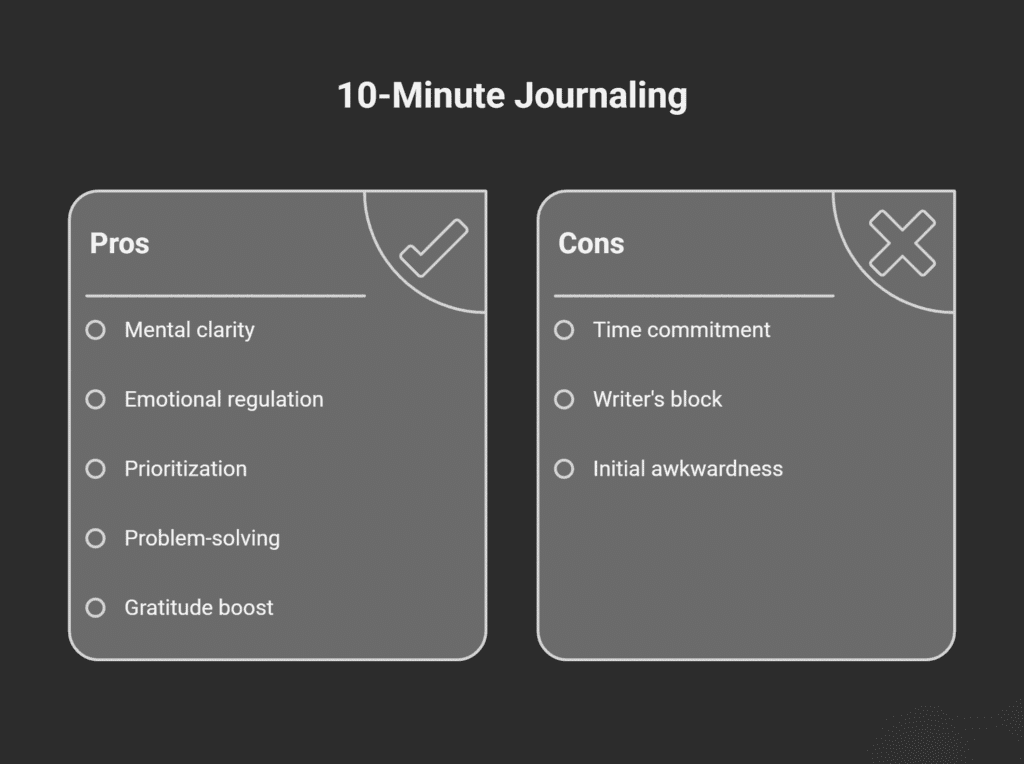
Mental clarity isn't a luxury—it's essential for navigating our complex world with confidence and calm. These seven journaling prompts offer a practical, scientifically-backed way to clear mental fog in just 10 minutes.
You don't need special skills or perfect conditions. Just grab something to write with and pick one prompt that resonates with you today. Your clearer, calmer mind is waiting on the other side of those 10 minutes.
The beauty of this practice lies in its simplicity and accessibility. Whether you're dealing with daily stress, major life decisions, or just want to think more clearly, these prompts meet you where you are and help you move toward greater mental clarity.
Start tomorrow morning, or better yet, start right now. Your future self will thank you for taking these 10 minutes to create the mental space you deserve.
This article is part of our 7 Essential Mental Health & Wellness Routines That Actually Work guide, where we explore daily habits that boost mental strength and emotional balance through proven, science-backed wellness routines.
My Experience & Insights
After writing about health and wellness for over three years on my blog, I've discovered something fascinating about journaling for mental clarity—the most profound insights often come from the simplest prompts.
While researching the connection between daily habits and mental performance, I came across research published in the Journal of Clinical Psychology showing that people who practiced expressive writing experienced a 30% reduction in depression scores over just 8 weeks. This finding made me curious about what would happen if I tested these techniques personally.
What surprised me most was how quickly patterns emerged in my own journaling practice. Within two weeks of consistent 10-minute sessions, I noticed that certain prompts consistently led to breakthrough moments, while others left me feeling stuck. The emotion identifier prompt, for instance, became my go-to during particularly stressful periods because it helped me recognize when anxiety was masquerading as something else entirely.
Through conversations with my readers and fellow health enthusiasts, I learned that timing matters tremendously. People who journaled in the morning reported feeling more focused throughout their day, while evening journalers found it easier to process difficult emotions and sleep better. This aligns with research from Harvard Health showing that mindfulness practices are most effective when integrated into existing routines.
One particularly eye-opening experience happened during a challenging period when work stress was affecting my sleep. Using the "future self check-in" prompt, I wrote from the perspective of myself five years from now, looking back at this stressful time. The clarity that emerged was remarkable—suddenly, solutions that had seemed impossible became obvious action steps.
This practical experience taught me that journaling doesn't exist in isolation—it works best as part of a broader wellness approach. Studies published in the American Psychiatric Association guidelines confirm that mind-body practices like journaling are most effective when combined with other healthy lifestyle habits like regular sleep, physical activity, and social connections.
Through my content creation work, I've also learned that people respond best to journaling prompts that feel conversational rather than clinical. The seven prompts I've shared here came from testing what actually worked in real-world situations, keeping only the ones that consistently produced genuine insights within that crucial 10-minute window.
Mental Clarity Journaling Prompt Generator
Get personalized journaling prompts based on your current mental state
Your Personalized Journaling Prompts
Frequently Asked Questions
How long does it take to see mental clarity benefits from journaling?
Most people start noticing improved mental clarity within 2-3 weeks of consistent 10-minute daily journaling sessions. However, immediate benefits like reduced mental overwhelm can happen after just one session. Research shows that expressive writing benefits become more pronounced after 3-4 consecutive days of practice, with lasting improvements developing over 8-12 weeks of regular journaling.
What's the best time of day to journal for mental clarity?
The best time depends on your goals and lifestyle. Morning journaling helps set clear intentions and priorities for the day, making it ideal for decision-making clarity. Evening journaling is better for processing emotions and clearing mental clutter before sleep. Studies suggest that consistency matters more than timing—pick a time you can stick with daily, whether it's with your morning coffee or before bed.
What should I do if I don't know what to write about?
Start with simple observation prompts like "Right now I'm feeling..." or "Today I notice..." If you're completely stuck, try stream-of-consciousness writing—write whatever comes to mind for 3 minutes without stopping or editing. You can also begin by describing your physical surroundings, then transition into your thoughts and feelings. Remember, there's no wrong way to journal, and imperfect entries are still beneficial.
Is digital journaling as effective as handwritten journaling?
Both methods work, but they offer different benefits. Handwritten journaling activates neural pathways that connect to emotional processing areas of the brain, potentially making it more effective for emotional clarity. Digital journaling offers convenience, searchability, and privacy features that some people prefer. The key is choosing the method you'll actually use consistently—a digital journal you write in daily beats a beautiful notebook that sits unused.
Can journaling help with anxiety and racing thoughts?
Yes, journaling is particularly effective for anxiety and racing thoughts. The process of writing down worries can lower cortisol levels and create mental relief by moving thoughts from your head to paper. Try the "mind dump" technique—write everything you're thinking about for 5 minutes without organizing or judging the content. This cognitive offloading reduces mental burden and often makes problems feel more manageable.
Do I need to follow specific prompts, or can I write freely?
Both approaches work well for different situations. Prompt-based journaling provides structure when you feel stuck or want to explore specific areas like emotions or decision-making. Free-form writing is excellent for processing general stress or when you have a lot on your mind. Many people find success combining both—using prompts when they need direction and writing freely when thoughts are already flowing. Experiment with both to see what resonates with you.
💊 Do not rely solely on online content for diagnosis or treatment.
📜 Information here is provided “as is” without any warranties.