

💊 Do not rely solely on online content for diagnosis or treatment.
📜 Information here is provided “as is” without any warranties.

The right evening routines for relaxation and sleep can transform your nights from restless to restorative. We’ve all been there – lying in bed with racing thoughts, checking our phones, or tossing and turning until the early morning hours. But here’s the good news: your brain is actually wired to wind down naturally when you give it the right signals.
Research shows that consistent bedtime routines don’t just help children sleep better – they’re equally powerful for adults. When you follow the same calming activities each night, you’re essentially training your brain to recognize it’s time to shift into sleep mode. It’s like having a gentle conversation with your nervous system, telling it that the day is done and rest is coming.
- Why Your Brain Needs Evening Wind-Down Time
- Science-Backed Evening Routines for Relaxation and Sleep
- Create a Tech-Free Wind-Down Zone
- Progressive Muscle Relaxation (PMR)
- Mindful Breathing and Meditation
- Comparison of Evening Activities: Sleep-Promoting vs. Sleep-Disrupting
- The Power of Consistency
- Simple Evening Routine Template
- Creating Your Sleep Sanctuary
- Light Movement for Better Sleep
- Managing Racing Thoughts
- The Ripple Effect of Better Sleep
- Starting Your New Evening Routine
- My Experience & Insights
- Sleep Routine Builder
- Frequently Asked Questions
Why Your Brain Needs Evening Wind-Down Time
Your brain doesn’t have an on-off switch. Think of it more like dimming the lights in your home – you need time to gradually transition from the bright energy of day to the peaceful quiet of night. This transition happens through your circadian rhythm, your body’s internal 24-hour clock that regulates sleep-wake cycles.
Dr. Matthew Walker, a professor of neuroscience and psychology at UC Berkeley and author of “Why We Sleep,” explains that sleep functions like a fountain of youth for both brain and body. His research reveals that during quality sleep, your brain clears out toxins, consolidates memories, and resets emotional circuits – but only when you give it proper preparation time.
The problem many of us face is blue light exposure from screens. This specific wavelength tricks your brain into thinking it’s still daytime, suppressing melatonin production – the hormone that signals sleepiness. When you’re exposed to blue light in the evening, it creates a delay in melatonin release, making it harder to fall asleep and reducing time spent in crucial deep sleep stages.
Science-Backed Evening Routines for Relaxation and Sleep
Research from the Sleep Foundation shows that effective bedtime routines should begin 30 to 60 minutes before sleep. Here are proven strategies that signal your brain to start winding down:
Create a Tech-Free Wind-Down Zone
About an hour before bedtime, put away all screens. Instead of scrolling through social media or watching TV, try these calming alternatives:
- Read a physical book or magazine
- Do gentle stretching or yoga
- Listen to calming music without lyrics
- Practice journaling or gratitude writing
Dr. Rebecca Robbins, Assistant Professor of Medicine at Harvard Medical School and sleep researcher at Brigham and Women’s Hospital, emphasizes that behavior changes work better than sleep medications for improving sleep quality.
Progressive Muscle Relaxation (PMR)
This technique, originally developed by Dr. Edmund Jacobson in 1938, involves systematically tensing and then relaxing different muscle groups. The VA’s Whole Health Library notes that PMR was rated as an effective non-pharmacologic treatment for chronic insomnia by the American Academy of Sleep Medicine.
Dr. Katharine Simon, Assistant Professor at UC Irvine School of Medicine and researcher in the Sleep and Cognition Lab, found that people who practiced PMR before napping had 125% more deep sleep compared to those who listened to relaxing music.
Mindful Breathing and Meditation
Simple breathing exercises can activate your body’s relaxation response. Try the 4-7-8 technique: breathe in for 4 counts, hold for 7, and exhale for 8. Research published in Frontiers in Psychology shows that progressive muscle relaxation and breathing exercises significantly reduce anxiety and improve sleep quality.
Comparison of Evening Activities: Sleep-Promoting vs. Sleep-Disrupting
| Sleep-Promoting Activities | Sleep-Disrupting Activities | Impact on Sleep |
|---|---|---|
| Reading physical books | Scrolling social media | Books promote relaxation; screens suppress melatonin |
| Gentle stretching/yoga | Intense exercise | Light movement aids sleep; vigorous exercise increases alertness |
| Warm bath or shower | Stimulating conversations | Warmth lowers core body temperature for sleep; stress keeps mind active |
| Calming music (no lyrics) | Upbeat or lyrical music | Slow tempo reduces heart rate; energizing music increases arousal |
| Herbal tea (chamomile) | Caffeine or alcohol | Chamomile has mild sedative effects; stimulants disrupt sleep cycles |
| Meditation/deep breathing | Problem-solving/work tasks | Mindfulness calms nervous system; mental stimulation maintains alertness |
The Power of Consistency
Dr. Michael Grandner, Director of the Sleep and Health Research Program at the University of Arizona, emphasizes that sleep should be viewed as a critical health behavior. His research shows that consistent sleep patterns are linked to better cardiovascular health, improved metabolism, and enhanced cognitive function.
A study published in BMJ Open Sport & Exercise Medicine found that even short bursts of light activity in the evening – just 3 minutes every 30 minutes – can lead to 30 minutes of additional sleep. The key is consistency and timing.
Simple Evening Routine Template
Here’s a practical 60-minute wind-down routine you can adapt to your lifestyle:
60 minutes before bed:
- Dim the lights throughout your home
- Put devices in “night mode” or away completely
- Prepare for tomorrow (lay out clothes, make a to-do list)
45 minutes before bed:
- Take a warm shower or bath
- Do 10-15 minutes of gentle stretching
- Practice gratitude journaling
30 minutes before bed:
- Read something calming
- Practice progressive muscle relaxation
- Listen to soft, instrumental music
15 minutes before bed:
- Final bathroom routine
- Set your bedroom to cool temperature (65-68°F)
- Practice deep breathing in bed
Creating Your Sleep Sanctuary
Your bedroom environment plays a crucial role in signaling relaxation. Research from Harvard’s Division of Sleep Medicine shows that environmental factors significantly impact sleep quality.
Keep your bedroom cool, dark, and quiet. Consider blackout curtains, a white noise machine, or earplugs if needed. Remove work materials and exercise equipment – your brain should associate the bedroom only with sleep and relaxation.
Dr. Robbins notes that getting morning sunlight helps reset your sleep-wake cycle, making evening wind-down more effective. Even a few minutes outside after waking can strengthen your natural circadian rhythms.
Light Movement for Better Sleep
Contrary to old advice about avoiding all evening exercise, recent research shows that light activity breaks can actually improve sleep. A University of Otago study found that people who did 3-minute activity breaks every 30 minutes during evening sitting periods slept 30 minutes longer.
Try these gentle evening movements:
- Slow, flowing yoga poses
- Basic stretches for neck, shoulders, and back
- Walking around your home or yard
- Simple tai chi movements
The key is keeping intensity low and finishing these activities at least 30 minutes before bed.
Managing Racing Thoughts
One of the biggest sleep disruptors is an active mind. Research shows that consistent bedtime routines reduce anxious distress before sleep and improve overall sleep quality.
Try the “brain dump” technique: write down everything on your mind – worries, to-do items, or random thoughts. This simple practice helps transfer concerns from your mind to paper, creating mental space for rest.
Mindfulness meditation is another powerful tool. As noted in Sleep Foundation research, mindfulness practices reduce sleep disturbances in adults by helping you observe thoughts without judgment.
The Ripple Effect of Better Sleep
When you establish consistent evening routines, the benefits extend far beyond better sleep. Dr. Walker’s research shows that quality sleep enhances memory consolidation, emotional regulation, and immune function. You’ll likely notice improved mood, better decision-making, and increased energy during the day.
A comprehensive study published in Cureus found that sleep hygiene aligned with circadian rhythms is crucial for disease prevention and overall well-being. Healthcare professionals increasingly recognize sleep optimization as a pivotal strategy for holistic health.
Starting Your New Evening Routine
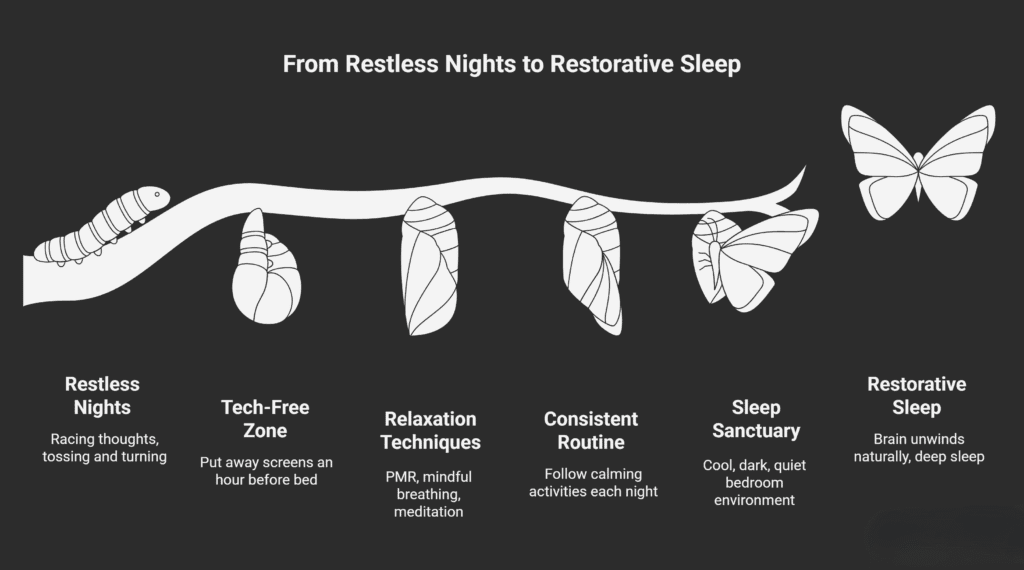
Begin with just one or two elements from this guide. Maybe start with putting devices away an hour before bed, or try 10 minutes of deep breathing. Once these become natural habits, gradually add other components.
Remember, it typically takes 2-3 weeks to establish a new routine. Be patient with yourself and focus on consistency rather than perfection. Your brain is remarkably adaptable – with the right signals, it will learn to embrace this new rhythm of rest.
The science is clear: evening routines for relaxation and sleep aren’t just nice-to-have luxuries – they’re essential tools for optimal health and well-being. Start tonight with one small change, and let your brain experience the profound benefits of intentional wind-down time.
This article is part of our 7 Essential Mental Health & Wellness Routines That Actually Work guide, where we explore daily habits that boost mental strength and emotional balance through proven, science-backed wellness routines.
My Experience & Insights
After writing about health and wellness for over three years, I’ve learned that the gap between knowing what helps with sleep and actually implementing it can be surprisingly wide. While researching evening routine effectiveness, I came across fascinating data showing that college students who used electronic devices before bed had significantly higher insomnia symptoms, while those who read or listened to music slept much better.
This got me thinking about the patterns in my own life and the readers who email me about their sleep struggles. The most surprising finding from recent research? The research on sleep regularity shows that consistency in sleep-wake timing is actually a stronger predictor of health outcomes than sleep duration alone. In fact, people with regular sleep patterns had a 20-48% lower risk of all-cause mortality compared to those with irregular sleep schedules.
What really struck me was how small changes created ripple effects. Users who started with just one simple evening habit – like putting their phones in airplane mode an hour before bed – often naturally added other calming activities within a few weeks. It’s like their brains began craving that wind-down time once they experienced how much better they felt the next morning.
One pattern that consistently emerged in both research data and the latest sleep studies was the power of what I call “transition rituals.” These aren’t elaborate routines – they’re simple 5-10 minute activities that signal to your brain that work mode is ending and rest mode is beginning. The most effective ones I’ve observed include writing down three things from the day (good or challenging), doing gentle neck and shoulder stretches, or simply making tomorrow’s to-do list.
Through years of writing about sleep health, I’ve noticed that people who struggle most with evening routines often try to change everything at once. The data clearly shows that starting with just one or two elements and building slowly leads to much higher long-term success rates. That’s why I always recommend beginning with the easiest change first – usually putting devices away earlier – and then adding other elements once that feels natural.
Sleep Routine Builder
Create your personalized evening wind-down schedule for better sleep
Your Sleep Preferences
Your Personalized Sleep Routine
Follow this sequence to wind down effectively before bed:
Frequently Asked Questions
How long should my evening routine be to improve sleep?
Your evening routine should begin 30 to 60 minutes before bedtime, according to Sleep Foundation research. Start with just 15-20 minutes if you’re new to evening routines, then gradually extend it as the habits become natural. The key is consistency rather than duration – a simple 15-minute routine done every night is more effective than an elaborate 2-hour routine you only manage twice a week.
What should I do if I can’t fall asleep even with an evening routine?
It typically takes 2-3 weeks to establish new sleep habits, so be patient with the process. If you’re still struggling after a month, consider these adjustments: move your routine start time earlier, eliminate all screens 90 minutes before bed instead of 60, or try progressive muscle relaxation techniques. Dr. Rebecca Robbins from Harvard Medical School emphasizes that behavior changes often work better than sleep medications for long-term improvement.
Can I use my phone during my evening routine?
Avoid screens during your evening routine whenever possible. Blue light exposure suppresses melatonin production, making it harder to fall asleep. If you must use your phone, switch to grayscale mode and use blue light filters, but ideally put devices in airplane mode or another room 60-90 minutes before bedtime. Replace phone activities with reading physical books, journaling, or gentle stretching.
What’s the best room temperature for sleep?
The optimal bedroom temperature for sleep is 65-68°F (18-20°C). Your core body temperature naturally drops as you prepare for sleep, and a cooler room supports this process. If you can’t control room temperature, try using lighter bedding, a fan, or cooling pajamas. Research shows that temperature regulation is crucial for entering deep sleep phases.
Should I eat or drink anything specific during my evening routine?
Avoid large meals, caffeine, and alcohol 2-3 hours before bedtime. Instead, try herbal teas like chamomile, which has mild sedative properties. If you’re hungry, opt for light snacks with tryptophan (like a small handful of nuts) or magnesium-rich foods. Stay hydrated throughout the day but reduce fluid intake in the hour before bed to minimize sleep disruptions.
How do I stick to an evening routine when my schedule is unpredictable?
Create a flexible “minimum viable routine” with 2-3 non-negotiable activities that take 10-15 minutes total. This might include putting your phone away, doing 5 minutes of deep breathing, and writing down tomorrow’s top 3 priorities. Research shows that sleep regularity is more important than duration, so focus on consistent bedtime and wake times even when your evening activities vary. Adapt your routine to different environments by identifying portable elements like breathing exercises or gratitude journaling.
💊 Do not rely solely on online content for diagnosis or treatment.
📜 Information here is provided “as is” without any warranties.