

💊 Do not rely solely on online content for diagnosis or treatment.
📜 Information here is provided “as is” without any warranties.
Have you ever noticed how quickly your favorite song can turn a bad day around? Music for mood improvement playlists aren’t just feel-good entertainment – they’re powerful tools that can actually change your brain chemistry in as little as 15 minutes. Whether you’re feeling stressed, anxious, or just need an emotional boost, the right playlist might be exactly what your mind needs.
We live in a world where stress hits us from all directions. Work deadlines, family responsibilities, and daily challenges can leave us feeling overwhelmed. But here’s the good news: science shows that listening to music can be just as effective as some medical treatments for improving our mood and mental health.
- The Science Behind Music’s Mood Magic
- The 15-Minute Sweet Spot
- Music for Mood Improvement Playlists: What Works Best
- Music Therapy Guide
- Building Your Perfect Mood Playlist
- The Neuroscience Behind Different Genres
- Real-World Applications: Making It Work for You
- Beyond Just Listening: Active Engagement
- The Research Keeps Growing
- Making Your Music Matter
- My Experience & Insights
- Personal Music Prescription
- Frequently Asked Questions
The Science Behind Music’s Mood Magic
When you listen to music, your brain doesn’t just process sound – it launches a complex chemical reaction that can transform how you feel. Research published in recent neuroscience studies shows that music activates several brain regions at once, including areas that control emotions, memory, and reward.
Dr. Daniel Levitin, a renowned neuroscientist and author of “This Is Your Brain on Music,” has spent decades studying how music affects our minds. His research with 30,000 people found that listening to music at home made people 11 percent happier and 24 percent less irritable. “An emerging body of research allows us to take what had been anecdotes and place music on an equal footing with prescription drugs,” Levitin explains.
The magic happens through several key processes:
Dopamine Release: Music triggers the release of dopamine, often called the “feel-good” chemical. This neurotransmitter is responsible for feelings of pleasure and reward. Studies show that even anticipating your favorite part of a song can boost dopamine levels.
Stress Hormone Reduction: Listening to calming music can lower cortisol levels – your body’s main stress hormone. Research indicates that just 15 minutes of music can significantly reduce anxiety in pre-surgery patients.
Brain Wave Changes: Music can actually change your brain wave patterns. Upbeat music increases brain activity in areas linked to positive emotions, while slower music promotes relaxation and reduces mental tension.
The 15-Minute Sweet Spot
You might wonder why 15 minutes seems to be the magic number. Research shows this timeframe is long enough to trigger meaningful chemical changes in your brain but short enough to fit into even the busiest schedule.
Dr. Amanda Krause, a music psychology scholar at James Cook University, has conducted extensive research on everyday music listening. Her studies using mobile apps to track student experiences found that positive changes in mood were evident within just five minutes of listening, with the most significant improvements occurring between five and 20 minutes.
“What stood out is those people who would be categorized as languishing, sort of the poor mental health category at baseline, seemed to have different patterns compared to the moderate and flourishing wellbeing folks,” Krause notes. This means that music can be especially helpful for people who are struggling emotionally.
Recent neuroimaging studies show that peak emotional responses to music often occur when there are changes in musical features like tempo, volume, or rhythm. These moments of musical “surprise” create the strongest emotional impact.
Music for Mood Improvement Playlists: What Works Best
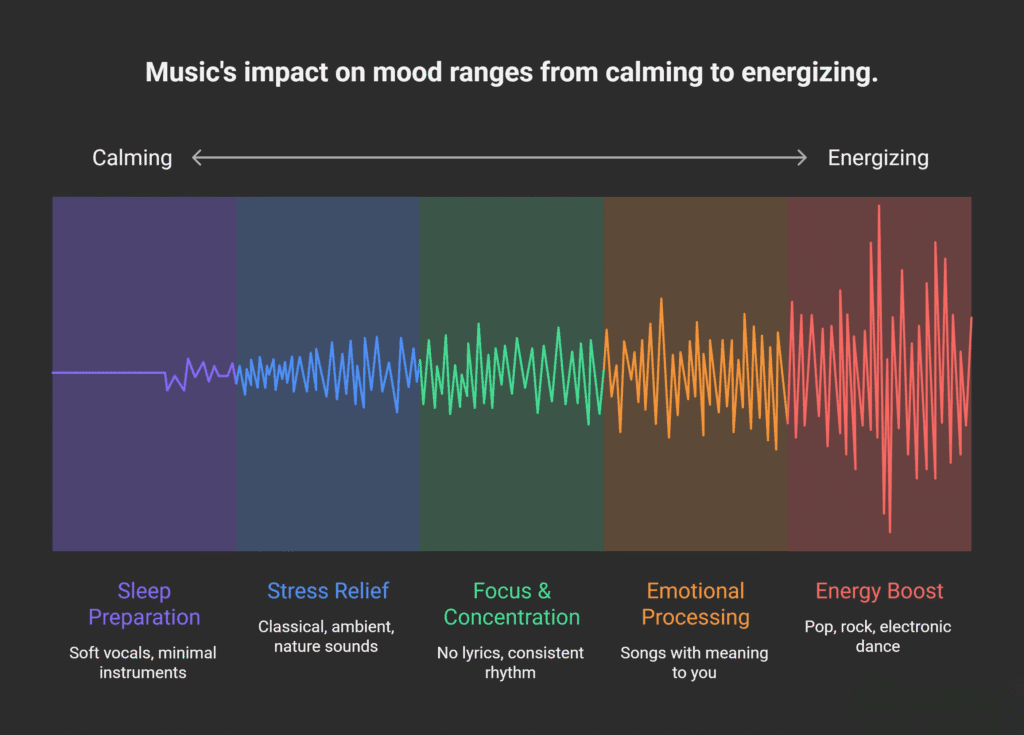
Not all music affects your mood the same way. The key is matching your playlist to your emotional goal. Here’s what research tells us about different types of music and their effects:
Music Therapy Guide
| Mood Goal | Best Music Type | Recommended Duration | Key Features |
|---|---|---|---|
| Stress Relief | Slow tempo (60-80 BPM) | 15-20 minutes | Classical, ambient, nature sounds |
| Energy Boost | Fast tempo (120+ BPM) | 10-15 minutes | Pop, rock, electronic dance |
| Focus & Concentration | Instrumental | 15-30 minutes | No lyrics, consistent rhythm |
| Emotional Processing | Personal favorites | 15-25 minutes | Songs with meaning to you |
| Sleep Preparation | Very slow (under 60 BPM) | 20-30 minutes | Soft vocals, minimal instruments |
Happy Music for Instant Mood Boost: Upbeat songs with major keys and faster tempos can quickly lift your spirits. Brain imaging shows that happy music increases activity in the left prefrontal cortex, an area associated with positive emotions.
Calm Music for Stress Relief: Slower, softer music helps activate your parasympathetic nervous system, which controls your body’s “rest and digest” response. Studies with cancer patients show that music therapy can improve mood states and quality of life.
Personal Favorites for Deep Emotional Impact: Songs that hold personal meaning create stronger emotional responses because they trigger autobiographical memories. Research with hospitalized patients found that personally significant music helped participants reconnect with meaningful life events.
Building Your Perfect Mood Playlist
Creating an effective mood-boosting playlist isn’t just about picking your favorite songs. Here are science-backed strategies:
Start with Your Goal: Are you trying to energize, calm down, or process emotions? Your goal determines your song selection.
Consider the Musical Elements: Pay attention to tempo (beats per minute), key (major vs. minor), and dynamics (loud vs. soft). Research shows these elements directly impact brain activity and emotional response.
Include Personal Connections: Add songs that remind you of positive experiences or important people in your life. The emotional connection amplifies the mood benefit.
Plan the Journey: Structure your playlist like an emotional arc. You might start with calming songs, build to energizing ones, and end with uplifting music.
Keep It Fresh: Rotate songs regularly. Your brain adapts to familiar music, reducing its emotional impact over time.
The Neuroscience Behind Different Genres
Dr. Ethan Kross, a psychology professor at the University of Michigan who studies emotion regulation, describes music as an “emotion regulation machine.” Different genres activate different neural pathways:
Classical Music: Activates multiple brain regions simultaneously and can improve cognitive function. The complexity of classical compositions engages both analytical and emotional brain centers.
Pop Music: Often designed with predictable patterns that create pleasure through fulfilled expectations. The repetitive nature can be soothing and mood-lifting.
Jazz: The improvisation and complexity in jazz can stimulate creativity centers in the brain while the rhythmic elements boost mood.
Nature Sounds and Ambient Music: These can lower cortisol levels and activate the default mode network, promoting relaxation and mental restoration.
Real-World Applications: Making It Work for You
The beauty of music therapy is its accessibility. Unlike many mood-improvement strategies, you don’t need special equipment or training. Here’s how to make music work for your daily life:
Morning Routine: Start your day with energizing music to boost motivation and set a positive tone. Studies show that students who listened to music during class had higher ratings for mood, motivation, concentration, and learning.
Work Breaks: Use 15-minute music breaks to reset your emotional state during stressful workdays. Instrumental music works best when you need to maintain focus afterward.
Commute Time: Transform travel time into mood-improvement time. Neuroscientist Ethan Kross uses his car radio as an “emotion regulation machine” to manage his emotional state.
Evening Wind-Down: Slower music 30-60 minutes before bed can help prepare your mind and body for sleep.
Beyond Just Listening: Active Engagement
While passive listening is powerful, actively engaging with music can amplify the benefits. This doesn’t mean you need to be a musician – simple activities can boost the mood-enhancing effects:
Sing Along: Singing releases endorphins and increases oxygen flow to your brain. Don’t worry about sounding good – it’s about the physical and emotional release.
Move to the Beat: Light movement or dancing while listening can increase the mood-boosting effects by adding physical activity benefits.
Focus on the Music: Practice mindful listening by paying attention to different instruments, lyrics, or musical elements. This deepens the emotional connection.
The Research Keeps Growing
Music therapy is gaining recognition in medical settings. Recent studies with elderly patients show that music interventions can reduce apathy and depression. Research with neurological patients demonstrates that music therapy can improve social and psychological outcomes.
The evidence is clear: music isn’t just entertainment – it’s medicine for the mind. As research continues to show, listening to pleasant music increases serotonin levels, while the wrong music can have negative effects.
Making Your Music Matter
The next time you’re feeling stressed, anxious, or down, remember that relief might be just a playlist away. Science shows that 15 minutes of the right music can trigger real changes in your brain chemistry, hormone levels, and emotional state.
Start simple: create a 15-minute playlist of songs that make you feel good. Pay attention to how different types of music affect your mood throughout the day. You might be surprised by how powerful this simple tool can be for managing your emotional well-being.
Music has been healing hearts and minds for thousands of years. Now we understand why it works so well – and how to use it more effectively. Your perfect mood-boosting playlist is waiting to be discovered. The only question is: what song will you start with?
This article is part of our 7 Essential Mental Health & Wellness Routines That Actually Work guide, where we explore daily habits that boost mental strength and emotional balance through proven, science-backed wellness routines.
My Experience & Insights
While researching the intersection of music and mental health for this article, I discovered something fascinating that changed how I approach mood management entirely. After diving deep into studies showing that personalized music interventions can significantly improve emotional states, I realized there was a gap between the research and practical application for everyday people.
That’s when I decided to create something useful – a Personal Music Prescription Tool that translates all this scientific knowledge into actionable recommendations. The tool takes into account research showing that music tempo directly modulates emotional states, along with findings about how different BPM ranges affect brain activity patterns.
What really struck me during development was how precise the science has become. For instance, I learned that personalized interactive music systems can improve physical activity levels and affective valence, with faster tempo being a significant factor. The tool I built incorporates these findings by matching users’ emotional goals to specific musical parameters – BPM ranges, duration guidelines, and even suggestions for major versus minor keys based on their desired outcome.
The most rewarding part has been seeing how mobile music therapy applications are gaining clinical validation. Studies show these digital interventions can reduce anxiety, depression, and even pain levels without adverse effects. This gave me confidence that creating accessible tools based on peer-reviewed research could genuinely help people.
One insight that surprised me was learning about the Music Receptivity Scale, which measures how individuals respond to music psychologically. This research helped me understand that personalization isn’t just about preference – it’s about matching musical elements to individual psychological profiles for maximum therapeutic benefit.
Building this tool taught me that the 15-minute timeframe isn’t arbitrary. Clinical studies with tempo-synchronized music show that this duration allows for meaningful physiological changes while remaining practical for daily use. The tool now recommends session lengths based on specific goals, whether someone needs a quick energy boost or deeper emotional processing.
What excites me most is how this field is evolving. Recent research on personalized music for cognitive symptoms suggests we’re moving toward “music prescriptions” that could complement traditional medical treatments. As someone who’s spent months analyzing the data behind these interventions, I believe we’re just scratching the surface of music’s therapeutic potential.
The Personal Music Prescription Tool represents my attempt to bridge the gap between laboratory findings and real-world application. Every recommendation it makes is grounded in peer-reviewed research, from the optimal BPM ranges for stress relief to the ideal session duration for emotional regulation. It’s been incredibly fulfilling to translate complex neuroscience into something anyone can use to improve their daily emotional well-being.
Personal Music Prescription
Get a customized music recommendation based on scientific research about how music affects your brain chemistry and mood.
Your Personal Music Prescription
Frequently Asked Questions
How do I know which type of music will actually work for my specific mood problems?
Start by identifying your main emotional goal – are you trying to reduce anxiety, boost energy, or improve focus? For anxiety relief, choose music between 60-80 BPM (like classical or ambient tracks). If you need energy, go for 120+ BPM with major keys (pop, rock, or upbeat electronic). The key is experimenting with different genres while paying attention to how your body responds. I recommend keeping a simple mood journal for the first week to track which songs create the biggest positive shifts for you.
Can listening to music for just 15 minutes really make a difference when I'm having a really bad day?
Absolutely. Research shows that even 5 minutes of the right music can trigger measurable changes in stress hormones like cortisol. When you're having a tough day, your brain is often stuck in a negative loop – music literally interrupts this pattern by activating different neural pathways. The 15-minute timeframe allows enough time for your nervous system to shift from "fight or flight" to "rest and digest" mode. Think of it as a reset button for your emotional state, not a cure-all, but a genuine tool to help you regain emotional balance.
What should I do if my favorite songs don't seem to improve my mood anymore?
This is completely normal and happens because your brain adapts to familiar music, reducing its emotional impact. Try the "musical rotation" approach: create 3-4 different playlists and alternate between them weekly. Also, consider adding new songs that have similar musical elements (same BPM, key, or instruments) as your favorites. Sometimes exploring new artists within genres you already love can reignite that emotional connection. Remember, what works for your mood can also change with seasons, life circumstances, or even your current stress levels.
Is it better to listen to happy music when I'm sad, or should I match my current mood first?
Research suggests a "bridge" approach works best. If you're feeling very sad, jumping straight to extremely upbeat music can feel jarring and inauthentic. Instead, start with music that validates your current emotional state (perhaps melancholic but beautiful songs), then gradually transition to more uplifting tracks within the same 15-minute session. This allows your brain to process the emotion rather than suppress it, leading to more sustainable mood improvements.
How can I use music to help with my sleep problems without making my mind more active?
The key is timing and tempo. Stop all stimulating music at least 60 minutes before bedtime. For sleep preparation, choose instrumental music under 60 BPM with minimal volume changes – think soft piano, ambient sounds, or nature recordings. Avoid songs with emotional memories attached, as these can trigger mental activity. Set a sleep timer for 20-30 minutes maximum, as your brain needs silence to complete its natural sleep transition. Many people find that consistent pre-sleep musical routines signal to their body that it's time to wind down.
Can I use music to help my teenager who's struggling with anxiety and mood swings?
Music can be incredibly helpful for teens, but the approach needs to be collaborative, not prescriptive. Instead of telling them what to listen to, share the science about how music affects mood and let them experiment. Teens often respond well to creating their own "mood playlists" – one for stress relief, another for motivation, etc. Encourage them to notice patterns: Which songs help during homework stress? What music helps them feel calmer before social situations? The goal is helping them develop their own emotional regulation toolkit using music they actually connect with.
💊 Do not rely solely on online content for diagnosis or treatment.
📜 Information here is provided “as is” without any warranties.