
💊 Do not rely solely on online content for diagnosis or treatment.
📜 Information here is provided “as is” without any warranties.
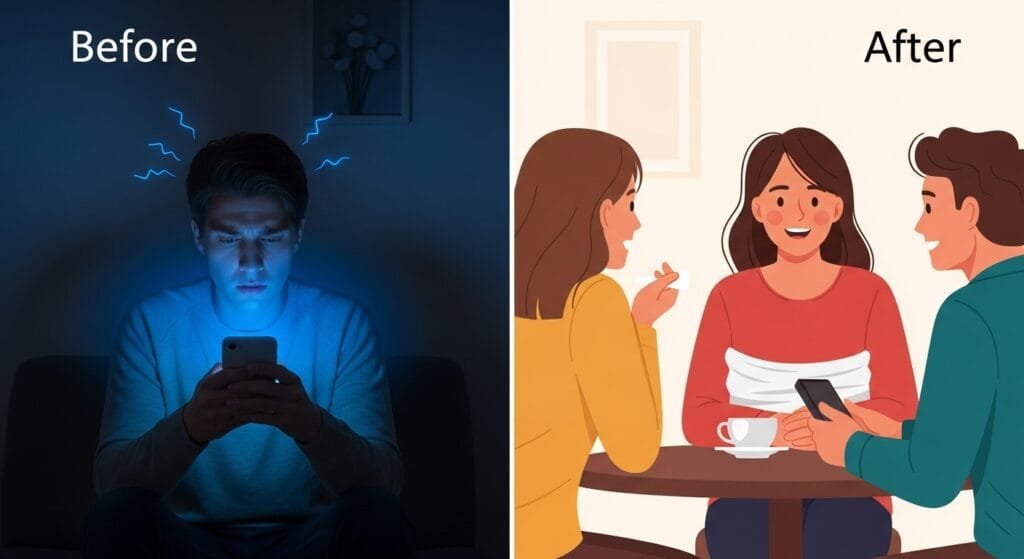
When it comes to social media use mental health balance tips, I’ve learned the hard way that scrolling without limits can mess with your head. You’re not alone if you’ve ever felt worse after checking your feeds or wondered why everyone else seems to have it all figured out. The good news? Research shows we can enjoy social media’s benefits while protecting our mental health.
Social media isn’t going anywhere, and honestly, it doesn’t have to. The key is using these platforms in ways that lift you up instead of bringing you down. Let’s explore science-backed strategies that help you stay connected without sacrificing your peace of mind.
- The Real Impact of Social Media on Mental Health
- Social Media Use Mental Health Balance Tips
- Set Clear Time Limits
- Curate Your Digital Environment
- Practice Mindful Scrolling
- Turn Off Notifications
- Healthy vs. Unhealthy Social Media Habits
- Healthy vs Unhealthy Social Media Use
- The Science Behind Social Media Breaks
- Signs You Might Need a Break
- How to Take Effective Breaks
- Building Better Digital Boundaries
- Creating Your Personal Social Media Wellness Plan
- The Bottom Line
- My Experience & Insights
- Social Media Health Score Quiz
- Your Social Media Health Score
- Frequently Asked Questions
The Real Impact of Social Media on Mental Health
We need to talk about what’s actually happening when we spend too much time on social platforms. Recent research from UT Southwestern Medical Center found that 40% of young people with depression reported problematic social media use. That’s a big number, and it shows how real this issue has become.
Dr. Betsy Kennard, a Distinguished Teaching Professor of Psychiatry at UT Southwestern, explains that people who feel upset when they can’t use social media also report higher levels of depression, anxiety, and suicidal thoughts. Her research with over 5,000 Texas youth shows that heavy social media use often makes existing mental health problems worse.
But here’s what’s interesting: it’s not just about the time we spend online. Studies show that using multiple social media platforms increases our risk for depression and anxiety. People who use 7-11 different platforms have three times higher odds of experiencing severe depressive symptoms compared to those using just two or fewer platforms.
The problem often comes down to social comparison. When we constantly see other people’s highlight reels, our brains start making unfair comparisons. Research published in Frontiers in Psychology shows that upward social comparisons (thinking others have it better) directly impact our self-esteem and can lead to depression symptoms.
Social Media Use Mental Health Balance Tips
The secret to healthy social media use isn’t going cold turkey. Instead, it’s about creating smart boundaries that work with your lifestyle. Here are the strategies that research shows actually make a difference.
Set Clear Time Limits
The 30-minute rule has solid science behind it. Iowa State University researchers found that college students who limited their social media to 30 minutes per day scored significantly lower for anxiety, depression, and loneliness after just two weeks.
What’s cool about this study is that even people who sometimes went over the limit still saw improvements. As lead researcher Ella Faulhaber explains, “it’s not about being perfect but putting in effort, which makes a difference.” The key ingredients are self-limiting and paying attention to your usage.
Here’s how to make time limits work:
- Use your phone’s built-in screen time controls
- Set app timers for each social platform
- Try the “one-check rule” – check each app once per day
- Put your phone in another room during meals and before bed
Curate Your Digital Environment
Your social media feeds don’t have to be a source of stress. Dr. Larry Rosen, an international expert in the Psychology of Technology, has spent over 30 years studying how technology affects our mental health. His research with more than 70,000 people across 22 countries shows that what we see online matters just as much as how much time we spend there.
Smart curation means:
- Unfollowing accounts that make you feel bad about yourself
- Following accounts that inspire or educate you
- Using keywords and hashtag filters to block triggering content
- Choosing quality over quantity in your social connections
Practice Mindful Scrolling
Mindful social media use involves being intentional about why and how you use these platforms. Instead of mindless scrolling, try these approaches:
Before opening an app, ask yourself:
- What am I hoping to find right now?
- Am I trying to avoid or escape something?
- How do I want to feel after this session?
While scrolling, notice:
- Physical sensations in your body
- Emotional reactions to different posts
- When you start feeling drained or anxious
After closing the app, reflect:
- Did I get what I was looking for?
- How do I feel compared to when I started?
- Was this time well spent?
This kind of awareness helps break the automatic habit of reaching for your phone whenever you feel bored or uncomfortable.
Turn Off Notifications
One of the simplest changes you can make is turning off social media notifications. Research shows that constant notifications create a cycle of distraction that affects our ability to focus and increases stress levels.
Most people check their phones every 12 minutes, often because of notifications. By turning these off, you take back control over when you engage with social media instead of letting it interrupt your day.
Healthy vs. Unhealthy Social Media Habits
Understanding the difference between helpful and harmful social media use can guide your daily choices. Here’s a clear comparison:
The Science Behind Social Media Breaks
Taking breaks from social media isn’t just trendy advice – it’s backed by solid research. A randomized controlled trial found that people who took a four-week break from social media improved their subjective well-being by 25-40% – that’s about the same effect you’d get from therapy or self-help programs.
Even shorter breaks make a difference. Studies show that limiting social media to 30 minutes daily for three weeks led to significant improvements in depression, especially for people who were already struggling with mental health issues.
Signs You Might Need a Break
Sometimes our relationship with social media gets out of balance, and that’s okay. Here are signs it might be time for a reset:
- Feeling anxious or upset when you can’t check your feeds
- Comparing yourself to others more often
- Losing sleep because you’re scrolling late at night
- Feeling worse about yourself after using social media
- Neglecting real-world relationships and activities
How to Take Effective Breaks
Start small: Try a “digital sunset” – no social media after 8 PM for one week.
Try a weekend detox: Log out of all social apps Friday evening and don’t log back in until Monday morning.
Use the substitution method: When you feel the urge to scroll, do something else instead – call a friend, take a walk, or read a book.
Create phone-free zones: Designate certain areas of your home (like the bedroom or dining room) as social media-free spaces.
Building Better Digital Boundaries
Strong boundaries protect your mental health without isolating you from the benefits of social connection. Mental Health America recommends being intentional about your social media use. This means deciding your purpose before logging on and signing off when you’ve accomplished that goal.
Effective boundaries include:
Time boundaries: Specific hours when you will and won’t use social media
Content boundaries: What types of posts and accounts you’ll engage with
Emotional boundaries: Recognizing when social media affects your mood negatively
Physical boundaries: Keeping phones out of bedrooms and away from meals
Social boundaries: Not letting online interactions replace face-to-face relationships
Research from multiple studies shows that quantity matters – both the total time spent and the number of platforms used affect mental health outcomes. People who use fewer platforms and spend less total time online report better mental health and life satisfaction.
Creating Your Personal Social Media Wellness Plan
Every person’s relationship with social media is different, so your approach should fit your specific needs and goals. Here’s how to create a plan that works for you:
Step 1: Assess your current use
- Track your daily social media time for one week
- Notice which apps you use most and when
- Pay attention to how different platforms make you feel
Step 2: Set realistic goals
- Choose one or two changes to start with
- Make your goals specific and measurable
- Focus on progress, not perfection
Step 3: Choose your strategies
- Pick 2-3 techniques from this article that appeal to you
- Start with the easiest changes first
- Build new habits gradually
Step 4: Monitor and adjust
- Check in with yourself weekly
- Notice improvements in your mood and stress levels
- Adjust your approach based on what’s working
Remember, the goal isn’t to eliminate social media entirely – it’s to use it in ways that support your mental health rather than undermining it. As Dr. Rosen’s research shows, our relationship with technology matters more than the technology itself.
The Bottom Line
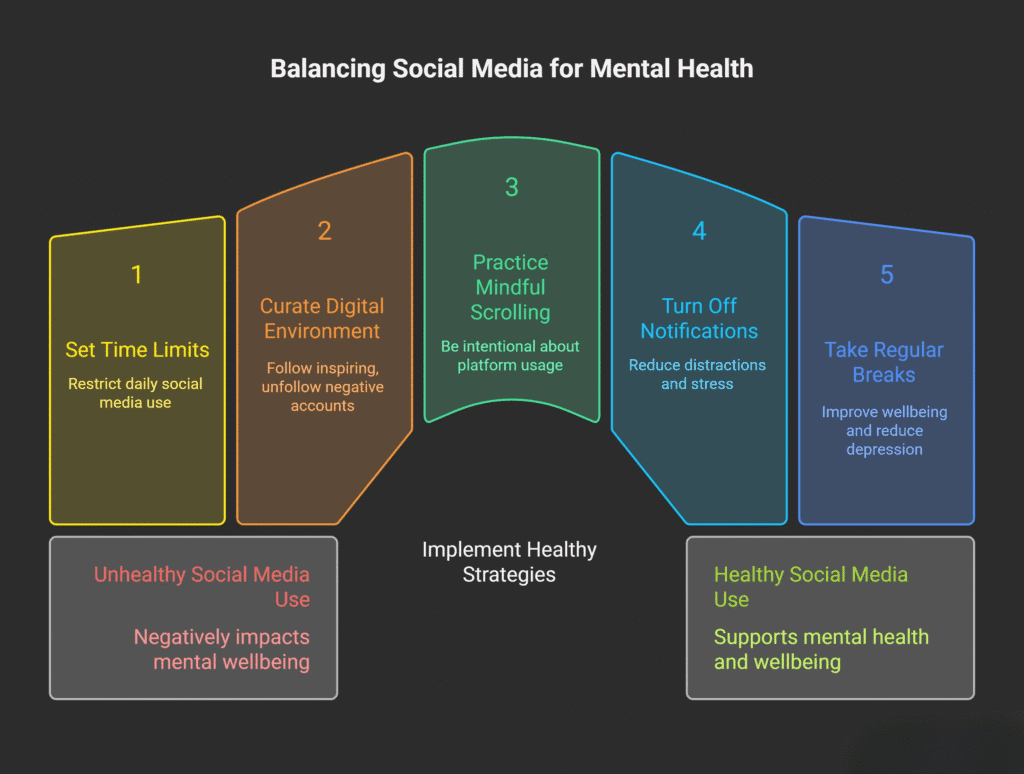
Social media doesn’t have to harm your mental health. With the right strategies – time limits, mindful usage, good boundaries, and regular breaks – you can enjoy staying connected while protecting your wellbeing. The research is clear: small, intentional changes in how we use these platforms can lead to significant improvements in anxiety, depression, and overall life satisfaction.
Start with one strategy that feels manageable, and remember that progress isn’t about perfection. Even small steps toward more mindful social media use can make a big difference in how you feel day to day. Your mental health is worth the effort, and you have more control over your social media experience than you might think.
This article is part of our 7 Essential Mental Health & Wellness Routines That Actually Work guide, where we explore daily habits that boost mental strength and emotional balance through proven, science-backed wellness routines.
My Experience & Insights
After spending three years writing about health and wellness topics, I’ve noticed that social media’s impact on mental health is one of the most requested subjects from my readers. What started as casual research turned into a deep dive that completely changed how I use these platforms myself.
While investigating the latest studies on digital wellness, I discovered something surprising: most people have no idea how their social media habits actually affect their daily mood and energy levels. The research was clear, but translating those findings into practical self-awareness seemed like a missing piece.
That’s when I decided to create something useful for my readers. I developed the Social Media Health Score Quiz – an interactive tool that helps people assess their current social media habits and get a personalized wellness score with actionable recommendations. What I learned while building this quiz opened my eyes to patterns I hadn’t recognized in my own behavior.
For instance, I used to check Instagram first thing every morning, thinking it was harmless. But after tracking my responses and comparing them with Dr. Larry Rosen’s research on morning technology use, I realized this habit was setting a comparison-focused tone for my entire day. The quiz helped me identify that my “mindless morning scroll” was actually a red flag behavior that contributed to afternoon energy crashes.
The most eye-opening feedback came from users who discovered they were using social media as an emotional coping mechanism without realizing it. One reader shared that the quiz results showed her checking Facebook whenever she felt stressed at work – something she’d never consciously connected before. This aligns perfectly with what Mental Health America describes as problematic usage patterns.
What surprised me most during this research was learning about the 30-minute rule from Iowa State University. I had been spending nearly two hours daily across different platforms without realizing it. When I tested this limit myself for two weeks, the difference in my focus and sleep quality was remarkable – exactly what Ella Faulhaber’s research predicted.
The quiz also revealed something interesting about platform-switching behavior. Many users, including myself, weren’t aware they were checking multiple apps in rapid succession – what I call “app hopping.” This behavior, which research shows significantly increases anxiety risk, was happening automatically during my work breaks.
Building this assessment tool taught me that awareness really is the first step toward healthier digital habits. Most people aren’t intentionally overusing social media – they’re just not conscious of their patterns. The quiz helps bridge that gap between research findings and personal insight, giving people a starting point for the strategies outlined in this article.
If you’re curious about your own social media wellness score, the quiz takes about five minutes and provides personalized recommendations based on your responses. It’s designed around the same principles that helped me transition from mindless scrolling to intentional engagement – and the difference has been genuinely life-changing.
Frequently Asked Questions
How much social media use is considered "too much" for mental health?
Research from Iowa State University shows that limiting social media to 30 minutes per day significantly reduces anxiety, depression, and loneliness. The Mayo Clinic reports that using social media more than three times daily predicts poor mental health outcomes in teens. However, it's not just about time - Harvard research indicates that emotional connection (like checking apps obsessively or feeling disconnected when offline) matters more than routine usage. A good rule of thumb: if social media use interferes with sleep, work, or face-to-face relationships, it's likely too much.
Why do I feel worse about myself after scrolling through social media?
This happens because of upward social comparison - your brain automatically compares your real life to others' curated highlights. UC Davis Health explains that social media triggers your brain's reward center with dopamine when you get likes or positive feedback, but when that doesn't happen, it impacts your sense of self-worth. The constant exposure to filtered images and "highlight reels" creates false standards that make your everyday life seem inadequate by comparison. Research published in multiple studies confirms that even when you feel you're "winning" the comparison, the act of comparing yourself to others still negatively affects mental health.
Can social media actually be good for mental health?
Yes, when used mindfully. Harvard's School of Public Health research found that routine social media use - like staying connected with friends and responding to content - is actually associated with better social well-being, positive mental health, and self-rated health. Social media can provide valuable support for people with mental health conditions, offering anonymity, peer connection, and access to mental health resources. The key is using it as a tool for genuine connection rather than passive consumption or seeking validation. Benefits include staying connected with distant friends, finding support communities, accessing mental health resources, and discovering helpful information.
What are the warning signs of problematic social media use?
Key warning signs include feeling anxious when you can't check your phone, losing sleep because you're scrolling late at night, and feeling worse about yourself after using social media. Dr. Betsy Kennard's research at UT Southwestern identifies "feeling upset when unable to use social media" as a major red flag linked to higher depression and anxiety. Other signs include: constantly comparing yourself to others, neglecting real-world activities and relationships, using social media to escape negative emotions, feeling FOMO (fear of missing out), checking apps compulsively throughout the day, and experiencing physical symptoms like eye strain or headaches from excessive screen time.
How can I break the habit of mindless scrolling?
Start by turning off all non-essential notifications and removing social media apps from your home screen. Digital wellness experts recommend the "pause and purpose" technique: before opening any app, ask yourself what you're hoping to accomplish. Set specific times for checking social media rather than constantly throughout the day. Use your phone's built-in screen time controls to set daily limits. Replace the scrolling habit with healthier alternatives - when you feel the urge to scroll, try taking three deep breaths, going for a walk, or calling a friend instead. Create phone-free zones in your bedroom and during meals to break the automatic reaching behavior.
Should I take a complete break from social media if it's affecting my mental health?
A complete break can be beneficial, especially if you're experiencing significant mental health impacts. Research shows that people who took a four-week break from social media improved their well-being by 25-40%. However, you don't need to go cold turkey immediately. Start with a "digital sunset" - no social media after 8 PM for one week. Try weekend detoxes where you log out Friday evening and don't return until Monday. If you decide on a longer break, inform close friends and family of alternative ways to reach you. The goal isn't permanent elimination but developing a healthier relationship with these platforms. Many people find that even short breaks help them return with better boundaries and more intentional usage patterns.
💊 Do not rely solely on online content for diagnosis or treatment.
📜 Information here is provided “as is” without any warranties.