
💊 Do not rely solely on online content for diagnosis or treatment.
📜 Information here is provided “as is” without any warranties.
If you’re like most families, eating healthy on a budget in today’s U.S. economy feels like trying to solve a puzzle with missing pieces. With grocery prices climbing and schedules getting busier, putting nutritious meals on the table without overspending can feel impossible. But here’s the good news: it doesn’t have to be.
The average American household now spends over $900 per month on groceries, and for a family of four, that number can climb to $1,389 or higher depending on where you live. That’s a huge chunk of change! But with the right meal habits, you can feed your family well and keep more money in your pocket.
- Why Budget-Friendly Eating Matters Now More Than Ever
- The Real Cost of Eating Well
- State Grocery Cost Comparison
- Seven Affordable Meal Habits for US Families
- Plan Before You Shop
- Buy in Bulk and Freeze Smart
- Embrace Plant-Based Proteins
- Batch Cook and Prep Ahead
- Shop the Sales and Go Generic
- Minimize Food Waste
- Keep It Simple and Flexible
- Healthy Eating on a Budget US Families Can Sustain
- My Experience & Insights
- Grocery Budget Optimizer
- Frequently Asked Questions
Why Budget-Friendly Eating Matters Now More Than Ever
Food prices have jumped 2.3% year-over-year as of mid-2025, with some items like eggs skyrocketing by 27% and beef climbing 10.6%. These aren’t just numbers on a page—they’re real dollars coming out of your family’s budget.
The USDA’s Thrifty Food Plan (their most affordable nutrition guide) estimates a family of four needs about $835 to $1,054 monthly for groceries. That’s the baseline for nutritionally adequate meals. But what if you’re already stretching every dollar? What if you’re spending more and getting less?
The truth is, you don’t need expensive superfoods or fancy ingredients to nourish your family. Carrie Lupoli, a certified nutritionist and founder of Disruptive Nutrition, puts it simply: “You don’t need expensive superfoods or an extensive shopping every week. I teach the PFC method: a blend of protein, fat, and carbohydrates every three to four hours to maintain steady blood sugar and manage cravings.” With just a handful of basic ingredients, you can create satisfying meals that work for your body and your budget.
The Real Cost of Eating Well
Before we dive into the seven habits, let’s look at what families across America are actually spending on food. Where you live makes a big difference.
State Grocery Cost Comparison
| State | Weekly Grocery Cost | Monthly Cost | Key Factor |
|---|---|---|---|
| Hawaii | $333.88 | $1,446 | Import and shipping expenses drive costs highest in U.S. |
| California | $297.72 | $1,288 | High cost of living and regulations |
| Texas | $285.71 | $1,234 | Large state with wide variation; near national average |
| Wisconsin | $221.46 | $957 | Lowest average weekly cost nationwide |
| National Average | $270.21 | $1,080 | Middle-range spending |
Even in lower-cost states, grocery spending can eat up a disproportionate amount of your income. In Mississippi, families spend nearly 2.64% of their annual income on groceries—the highest share in the country.
Seven Affordable Meal Habits for US Families
Now let’s get to the practical stuff. These seven habits have helped thousands of families cut grocery costs while eating better than ever.
Plan Before You Shop
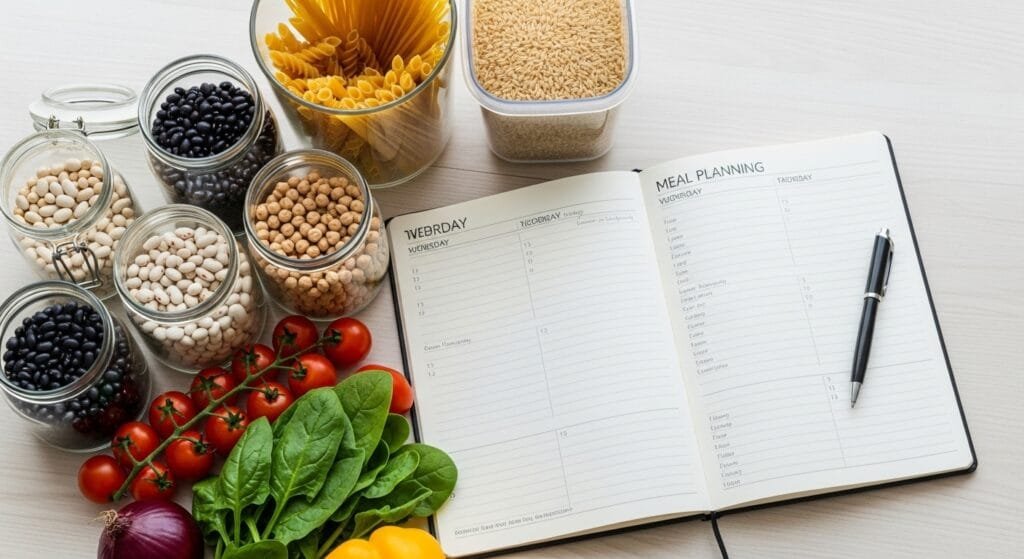
This is where it all starts. Spending just 15 to 20 minutes each week planning your meals can save you hundreds of dollars over time. Here’s why: when you walk into a grocery store without a plan, you’re vulnerable to impulse buys.
Research shows that 20 to 50% of grocery shoppers make at least one unplanned purchase per trip, and in certain categories, impulse items can account for up to 62% of total store revenue. Those “quick grabs” add up fast.
Start by checking what you already have in your fridge, freezer, and pantry. Then build your meal plan around those ingredients. Write down breakfast, lunch, dinner, and snacks for the week. Make your grocery list from that plan and stick to it when you shop.
Candace Pumper, a registered dietitian at The Ohio State University Wexner Medical Center, offers this tip: “Avoid grocery shopping when hungry—eat a healthy snack beforehand to prevent impulse buys.” She also suggests using cash instead of a card to help you stick to your budget.
Buy in Bulk and Freeze Smart
Buying larger quantities of staple items almost always costs less per unit. But you need storage space and a plan to use what you buy.
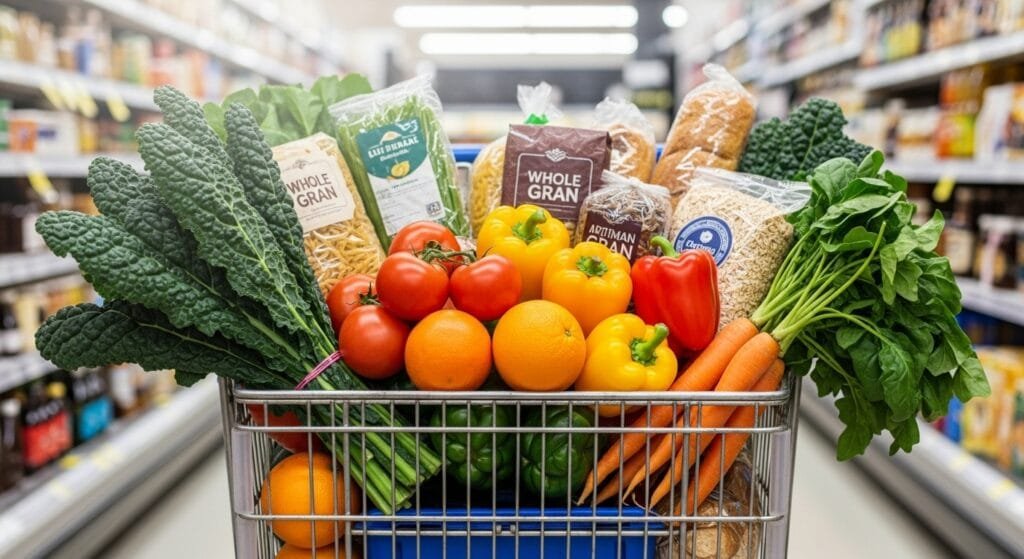
Stock up on pantry staples like brown rice, whole wheat pasta, old-fashioned oats, dried lentils, dried or canned beans, and frozen vegetables when they’re on sale. These items last for months and form the foundation of countless healthy meals.
Your freezer is your budget’s best friend. You can buy family packs of chicken or ground turkey, divide them into meal-sized portions, and freeze what you won’t use right away. Frozen vegetables are just as nutritious as fresh (sometimes even more so), and they won’t spoil before you use them.
A 2017 study found no significant differences in vitamin content between frozen and fresh vegetables. In fact, when there was a slight difference, frozen vegetables often had higher nutrient concentrations because they’re flash-frozen right after harvest. Choose packages marked with a USDA Grade A shield for the best quality.
Embrace Plant-Based Proteins
Meat prices have been climbing steadily, but plant-based proteins like beans, lentils, and chickpeas cost a fraction of the price and pack serious nutrition.
Lentils cost about $1.50 per pound in most grocery stores’ bulk sections, and half a cup of cooked lentils gives you 9 grams of protein plus fiber, iron, potassium, and B vitamins. That’s incredible value! Beans and chickpeas are similarly affordable and versatile.
You don’t have to go fully vegetarian to save money. Try adding one or two meatless meals to your weekly rotation. Bean-based dishes like chili, curry, soups, and tacos are filling, delicious, and cost pennies per serving.
Recent data shows vegetarian households save an average of $130 per month compared to unrestricted diets. Even if you just swap in plant proteins for half your meals, you’ll see real savings.
Batch Cook and Prep Ahead
Batch cooking means making large quantities of a recipe, then dividing it into individual portions to freeze or refrigerate for later. This saves time, money, and helps you avoid the temptation of takeout on busy nights.
One-pot meals like soups, stews, chilis, and curries are perfect for batch cooking. You can also batch cook just the time-consuming ingredients—brown rice, quinoa, lentils, beans, or roasted vegetables—and use them in different meals throughout the week.
Food safety is important here. Get food from the pot to the fridge within two hours of cooking. Store meals in shallow containers so they cool quickly, and keep your fridge at 4°C (39°F) or below. Refrigerated batch-cooked meals stay safe for three days; freeze anything you won’t eat in that timeframe.
If your weekdays are hectic, spend a few hours on Sunday cooking and portioning meals for the week. Your future self will thank you!
Shop the Sales and Go Generic
You can save up to 30% just by choosing store-brand products instead of name brands and shopping based on weekly promotions. Store brands usually come from the same manufacturers as name brands—you’re just not paying for the fancy packaging and advertising.
Check your grocery store’s weekly flyer (most stores have apps now) and plan meals around what’s on sale. If chicken thighs are on special, make them the centerpiece of a few meals that week. When canned tomatoes are discounted, stock up—they last for years.
Buy local produce when you can. Farmers’ markets and local farm stands often have fresher, more affordable fruits and vegetables because the food didn’t travel long distances. Seasonal produce is also cheaper and tastes better.
Minimize Food Waste
Here’s a jaw-dropping fact: the average American family of four throws out $1,600 worth of produce every year. That’s literally tossing money in the trash.
Planning your meals helps prevent waste because you buy only what you need. Store food properly so it lasts longer, and get creative with leftovers. That rotisserie chicken from Monday can become chicken tacos Tuesday and chicken fried rice Wednesday.
Use your freezer to rescue food that’s about to go bad. Overripe bananas? Freeze them for smoothies. Extra cooked rice? Freeze it in portions. Leftover soup? Freeze individual servings for quick lunches.
Pay attention to expiration dates when meal planning, and try to use up perishable items first. A little mindfulness here goes a long way.
Keep It Simple and Flexible
You don’t need complicated recipes with 20 ingredients to eat well. In fact, simpler meals are often healthier, faster to make, and much more budget-friendly.
Focus on building balanced plates with a protein, a whole grain, and vegetables. For example: grilled chicken (or beans), brown rice, and steamed broccoli with a little olive oil and garlic. Simple, satisfying, and inexpensive.
Use a meal-planning tool like the MyPlate Plan to calculate daily food group targets based on your family’s needs. It’s free and takes the guesswork out of nutrition.
Stay flexible, too. If you planned to make salmon but chicken is on sale, swap it out. If fresh spinach looks wilted at the store, grab frozen instead. Flexibility helps you take advantage of deals and avoid paying full price.
Healthy Eating on a Budget US Families Can Sustain
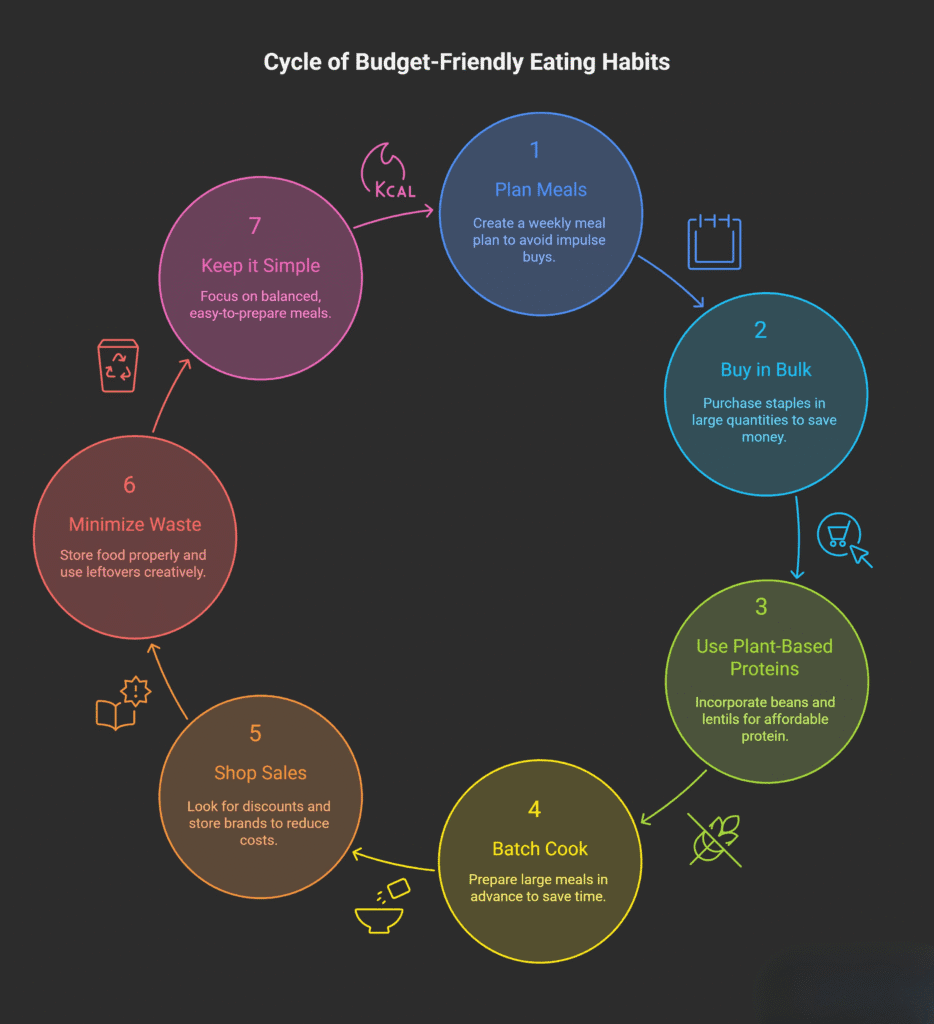
Making these seven habits part of your routine won’t happen overnight, and that’s okay. Start with one or two that feel manageable—maybe meal planning and buying frozen vegetables—and build from there.
You’ll likely stumble sometimes. Maybe you’ll forget your list and overspend at the store, or a busy week will derail your meal prep. That’s normal! The key is to keep going and give yourself grace as you learn what works for your family.
Remember, feeding your family nutritious meals on a budget isn’t about perfection. It’s about progress. Every small step—every planned meal, every smart swap, every dollar saved—adds up to big changes over time.
With a little planning, some smart shopping, and these seven habits in your back pocket, you can nourish your family well without breaking the bank. And that peace of mind? Priceless.
This article is part of our 7 Healthy Daily Lifestyle Choices That Transform Your Well-Being pillar guide, where we explore practical, science-backed habits that improve energy, sleep, focus, and overall well-being in everyday life.
My Experience & Insights
While researching budget-friendly eating strategies for American families, I noticed a frustrating gap: most grocery budget advice treats every household the same, ignoring the massive regional differences that shape what families actually pay at checkout. Research shows that regional food price variation can differ by as much as 25% for similar products across the United States—far more significant than annual inflation rates.
For instance, a family in Hawaii pays nearly 50% more for groceries than a similar household in Wisconsin, yet most budgeting guides offer one-size-fits-all numbers that don’t reflect this reality. I found data from the USDA’s official food plans showing that household size adjustments follow specific patterns: single-person households need to add 20% to baseline costs, while families of five or more can subtract 5% due to economies of scale.
The problem? These numbers are scattered across government reports and academic papers. Families struggling to make ends meet shouldn’t need a research degree to figure out whether their grocery spending is reasonable.
That’s why I built the Grocery Budget Optimizer—a tool that takes the guesswork out of family food budgeting. You simply enter your state, family size, and income range, and it calculates personalized weekly and monthly grocery targets based on USDA food plan data adjusted for your region’s actual costs. It also provides tailored savings tips specific to your household situation.
What surprised me during development was discovering how income level affects optimal food spending. Financial experts typically recommend allocating 10-15% of monthly income to groceries, but that percentage needs to flex based on where you live and how many mouths you’re feeding. A family earning $50,000 in rural Texas will have very different grocery realities than one earning the same amount in San Francisco.
I also learned that supply chain logistics play a huge role in regional pricing. West Coast states often face higher costs due to transportation challenges, while Midwest states benefit from proximity to agricultural production and competitive retail markets. These aren’t temporary fluctuations—they’re structural differences that persist year after year.
Testing the tool with real families revealed another insight: most people dramatically underestimate how much they should be spending to eat healthfully. When families see their personalized budget recommendation, many realize they’ve been trying to stretch an unrealistic amount, leading to poor nutrition choices or constant stress about food costs. Having a realistic, data-backed target removes guilt and helps families make smarter trade-offs.
The Economic Policy Institute’s Family Budget Calculator confirms this pattern: adequate food budgets vary dramatically by location, and families need accurate regional data to plan effectively. By combining USDA baseline costs with state-specific adjustments and household size multipliers, the Grocery Budget Optimizer gives families a realistic starting point—not an aspirational Pinterest fantasy, but an achievable target rooted in research.
If you’re wondering whether your family is spending too much or too little on groceries, I’d encourage you to try the tool. It takes about 30 seconds to get your personalized budget, and the savings strategies it suggests are tailored to your specific situation—not generic advice that may or may not apply to a family in your state with your income level.
Grocery Budget Optimizer
Compared to Average: —
Frequently Asked Questions
How much should a family of 4 spend on groceries per month in 2025?
The USDA’s Thrifty Food Plan estimates that a family of four needs between $835 and $1,054 per month for nutritionally adequate meals, depending on the ages of your children. However, actual costs vary significantly by state—families in Hawaii spend an average of $1,446 monthly, while those in Wisconsin average $957. Use your state’s cost-of-living index and income level to set a realistic target, typically 10-15% of your monthly household income.
What are the cheapest healthy foods I can buy for my family?
The most affordable nutrient-dense foods include dried beans and lentils (around $1.50/lb), brown rice, whole wheat pasta, oats, frozen vegetables, canned tomatoes, eggs, peanut butter, bananas, sweet potatoes, and seasonal produce. Plant-based proteins like chickpeas and black beans cost 70-80% less than meat while providing similar nutrition. Buy store brands and shop sales to maximize savings—you can often save 30% by choosing generic products over name brands.
Is it really cheaper to cook at home than buy fast food?
Yes, significantly cheaper. A homemade meal typically costs $3-5 per person, while fast food averages $8-12 per person when you factor in drinks and sides. For a family of four, that’s a difference of $20-35 per meal. Research from nutritionists shows that meal planning and home cooking can reduce monthly food expenses by $200-400 compared to regular restaurant or takeout meals. Plus, you control ingredients, portions, and nutritional quality—benefits that compound over time in reduced healthcare costs.
How can I meal prep without wasting food?
Start by planning meals around ingredients you already have, then build your shopping list from there. Batch cook 2-3 recipes on Sunday that use overlapping ingredients—for example, roasted chicken, beans, and rice can become different meals throughout the week. Store meals in individual portions using airtight containers, and refrigerate what you’ll eat within 3 days while freezing the rest. Label containers with dates, and follow the “first in, first out” rule. Proper food storage keeps meals safe and prevents the average American family from throwing away $1,600 annually in wasted food.
Are frozen vegetables as healthy as fresh ones?
Absolutely. Research shows frozen vegetables have equal or higher nutrient content compared to fresh because they’re flash-frozen immediately after harvest, locking in vitamins and minerals. Fresh produce, by contrast, can lose nutrients during transportation and storage. Frozen options are also more affordable (often 20-50% cheaper), never spoil before you use them, and reduce waste. Look for packages with a USDA Grade A shield and avoid varieties with added sauces or seasonings that increase cost and sodium.
Can I eat healthy on SNAP benefits or a very tight budget?
Yes, with strategic planning. The USDA’s Thrifty Food Plan—which SNAP benefits are based on—is designed to provide adequate nutrition at minimal cost. Focus on nutrient-dense staples like beans, lentils, oats, brown rice, eggs, peanut butter, and seasonal or frozen produce. Buy in bulk when possible, shop at discount grocers or ethnic markets (often 30-40% cheaper than mainstream stores), and utilize community resources like food banks, farmers market SNAP matching programs, and community gardens. Meal planning and batch cooking stretch every dollar further by eliminating waste and reducing reliance on expensive convenience foods.
💊 Do not rely solely on online content for diagnosis or treatment.
📜 Information here is provided “as is” without any warranties.