
💊 Do not rely solely on online content for diagnosis or treatment.
📜 Information here is provided “as is” without any warranties.
If you’ve ever felt your shoulders tense up while staring at your screen, you’re not alone—breathing techniques for stress at desk can help you find calm in just a few minutes. Work stress is real, and it shows up in tight muscles, racing thoughts, and that constant feeling of being overwhelmed. The good news? You already have one of the best stress-relief tools built right into your body: your breath.
Let’s explore simple, science-backed ways to reduce daily stress at work without leaving your chair.
- Why Work Stress Happens (And Why It Matters)
- Breathing Techniques for Stress at Desk
- Beyond Breathing: Other Quick Stress Relievers
- Stress Management Techniques
- Progressive Muscle Relaxation at Your Desk
- Time Management to Reduce Overwhelm
- The Power of Boundaries
- Making It Stick: Building Your Stress-Relief Routine
- Your Next Steps
- My Experience & Insights
- Stress Management Tools
- Frequently Asked Questions
Why Work Stress Happens (And Why It Matters)

Workplace stress isn’t just in your head. When you’re facing tight deadlines or back-to-back meetings, your body kicks into fight-or-flight mode. Your heart rate speeds up, your muscles tense, and stress hormones like cortisol flood your system. Over time, this constant state of alert wears you down, affecting your sleep quality, focus, and even your immune system.
Dr. Herbert Benson, a cardiologist and professor at Harvard Medical School, discovered what he calls the “Relaxation Response”—a natural way our bodies can switch off the stress reaction. He found that simple breathing exercises can lower your heart rate, decrease blood pressure, and bring your body back into balance. Think of it as hitting the reset button on your nervous system.
Breathing Techniques for Stress at Desk
Your breath is a direct line to your nervous system. Dr. Emma Seppälä, Science Director at Stanford’s Center for Compassion and Altruism Research and Faculty Director at Yale School of Management, explains that breathing is one of the most effective and quickest ways to change the response of your nervous system. When you’re stressed, your breathing becomes shallow and quick. But when you consciously slow down your exhale, you signal your body to relax.
Here are five simple breathing techniques you can try right at your desk:
1. Box Breathing (4x4x4x4)
This technique creates a steady rhythm that calms your mind. Simply inhale for four counts, hold for four, exhale for four, and hold empty for four. Repeat this cycle four to eight times. Box breathing activates your parasympathetic nervous system, which tells your brain it’s safe to relax.
2. The 4-7-8 Method
Start by exhaling completely through your mouth. Then breathe in quietly through your nose for four seconds, hold for seven seconds, and exhale forcefully through your mouth for eight counts while making a gentle whooshing sound. This pattern is especially helpful when anxiety spikes because the long exhale naturally lowers your pulse.
3. Diaphragmatic (Belly) Breathing
Place one hand on your chest and the other on your belly. As you breathe in through your nose, let your belly rise while keeping your chest relatively still. Research shows that diaphragmatic breathing can lower cortisol levels and improve sustained attention. It’s a simple shift that makes a big difference.
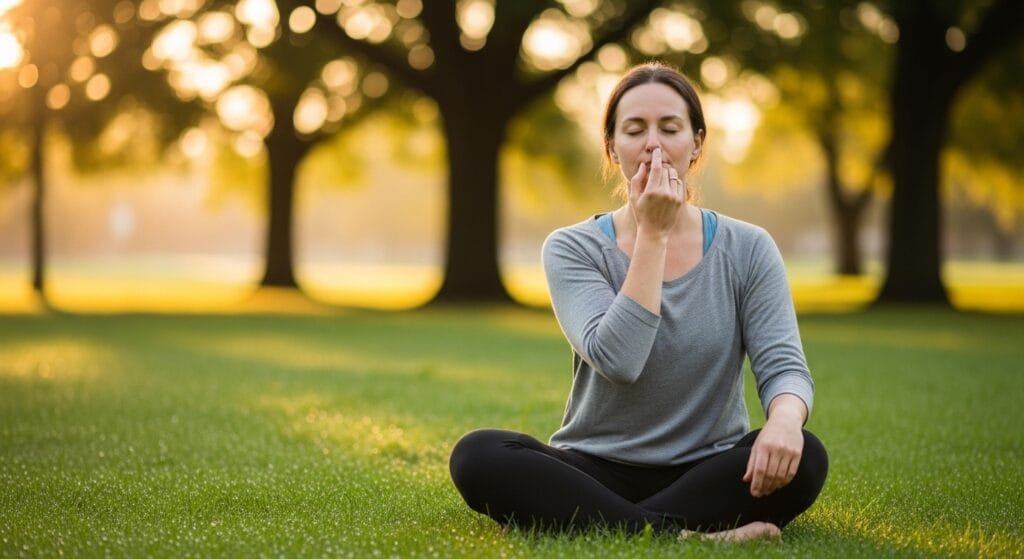
4. Alternate Nostril Breathing
This yoga technique might feel unusual at first, but it’s great for focus. Close your right nostril with your thumb, inhale through the left, then close the left nostril with your ring finger and exhale through the right. The practice is said to reduce stress and restore balance to your nervous system.
5. The Relaxation Response Technique
Dr. Benson’s method combines breathing with a mental focus word. Sit comfortably, close your eyes, and breathe naturally through your nose. As you exhale, silently say the word “one” (or any calming word you prefer). Continue for 10 to 20 minutes, gently returning to your focus word whenever your mind wanders. This practice has been shown to produce measurable physiological changes similar to meditation.
Beyond Breathing: Other Quick Stress Relievers
While breathing exercises are powerful, combining them with other strategies can boost your resilience even more. Here’s a quick comparison of techniques you can use throughout your workday:
Stress Management Techniques
| Technique | Time Needed | Best For | How It Helps |
|---|---|---|---|
| Deep breathing exercises | 2-5 minutes | Immediate calm during stress spikes | Lowers cortisol and heart rate |
| Progressive muscle relaxation | 10-15 minutes | Releasing physical tension | Reduces muscle tightness and improves sleep |
| Time-blocking | Ongoing daily practice | Managing overwhelming workloads | Reduces stress by 43% and boosts work-life balance |
| Micro-breaks with movement | 2-3 minutes every hour | Preventing burnout | Boosts mood and energy while decreasing fatigue |
| Setting work boundaries | Ongoing commitment | Protecting personal time | Increases job satisfaction by 19% and prevents overcommitment |
Progressive Muscle Relaxation at Your Desk
If you’re holding tension in your shoulders or jaw, try progressive muscle relaxation (PMR). Starting with your feet, tense each muscle group for about five seconds, then release and notice the difference. Work your way up through your legs, abdomen, arms, and face. The beauty of PMR is that you can do it while sitting at your desk, making it perfect for busy workdays.
Time Management to Reduce Overwhelm
Sometimes stress comes from feeling like there’s simply too much to do. Time-blocking—assigning specific hours to focused tasks—can help you regain control. People who schedule breaks report 62% better work-life balance and significantly less stress. Try the Pomodoro Technique, which encourages focused work in short bursts with breaks in between to maintain concentration without burnout.
The Power of Boundaries
Learning to say no is hard, but it’s essential for protecting your mental energy. Setting clear boundaries at work helps you prioritize effectively and concentrate on what truly matters. This might mean declining extra projects when your plate is full or blocking off time on your calendar for deep work. Clear boundaries show professionalism and encourage colleagues to respect your needs, leading to healthier relationships all around.
Making It Stick: Building Your Stress-Relief Routine
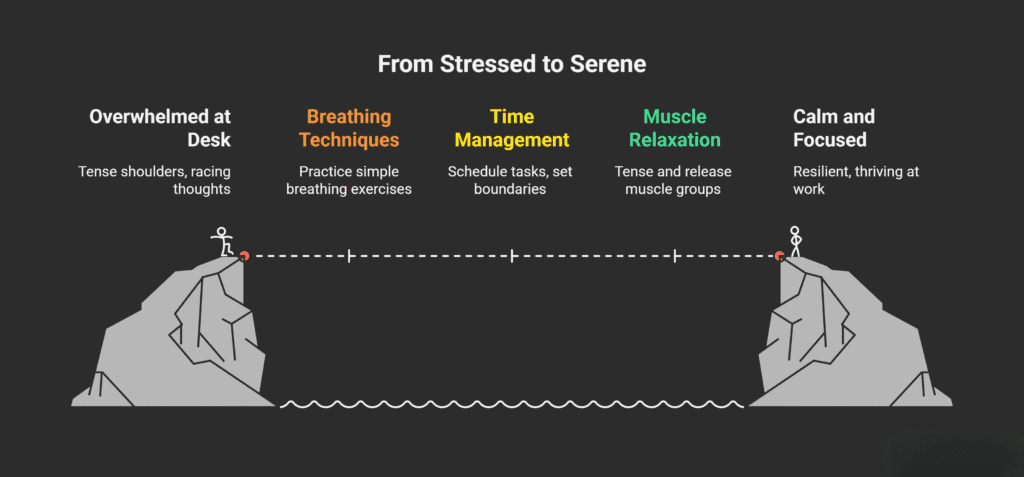
The key to managing work stress isn’t doing everything perfectly—it’s finding what works for you and practicing it regularly. Start small. Maybe you begin your day with two minutes of belly breathing before you check your email. Or perhaps you set a reminder to do box breathing before every big meeting.
Carole Spiers, MBE, founder of the International Stress Management Association and CEO of a leading UK stress management consultancy, emphasizes that stress management training should be practical and immediately applicable. Her approach has helped organizations reduce stress and improve their bottom line by giving employees tools they can use right away.
You don’t need a meditation app or a quiet room to start feeling better. Just a few conscious breaths can interrupt the stress cycle and bring you back to center. The more you practice, the easier it becomes to tap into that calm state whenever you need it.
Your Next Steps
We’ve all been there—staring at the computer, feeling the weight of the workday pressing down. But now you have real tools to fight back. Whether it’s the 4-7-8 breath when anxiety hits, a quick round of box breathing between meetings, or simply lengthening your exhale while reading emails, you’re training your nervous system to become more resilient.
Remember, stress might be inevitable, but burnout doesn’t have to be. By combining breathing techniques with smart time management and healthy boundaries, you’re not just surviving your workday—you’re setting yourself up to thrive. Start with one technique today, and notice how your body responds. You might be surprised at how much power you already have to change how you feel, one breath at a time.
This article is part of our 7 Healthy Daily Lifestyle Choices That Transform Your Well-Being pillar guide, where we explore practical, science-backed habits that improve energy, sleep, focus, and overall well-being in everyday life.
My Experience & Insights
When I started diving into workplace stress research last year, I kept noticing the same pattern: people knew they were stressed, but they didn’t know what to actually do about it in the moment. I came across a Yale study from 2020 that found college students who learned specific breathing techniques showed improvements in six areas—depression, stress, mental health, mindfulness, positive affect, and social connectedness. What struck me was how simple the intervention was, yet how powerful the results were.
Around the same time, I found research from Stanford Medicine showing that a tiny cluster of neurons actually links our breathing patterns directly to relaxation, attention, and anxiety. Dr. Mark Krasnow and his team discovered that slow breathing activates specific neural pathways that calm the brain. This wasn’t just “take a deep breath and relax” advice—this was hard neuroscience showing why it works.
The problem? Most articles I read just listed breathing techniques without helping people figure out which one to use when. If you’re in a tense meeting, do you try box breathing or the 4-7-8 method? What if you only have 60 seconds versus five minutes?
That’s when I decided to build two simple tools for readers on my site:
1. Breathing Technique Finder – This gives you personalized recommendations based on your current situation (whether you’re anxious, overwhelmed, can’t focus, or need quick relief) and how much time you have. Instead of trying to remember five different techniques, you answer two quick questions and get the right method for that exact moment.
2. Cortisol Reset Timer – This is a guided 4-7-8 breathing timer specifically designed around research showing this technique significantly reduces anxiety. A 2023 study published in Scientific Reports found that slow-paced breathwork lowered cortisol levels compared to control groups. The timer walks you through the 4-count inhale, 7-count hold, and 8-count exhale with visual cues, so you don’t have to count in your head while trying to relax.
I based both tools on findings from Yale’s Center for Emotional Intelligence and Stanford’s breathing research, which consistently show that breathing interventions work—but they work better when they’re personalized and easy to access. A 2024 systematic review in Biological Research for Nursing confirmed that breathing exercises effectively reduce anxiety and stress in adults, with no reported adverse events across 19 studies.
What I’ve learned from building these tools and testing them myself? The best breathing technique is the one you’ll actually use. Having a quick reference that matches your stress level and available time makes all the difference. Whether it’s a 2-minute box breathing session before a presentation or a 10-minute relaxation response practice during lunch, the key is making it practical enough that it becomes a habit, not just something you know you “should” do.
Stress Management Tools
Select the tool that matches your current needs for immediate stress relief
Find Your Perfect Breathing Technique
Answer two questions to get a personalized breathing technique recommendation
Cortisol Reset Breathing Timer
Follow the guided breathing pattern to lower stress hormones and calm your nervous system
How This Works
This 4-7-8 breathing pattern activates your parasympathetic nervous system, signaling your body to reduce cortisol production and enter a relaxed state.
Research shows that extending your exhale relative to your inhale can lower heart rate and blood pressure within minutes.
Frequently Asked Questions
How long does it take for breathing exercises to reduce stress?
You can start feeling calmer within just 2-5 minutes of focused breathing. A Stanford Medicine study found that five minutes of daily breathing exercises like cyclic sighing immediately reduced anxiety and improved mood. For one or two quick deep sighs, you might notice a difference in under 30 seconds. However, practicing regularly for at least a few weeks creates longer-lasting changes in how your body responds to stress.
Which breathing technique works best for anxiety at work?
The 4-7-8 breathing technique is particularly effective for anxiety because the extended exhale activates your parasympathetic nervous system, which naturally calms your body. For immediate panic relief, try cyclic sighing (deep inhales followed by long exhales), which Stanford researchers found can help breathe away anxiety in just minutes. Both techniques are quiet and discreet enough to do right at your desk during stressful moments.
Can breathing exercises actually lower cortisol levels?
Yes, research shows that controlled breathing practices can reduce cortisol, the primary stress hormone. A 2023 study published in Scientific Reports found that slow-paced breathwork significantly lowered cortisol levels compared to control groups. Additionally, a 2025 study showed that diaphragmatic breathing exercises reduced both cortisol and blood pressure while improving sleep quality. The effects are physiological, not just psychological.
How many times a day should I practice breathing exercises for stress?
For best results, practice 2-4 times daily for 5-10 minutes each session. Start with just 5 minutes once per day if you're a beginner. A 2023 research review found that effective breathing practices included multiple sessions throughout the day rather than just one long session. You can also use breathing techniques "as needed" during stressful moments—there's no upper limit to how often you can practice.
What's the difference between box breathing and 4-7-8 breathing?
Box breathing uses equal counts for all four parts: inhale for 4, hold for 4, exhale for 4, hold for 4. It creates a steady, balanced rhythm that's great for focus and general calm. The 4-7-8 method uses unequal counts: inhale for 4, hold for 7, exhale for 8. The longer exhale makes it more powerful for anxiety relief because exhalation activates your calming nervous system. Use box breathing for steady focus during work; use 4-7-8 when anxiety spikes.
Do I need to close my eyes or be in a quiet place for breathing exercises to work?
No, breathing exercises work even in busy environments with your eyes open. While closing your eyes can help you focus initially, you can practice any breathing technique discreetly at your desk, in meetings, or even while walking. The key is paying attention to your breath pattern—counting your breaths or focusing on the rise and fall of your belly—regardless of your surroundings. Many people successfully use these techniques during their commute, between meetings, or while reading emails.
💊 Do not rely solely on online content for diagnosis or treatment.
📜 Information here is provided “as is” without any warranties.