
💊 Do not rely solely on online content for diagnosis or treatment.
📜 Information here is provided “as is” without any warranties.
Micro workouts are reshaping how we think about fitness in America, and honestly, it’s about time. If you’ve ever felt like traditional hour-long gym sessions are impossible to squeeze into your packed schedule, you’re not alone. These bite-sized bursts of exercise—typically lasting anywhere from 30 seconds to 10 minutes—are proving that you don’t need to spend hours sweating to see real results.
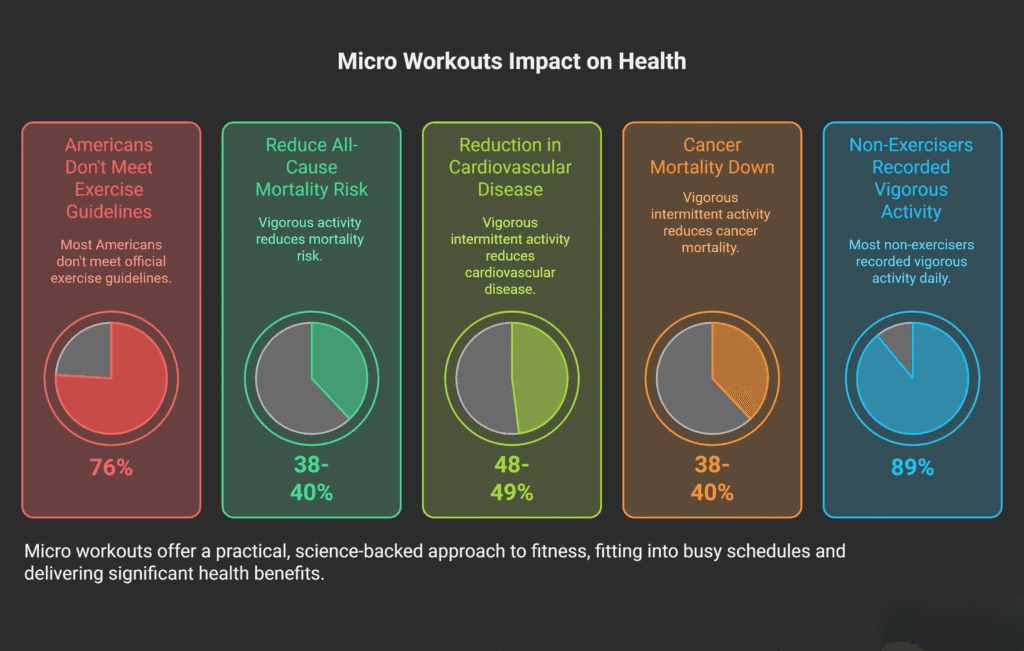
We’re living in a time when 76% of Americans don’t meet the official exercise guidelines. That’s a pretty big red flag. But here’s the thing: the problem isn’t that we’re lazy. It’s that the traditional approach to fitness doesn’t fit into modern life. Enter the tiny fitness trend that’s catching fire across the country—short, intense bursts of movement that you can do anywhere, anytime.
- Why Americans Are Falling for Short Exercise Bursts
- What Makes These Mini Sessions So Effective
- Traditional Workouts vs. Quick Exercise Sessions
- Traditional vs Micro Workouts
- Building Strength in Small Time Windows
- Making Mini Movement a Daily Habit
- The Mental Win Behind Tiny Training
- Creating Your Personal Quick Fitness Plan
- Real Results from Real Research
- My Experience & Insights
- Micro Fitness Toolkit
- Create Your 2–10 Minute Micro Workout
- Daily Movement Score Calculator
- Frequently Asked Questions
Why Americans Are Falling for Short Exercise Bursts
Let’s be real—most of us don’t have an extra hour every day to dedicate to the gym. Between work deadlines, family responsibilities, and trying to have some sort of social life, traditional workouts often get pushed to the bottom of the to-do list. That’s exactly why these quick fitness sessions have become so popular.
The beauty of this approach is in its simplicity. You don’t need fancy equipment, a gym membership, or even workout clothes for these short sessions. A few minutes of squats during your coffee break, some push-ups before your morning shower, or a quick set of jumping jacks between Zoom calls—it all adds up. Research from Professor Emmanuel Stamatakis at the University of Sydney shows that just three short bursts of vigorous activity per day (each lasting only 1-2 minutes) can reduce all-cause mortality risk by 38-40%.
That’s not a small number. We’re talking about lowering your risk of dying early by nearly half, just by adding a few minutes of intense movement to your daily routine. Even better? The median duration that showed these benefits was only 4.4 minutes per day. If you can brush your teeth for two minutes twice a day, you can definitely handle this.
Professor Ulrik Wisløff, an exercise physiologist at the Norwegian University of Science and Technology (NTNU), has been researching this area for nearly 20 years. His team found that just 30 minutes of high-intensity cardiovascular exercise per week—broken into small chunks—reduced the risk of premature death from heart disease by half compared to people who exercised much more but at moderate intensity. And in a 2022 UK study, researchers discovered that 4.5 minutes per day of high-intensity exercise, just one to two days per week, delivered significant health benefits.
What Makes These Mini Sessions So Effective

You might be wondering: how can something so short actually work? It comes down to intensity. When you’re only exercising for a few minutes, you can push yourself harder than you would during a longer workout. Those short recovery periods between bursts let you maintain that high intensity, which gives your body a bigger stimulus for adaptation.
Think of it like this—when you’re running a marathon, you pace yourself. But when you’re sprinting 100 meters, you give it everything you’ve got. These quick exercise sessions work on the sprint principle. You go all-out for a short time, rest, and repeat. This approach has been shown to improve maximal oxygen uptake (basically, how well your body uses oxygen) with as little as two or three 20-second intense bursts, done three times per week.
The science is pretty clear. During an average follow-up period of 6.9 years, people who did small amounts of vigorous intermittent physical activity (what researchers call VILPA) saw a 48-49% greater reduction in cardiovascular disease mortality risk compared to those who did none at all. Cancer mortality? Down by 38-40%. These numbers come from studying real people going about their daily lives—not professional athletes in a lab.
Traditional Workouts vs. Quick Exercise Sessions
So how do these mini movements stack up against your standard gym routine? Let’s break it down in a way that makes sense.
Traditional vs Micro Workouts
| Factor | Traditional Workouts | Micro Workouts |
|---|---|---|
| Time Commitment | 45-60 minutes per session | 2-10 minutes per session |
| Equipment Needed | Often requires gym access or equipment | Bodyweight exercises, no equipment needed |
| Location | Gym or dedicated workout space | Anywhere—office, home, outdoors |
| Focus | Progressive overload, endurance building | Convenience, consistency, intensity |
| Best For | Building significant muscle mass, structured training | Busy schedules, building exercise habits |
| Intensity Level | Moderate to high, sustained | Very high, short bursts |
| Psychological Barrier | Higher (long time commitment) | Lower (short duration reduces intimidation) |
Both approaches have their place. Traditional workouts are excellent for building substantial muscle mass and improving endurance through progressive overload. But if you’re someone who struggles with time or motivation, the shorter option removes that mental barrier. Completing even a short workout can give you a sense of accomplishment and boost your motivation to keep going.
Studies show that high-intensity interval training can deliver meaningful health and fitness benefits in just two to 12 weeks for people new to exercise. And here’s something that surprised me: research has found similar increases in aerobic fitness and reductions in blood pressure and insulin resistance between groups doing short, intense workouts and those doing longer, traditional sessions.
Building Strength in Small Time Windows
You might be thinking, “Sure, cardio is one thing, but can I actually build muscle this way?” It’s a fair question. The answer is yes—but with some caveats.
Building muscle with these quick sessions is definitely possible, though it may be more limited compared to traditional strength training. You won’t pack on massive amounts of muscle mass like a bodybuilder, but you can absolutely improve muscle tone, cardiovascular fitness, and endurance. For most of us who just want to stay healthy and feel strong, that’s more than enough.
The key is focusing on compound movements—exercises that work multiple muscle groups at once. Think squats, lunges, push-ups, and planks. These moves give you the biggest bang for your buck, maximizing calorie burn and muscle activation in a short amount of time. When you’ve only got a few minutes, you want to make every second count.
Here’s a practical example: a five-minute office break workout might include 30 seconds each of squats, push-ups, jumping jacks, and planks, followed by a one-minute rest, then repeating the circuit once. That’s it. Simple, effective, and totally doable even on your busiest days.
Making Mini Movement a Daily Habit

The real magic of this fitness approach isn’t just in the individual workouts—it’s in the cumulative effect. When you do several short exercise sessions throughout your day, every day, the benefits add up quickly. Research shows that small, repeated actions are crucial for building lasting habits.
Starting small is the secret. Maybe you begin with just 10 minutes of movement and one mobility drill each day. That’s your baseline—your “win” for the day. Then, whenever you hit your targets consistently, you increase the load by a tiny, fixed amount. This gradual approach prevents burnout and makes fitness feel less like a chore.
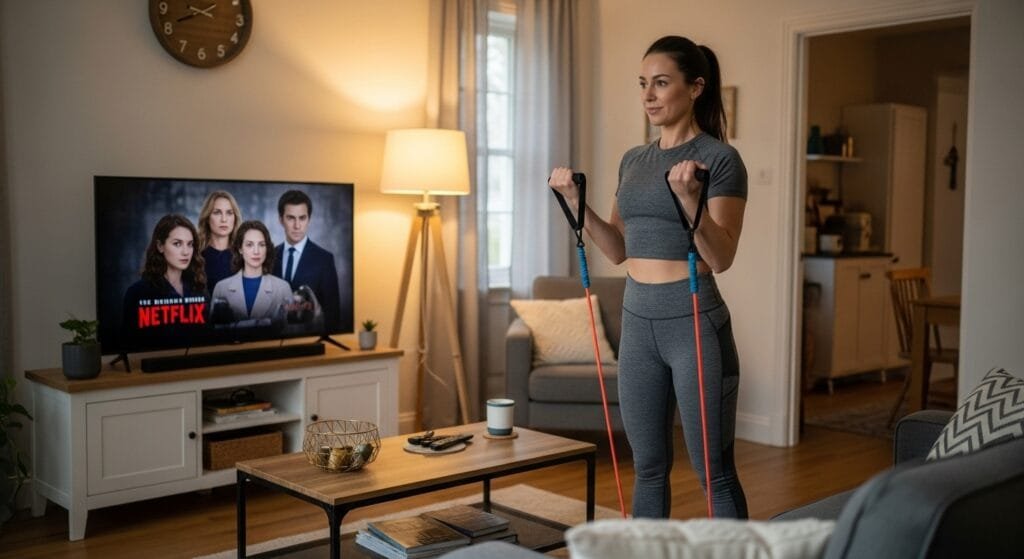
I’ve found that strategic placement is everything. Try integrating quick exercise bursts during natural breaks in your day—while your coffee brews, during TV commercials, or right before meals. Set reminders on your phone if you need to. Track your progress in a simple log or app. The goal isn’t perfection; it’s consistency.
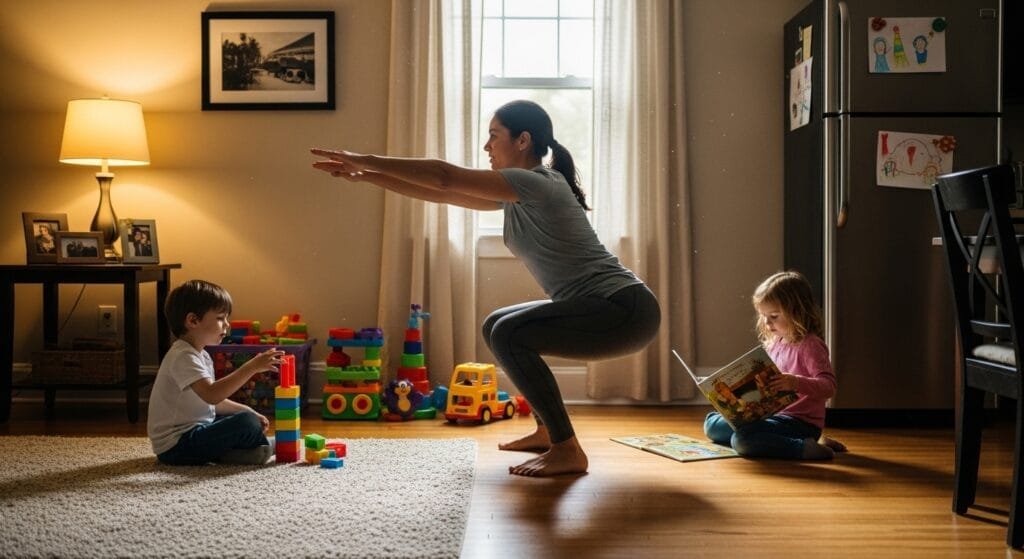
Professor Stamatakis’s research on vigorous intermittent lifestyle physical activity (VILPA) is particularly interesting here. We’re not talking about structured workouts in gym clothes. We’re talking about everyday activities done with intensity—climbing a few flights of stairs quickly, carrying groceries, even playing actively with your kids. When these activities are done vigorously (meaning they get your heart rate up) for just 1-2 minutes at a time, they count.
The Mental Win Behind Tiny Training
There’s a psychological component here that we can’t ignore. Long workouts can feel overwhelming before you even start. Your brain looks at that hour on your calendar and starts making excuses. But five minutes? That’s nothing. You can do anything for five minutes.
This reduced intimidation factor is huge for people who’ve struggled with exercise in the past. It removes the “all or nothing” mentality that causes so many people to quit. Can’t do a full workout today? No problem—do a quick five-minute session instead. Something is always better than nothing.
The sense of accomplishment you get from completing even a short workout can be surprisingly powerful. It creates momentum. One quick session leads to another, which leads to another. Before you know it, you’ve built a sustainable habit that actually sticks—without the guilt and frustration that often come with missed traditional workouts.
Participants in VILPA intervention studies reported positive impacts on self-reported general health and functional fitness. They found the approach acceptable and said they intended to continue after the study ended. That’s the real test, isn’t it? Not what you do during a research study, but what you keep doing when nobody’s watching.
Creating Your Personal Quick Fitness Plan
Ready to give this a try? Here’s how to build your own routine that actually works for your life. First, take an honest look at your schedule and identify small pockets of time where you could squeeze in movement. Maybe it’s first thing in the morning, during your lunch break, or while dinner’s cooking.
Next, choose exercises you actually enjoy (or at least don’t hate) that target different muscle groups. Variety prevents boredom and overuse injuries. Mix cardio moves like jumping jacks or high knees with strength exercises like squats and push-ups, plus some stretching or yoga poses for flexibility.
Here are some sample routines you can try:
The Morning Energizer (3 minutes)
- 30 seconds: jumping jacks
- 30 seconds: bodyweight squats
- 30 seconds: push-ups (on knees if needed)
- 30 seconds: high knees
- 30 seconds: plank hold
- 30 seconds: rest and breathe
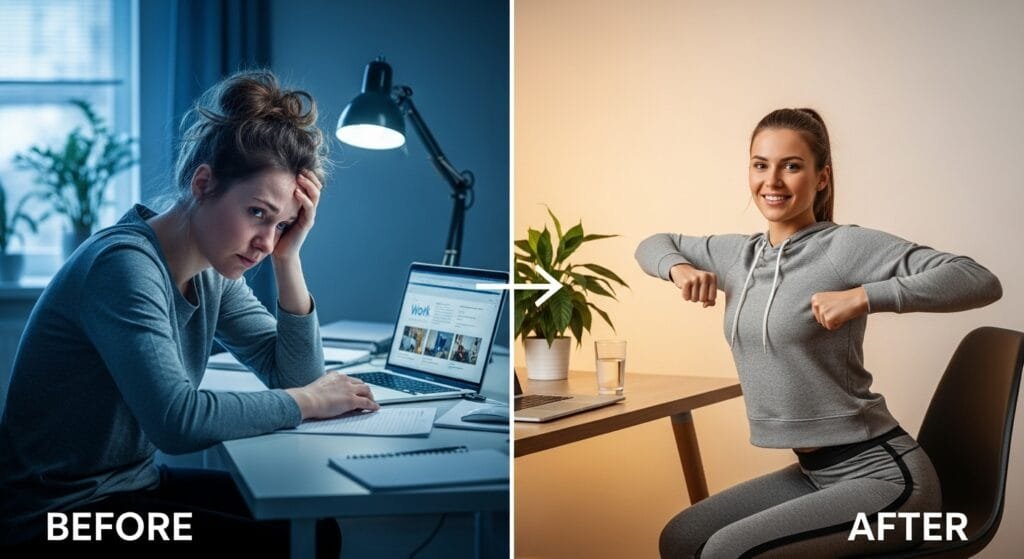
The Desk Break Blast (5 minutes)
- 1 minute: walk or march in place
- 30 seconds: desk push-ups
- 30 seconds: chair squats
- 30 seconds: standing leg raises
- 1 minute: arm circles and shoulder rolls
- 30 seconds: wall sit
- 1 minute: gentle stretching
The Evening Wind-Down (4 minutes)
- 1 minute: slow squats
- 30 seconds: plank hold
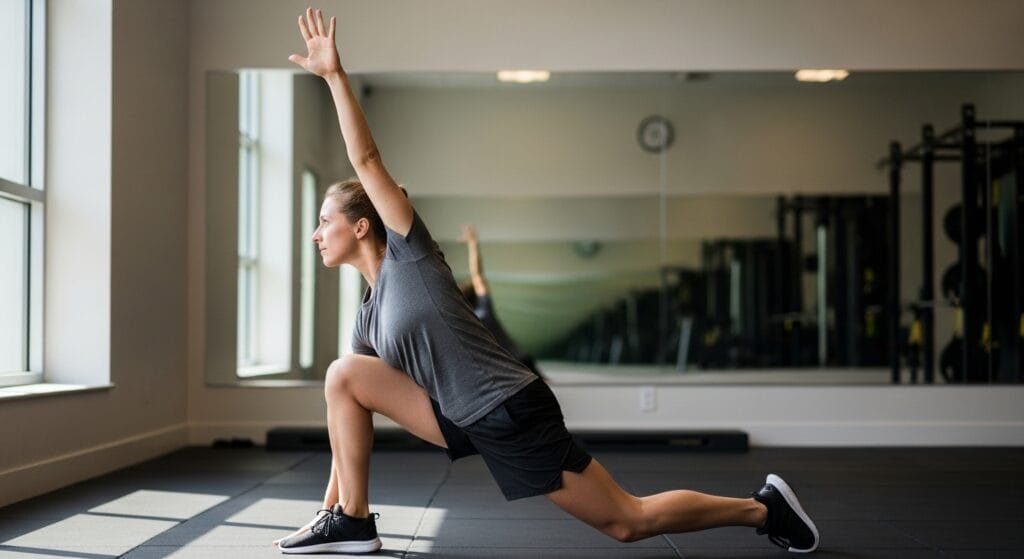
- 1 minute: gentle lunges
- 30 seconds: wall push-ups
- 1 minute: stretching and deep breathing
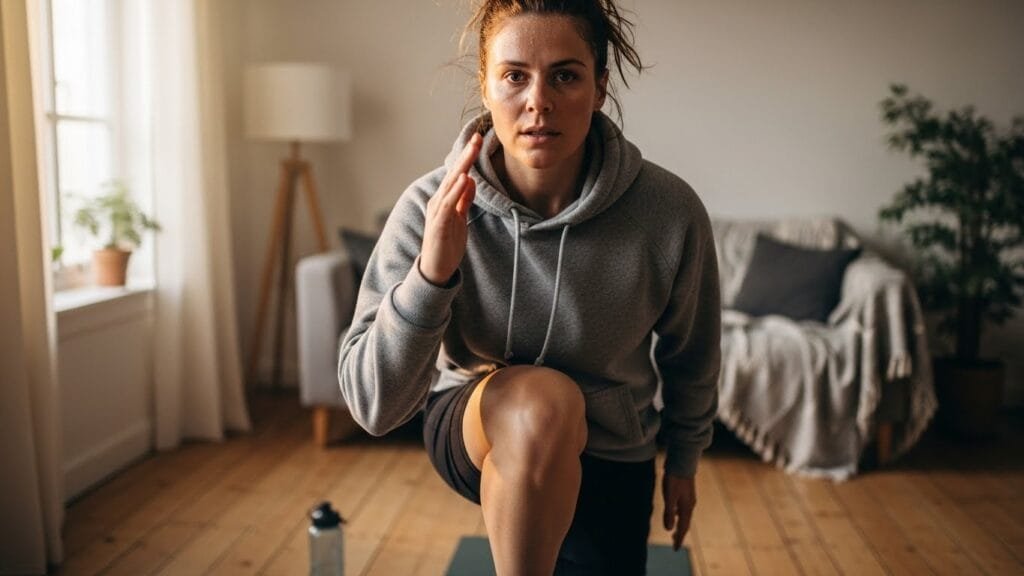
Remember, intensity matters when you’re working with limited time. During those exercise intervals, push yourself to work at a level that feels challenging. You should be breathing hard and feeling your heart rate climb. That’s the whole point—maximize the stimulus in minimal time.
As your fitness improves, gradually increase either the intensity or duration of your sessions. But don’t feel pressured to turn these into full-length workouts. The goal is to maintain consistency with something sustainable, not to burn yourself out chasing an unrealistic standard.
Real Results from Real Research
Let’s talk numbers for a second, because the research backing this fitness approach is genuinely impressive. In one major UK study involving 25,241 people aged 40-69, researchers tracked participants for an average of 6.9 years. The results? Those who performed three or more daily bouts of vigorous intermittent activity (lasting just 1-2 minutes each) showed dramatically lower mortality rates across the board.
The cardiovascular benefits were especially striking. The median daily duration of just 4.4 minutes of vigorous activity was associated with a 32-34% reduction in cardiovascular disease mortality risk. To put that in perspective, this is comparable to the risk reduction seen in people who do 75-150 minutes per week of traditional vigorous leisure-time physical activity.
Even more encouraging: 89% of non-exercisers in the study recorded some vigorous intermittent lifestyle physical activity in their daily routines. This suggests that almost everyone, regardless of current fitness level, naturally does some form of intense activity during their day—they just might not realize it counts as exercise.
Professor Wisløff’s earlier work with the HUNT Study examined 60,000 men and women and found similar patterns. The key takeaway from decades of research? Short bursts of high-intensity exercise have at least the same effect as much longer periods of moderate-intensity exercise. You’re not getting a watered-down version of fitness—you’re getting genuine, measurable health improvements.
The micro-workout trend isn’t just another fitness fad. It’s a practical, science-backed approach that meets people where they are—busy, tired, and short on time. Whether you’re squeezing in a few push-ups before your morning coffee or taking the stairs two at a time, every burst of intense movement counts toward better health.
You don’t need to overhaul your entire life to get fitter and healthier. You just need to start moving—in whatever small ways you can, whenever you can. The cumulative effect of those tiny efforts might surprise you. After all, something really is better than nothing, and a few minutes of exercise you’ll actually do beats an hour of exercise that stays on your to-do list forever.
So tomorrow morning, try just one quick circuit. See how it feels. You might discover that the hardest part isn’t the workout itself—it’s just getting started. And that part? That only takes a few minutes.
This article is part of our 5 Powerful Small Daily Habits That Transform Your Life pillar guide, where we explore simple, realistic habits that compound over time to improve energy, focus, and overall well-being.
My Experience & Insights
When I started digging into the research on micro workouts a few years ago, I’ll admit I was skeptical. The idea that a few minutes of exercise could genuinely move the needle on health outcomes seemed too good to be true. But then I came across Professor Stamatakis’s groundbreaking work on vigorous intermittent lifestyle physical activity, and everything clicked.
What fascinated me most wasn’t just the mortality data—though a 38-40% reduction in all-cause mortality from 4.4 minutes of daily activity is staggering. It was the realization that most people are already doing these tiny bursts of intense movement without recognizing them as “exercise.” That shift in perspective completely changed how I approached fitness content on my site.
I spent months reading through studies from NTNU’s Cardiac Exercise Research Group and tracking down emerging research on VILPA. The more I learned, the more I wanted to help readers apply these insights practically. So I built two simple tools that take the guesswork out of incorporating micro workouts into daily life.
The first is a Micro Workout Generator that creates custom 2–10 minute routines based on your specific situation. You tell it your fitness goal (maybe building energy, reducing stress, or just moving more), how much time you have, your current fitness level, and where you are—whether that’s your living room, office, or a park. Within seconds, you get a dynamic workout plan with a built-in timer. No more excuses about not knowing what to do or feeling overwhelmed by complicated programs.
The second tool I created is the Daily Movement Score Calculator, which directly applies the VILPA research I kept encountering. This one’s particularly interesting because it shows you how much vigorous intermittent activity you’re already doing—those stairs you climbed, the quick walks, the moments you moved with intensity. You enter basic info like your age, daily steps, how many flights of stairs you typically climb, and how many short bursts of activity you do. The calculator then gives you a personalized score and suggests small, specific habits to boost your VILPA without adding “workouts” to your calendar.
What I’ve learned from building these tools and talking with readers who use them is that the psychological shift matters as much as the physical one. When someone realizes that playing tag with their kids for two minutes counts as meaningful exercise, or that carrying groceries up two flights of stairs is building their cardiovascular health, it removes the guilt and overwhelm. Research published in the British Journal of Sports Medicine confirms what I’ve seen anecdotally—people find VILPA more acceptable and sustainable than traditional structured exercise.
I’ve also noticed that readers who start tracking their movement patterns through the Daily Movement Score Calculator often discover they’re doing more than they thought. That positive reinforcement seems to create momentum. Instead of feeling behind or inadequate, they start looking for small opportunities to add another burst of activity here and there. It’s exactly the kind of sustainable behavior change that experts like Professor Wisløff have been advocating for decades.
One pattern that surprised me: readers in their 40s and 50s consistently report that micro workouts feel more “doable” than what they remember from their 20s. There’s no pressure to spend an hour at the gym or keep up with intense workout videos. A 3-minute morning routine before coffee? Absolutely manageable. And when the University of Sydney research shows that these small efforts genuinely reduce disease risk, it validates what might otherwise feel like “not enough.”
The real breakthrough for me came when I stopped thinking about fitness as something that happens in dedicated blocks of time and started seeing movement opportunities everywhere. That’s the core insight I hope readers take away—and why I designed both tools to emphasize flexibility and personalization over rigid rules. Whether you’re using the Micro Workout Generator for a quick office break routine or checking your Daily Movement Score to identify easy wins, the goal is the same: make fitness fit your life, not the other way around.
Micro Fitness Toolkit
Create Your 2–10 Minute Micro Workout
Daily Movement Score Calculator
Frequently Asked Questions
How long should a micro workout be to see results?
Micro workouts typically last between 2 to 10 minutes, and you can see real health benefits from as little as 4.4 minutes of vigorous activity per day. Research from the University of Sydney shows that just three short bursts of intense movement daily (each lasting 1-2 minutes) can reduce mortality risk by 38-40%. The key isn’t duration—it’s intensity. When you’re working out for only a few minutes, you need to push yourself harder than you would during a longer session. Most people start noticing improved energy levels within a week or two, while measurable cardiovascular improvements typically appear within 2-12 weeks of consistent practice.
Can micro workouts replace going to the gym completely?
Yes and no—it depends on your goals. If you’re aiming for general health, cardiovascular fitness, and disease prevention, micro workouts can absolutely deliver meaningful results without a gym. Studies show they reduce heart disease risk, improve metabolic health, and boost longevity just as effectively as traditional exercise for many people. However, if your goal is building significant muscle mass, training for athletic performance, or achieving bodybuilder-level strength, you’ll likely need longer, more structured workouts with progressive overload. For most Americans just trying to stay healthy and active, though? Multiple short sessions throughout the day can be just as effective—and often more sustainable—than hour-long gym visits.
What are the best micro workouts for beginners?
The best beginner micro workouts focus on bodyweight compound movements that work multiple muscle groups without equipment. Start with a simple 3-minute routine: 30 seconds of marching in place (warm-up), 30 seconds of modified knee push-ups, 30 seconds of bodyweight squats, 30 seconds of standing knee raises, 30 seconds of gentle lunges, and finish with 30 seconds of stretching. You can do this anywhere—your bedroom, office, or living room. As you build confidence and strength, gradually increase the intensity by going faster, adding more reps, or holding positions longer. The beauty of starting small is that it removes intimidation and builds consistency, which matters more than intensity when you’re just beginning.
How many micro workouts should I do per day?
Aim for at least three vigorous bursts of activity per day, each lasting 1-2 minutes, according to Professor Stamatakis’s VILPA research. This could mean a quick 2-minute workout when you wake up, another during your lunch break, and one more in the evening. If you prefer longer sessions, doing two to four 5-10 minute workouts spread throughout your day works just as well. The key is accumulating that vigorous activity in ways that fit your schedule. Some people do better with several tiny 2-minute bursts, while others prefer three solid 5-minute sessions. Listen to your body and choose what you’ll actually stick with—consistency beats perfection. Just make sure you’re pushing yourself hard enough during those short windows to get your heart rate up and feel challenged.
Do micro workouts help with weight loss?
Yes, micro workouts can support weight loss, though they work differently than traditional steady-state cardio. High-intensity interval training and vigorous bursts of activity boost your metabolism, improve insulin sensitivity, and help burn calories both during and after exercise. Research shows that short, intense workouts can deliver similar metabolic benefits to much longer moderate-intensity sessions. However, weight loss ultimately depends on creating a calorie deficit through a combination of exercise and nutrition. Micro workouts are excellent for building muscle tone, increasing daily calorie burn, and making fitness more sustainable—but they’re most effective for weight loss when paired with mindful eating. The real advantage? They’re so quick and convenient that you’re more likely to stay consistent, which is what actually drives long-term weight management success.
Are micro workouts safe for older adults and people with health conditions?
Micro workouts can be very safe for older adults and people with health conditions—but it’s essential to start slowly and consult your doctor first, especially if you have heart disease, joint issues, or other medical concerns. The beauty of VILPA-style activity is that it can be scaled to your current fitness level. For older adults, this might mean climbing a single flight of stairs with purpose, doing wall push-ups instead of floor push-ups, or chair squats instead of full squats. Research actually shows that older adults who incorporate vigorous intermittent activity report positive impacts on functional fitness and general health. Start with just 30-60 seconds of gentle activity and gradually build up intensity as you feel comfortable. The short duration means you can stop immediately if something doesn’t feel right, and you’re less likely to experience overuse injuries compared to longer workout sessions. Always prioritize proper form over speed or intensity.
💊 Do not rely solely on online content for diagnosis or treatment.
📜 Information here is provided “as is” without any warranties.