


💊 Do not rely solely on online content for diagnosis or treatment.
📜 Information here is provided “as is” without any warranties.
What if I told you that gratitude habits could change your health in less time than it takes to brew your morning coffee? It sounds almost too good to be true, but science backs it up. Spending just a couple of minutes each day acknowledging what you’re thankful for can lower your blood pressure, reduce symptoms of depression, and even help you sleep better at night.
We’re not talking about hours of meditation or complicated rituals here. These are quick, easy practices you can squeeze in while you’re waiting for your lunch to heat up or right before bed. And the payoff? A healthier body, a calmer mind, and a brighter outlook on life.
Let’s dive into the science behind gratitude and explore seven simple habits that can fit into the busiest schedule.
- Why Gratitude Matters for Your Health
- How Gratitude Affects Your Body
- Gratitude Habits
- Comparing Different Gratitude Practices
- Gratitude Practices Overview
- What the Research Says About Quick Gratitude Practices
- Making Gratitude a Habit (Without Overthinking It)
- The Ripple Effect of Gratitude
- Your Two-Minute Challenge
- My Experience & Insights
- Find Your Perfect Gratitude Practice
- Frequently Asked Questions
Why Gratitude Matters for Your Health
Gratitude isn’t just a warm, fuzzy feeling—it triggers real changes in your body and brain. When you practice gratitude regularly, research shows it can rewire neural pathways, making it easier to notice positive moments and respond to stress in healthier ways.
Dr. Robert Emmons, a professor of psychology at the University of California, Davis, is one of the world’s leading experts on gratitude. His decades of research reveal that practicing gratitude for just 15 minutes a day, five days a week, for six weeks can enhance mental wellness and possibly promote lasting changes in how you see the world.
But here’s the thing—you don’t need 15 minutes to start seeing benefits. Even two-minute bursts of gratitude can make a difference when done consistently. A 2024 study published in JAMA Psychiatry found that people with the highest gratitude scores had a 9% lower risk of dying over the next four years compared to those with the lowest scores. That’s huge.
How Gratitude Affects Your Body
Your heart, your immune system, and even your sleep quality respond to gratitude. It’s not magic—it’s biology. When you focus on what you appreciate, your body shifts out of stress mode and into a calmer state.
A 2021 review of research found that keeping a gratitude journal can cause a significant drop in diastolic blood pressure, which is the force your heart exerts between beats. Even just having grateful thoughts—without writing them down—helps your heart by slowing and regulating your breathing to sync with your heartbeat.
Inflammation also takes a hit when gratitude becomes part of your routine. Lower inflammation levels mean a reduced risk of cardiovascular disease and hormonal imbalances. Plus, gratitude can improve heart rate variability (HRV), which is a key indicator of how well your body recovers from stress.
And if you struggle with sleep, gratitude might be your new best friend. Studies show that people who practice gratitude report better sleep and less fatigue. When your mind is focused on positive reflections instead of worries, falling asleep becomes easier.
Gratitude Habits
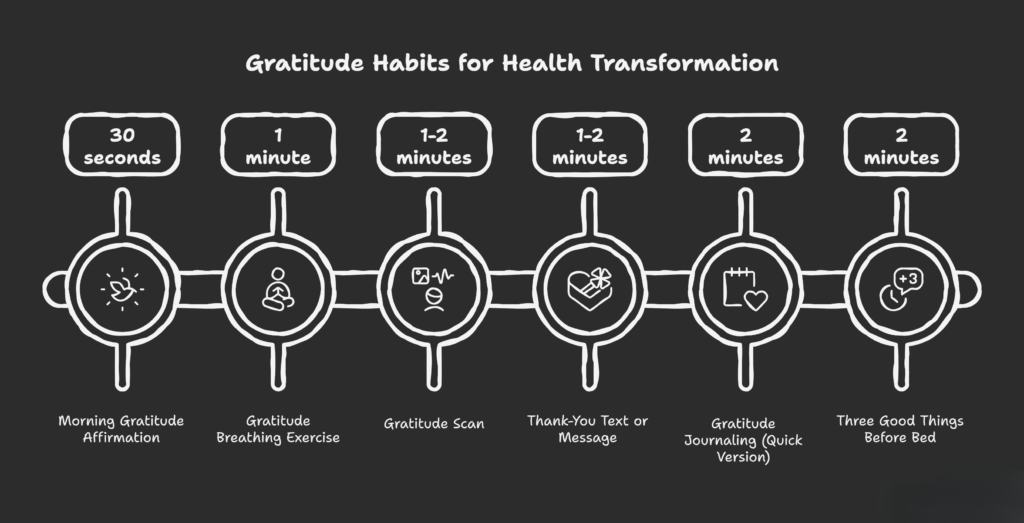
So, what are the simplest ways to practice gratitude when you’re short on time? Here are seven quick habits that take two minutes or less—and deliver real results.
1. Mental Gratitude Snapshot
This one’s as easy as it gets. Pause wherever you are, take a deep breath, and mentally list three things you’re grateful for right now. They don’t have to be big—maybe it’s the warmth of your coffee, a kind text from a friend, or the fact that your car started this morning.
The beauty of this practice is that it requires zero tools. You can do it while standing in line, sitting at a red light, or waiting for a meeting to start. Research suggests that simply bringing attention to gratitude without writing it down still activates positive emotions and helps anchor you in the present moment.
2. Three Good Things Before Bed
This is one of the most popular gratitude exercises, and for good reason. At the end of your day, write down three good things that happened and reflect on why they happened.
The Greater Good Science Center at UC Berkeley explains that this practice teaches you to notice, remember, and savor the better things in life. It tunes you into the sources of goodness around you and can change the emotional tone of your day. You might find it tough at first, but by day four or five, your brain starts recognizing positive moments more easily.
For maximum impact, stick with it for at least four weeks. You’ll notice a shift not just in your mood, but in how you approach challenges.
3. Gratitude Breathing Exercise
Combine gratitude with deep breathing for a double dose of calm. Try the 4-4-4 technique: breathe in for four seconds, hold for four, and exhale for four. As you exhale, smile and say to yourself, “I am grateful to be here in this moment.”
This simple practice brings you into the present and pairs physical relaxation with emotional gratitude. It’s perfect for moments when stress is creeping in—whether that’s before a presentation, after a tense conversation, or when you’re feeling overwhelmed.
4. Gratitude Scan
This is a quick mindfulness exercise you can do anywhere. Start by looking around your environment and focusing on something, then say to yourself, “For this, I am grateful.” Next, think of people you love and repeat the phrase. Then bring attention to yourself—your body, your mind, your strengths—and say it again. Finally, think about the gift of life itself and all the opportunities it offers, and say, “For this, I am grateful.”
The whole process takes less than two minutes, and it shifts your focus from whatever’s stressing you out to what’s actually going well.
5. Thank-You Text or Message
Gratitude doesn’t have to be a solo activity. Pick one person each day and send them a quick thank-you message. It could be a coworker who helped you out, a friend who made you laugh, or a family member who’s always there for you.
Dr. Sara Algoe, an associate professor of psychology and neuroscience at the University of North Carolina at Chapel Hill, specializes in the science of gratitude and relationships. Her research shows that expressing gratitude to someone in front of others creates a “witnessing effect” that enhances relationships not just between the two people involved, but also among everyone who sees or hears it. Even a simple text can strengthen your connection and boost both your moods.
6. Gratitude Journaling (Quick Version)
If traditional journaling feels like a commitment, try a stripped-down version. Keep a small notebook or use your phone’s notes app, and jot down just one or two sentences about something you appreciated today. That’s it.
Research led by Emmons and McCullough found that weekly gratitude journaling improved well-being, optimism, and even physical health. More recent studies show that gratitude journaling is linked to reduced perceived stress and fewer depressive symptoms.
You don’t need perfect prose or deep reflections. Even a quick “grateful for my dog’s goofy energy today” counts.
7. Morning Gratitude Affirmation
Start your day with a single gratitude statement. Before you even get out of bed, think of one thing you’re looking forward to or one thing you already have that you appreciate. Say it out loud or silently: “I’m grateful for another day to try my best,” or “I’m thankful for my cozy bed and a roof over my head.”
This tiny habit sets a positive tone for the rest of your day. It takes 30 seconds, and it reminds you that even on tough mornings, there’s something worth appreciating.
Comparing Different Gratitude Practices
Not all gratitude habits work the same way for everyone. Some people love journaling, while others prefer mental exercises or social expressions of thanks. Here’s a quick breakdown of how different practices stack up:
Gratitude Practices Overview
This table presents different gratitude exercises with their time requirements, tools needed, and key benefits. Use the filters below to find practices that match your available time or needs.
| Practice | Time Required | Tools Needed | Best For | Key Benefit |
|---|---|---|---|---|
| Mental Snapshot | 30 seconds | None | Instant mood boost, no prep | |
| Three Good Things | 2 minutes | Notebook or phone | Builds long-term optimism | |
| Gratitude Breathing | 1 minute | None | Combines calm with gratitude | |
| Gratitude Scan | 1-2 minutes | None | Anchors you in the now | |
| Thank-You Message | 1-2 minutes | Phone or email | Strengthens bonds, spreads positivity | |
| Journaling (Quick) | 2 minutes | Notebook or app | Tracks progress, enhances self-awareness | |
| Morning Affirmation | 30 seconds | None | Sets an optimistic tone for the day |
Each of these practices has been shown to improve mental and physical health when done consistently. The key is picking one or two that feel natural to you and sticking with them.
What the Research Says About Quick Gratitude Practices
You might be wondering: Can something so simple really work? The answer is yes—if you’re consistent. A meta-analysis of 70 studies involving more than 26,000 people found an association between higher levels of gratitude and lower levels of depression.
Another systematic review and meta-analysis showed that people who underwent gratitude interventions experienced 5.8% better mental health, 6.86% higher life satisfaction, and 7.76% lower anxiety symptoms compared to control groups. They also reported more positive moods, greater optimism, and less worry.
Dr. Jo-Ann Tsang, an associate professor of psychology and neuroscience at Baylor University, has spent years studying gratitude and its effects on well-being. Her work, along with colleagues like Dr. Robert Emmons, emphasizes that gratitude isn’t just a feel-good concept—it’s a tool for resilience and health.
Even brief gratitude writing interventions have been shown to help. A 2022 study published in Frontiers in Psychology found that gratitude writing decreased stress and negative affect more effectively than traditional expressive writing, especially under extremely stressful conditions.
Making Gratitude a Habit (Without Overthinking It)
The hardest part about starting any new habit is remembering to do it. Here are a few tips to help gratitude stick:
- Anchor it to something you already do. Pair your gratitude practice with brushing your teeth, making coffee, or getting into bed. When it’s tied to an existing routine, you’re more likely to remember it.
- Keep it simple. You don’t need fancy journals or apps. A scrap of paper, your phone’s notes, or even just a mental check-in works perfectly.
- Be flexible. If journaling feels like a chore, try a mental snapshot instead. If talking to yourself feels weird, send a quick thank-you text. There’s no single “right” way to practice gratitude.
- Track your progress. Notice how you feel after a week, then after a month. Small shifts in mood, sleep, or stress levels are signs that it’s working.
- Don’t beat yourself up for missing a day. Life happens. If you skip a day, just pick it back up the next. Consistency matters more than perfection.
The Ripple Effect of Gratitude
Here’s something cool: gratitude doesn’t just help you—it affects the people around you, too. When you express thanks to someone, they feel appreciated and more connected to you. If others witness that exchange, it creates a positive ripple effect that can strengthen group bonds in families, workplaces, and social circles.
Sara Algoe’s research on the “find-remind-and-bind” theory of gratitude suggests that the emotional response of gratitude helps us identify high-quality relationship partners and keep them interested in the relationship. In other words, gratitude isn’t just good for your health—it’s good for your connections.
So when you take two minutes to acknowledge what you’re thankful for, you’re not just improving your own well-being. You’re contributing to a more positive environment for everyone around you.
Your Two-Minute Challenge
If you’ve made it this far, you’re already halfway to starting a gratitude habit. The science is clear: small, consistent practices can lead to big changes in how you feel, how your body responds to stress, and how you relate to others.
Pick one of the seven habits above—just one—and try it for the next week. Set a reminder on your phone if you need to. Write it on a sticky note. Tell a friend so they can check in on you. Whatever it takes to make it happen.
Two minutes a day. That’s all it takes to start rewiring your brain, calming your heart, and building a healthier, happier life. And who knows? You might find yourself looking forward to those two minutes more than you ever expected.
This article is part of our 5 Powerful Small Daily Habits That Transform Your Life pillar guide, where we explore simple, realistic habits that compound over time to improve energy, focus, and overall well-being.
My Experience & Insights
While researching gratitude habits for this article, I kept noticing a gap in how people approach these practices. Most resources tell you what to do—journal, list three things, practice mindfulness—but they don’t help you figure out which practice fits your life right now. I came across a fascinating study from Brigham Young University that compared traditional gratitude journaling to a personalized menu-based approach, and the results were eye-opening. The group that got to choose from multiple gratitude exercises showed significantly better outcomes in both gratitude levels and subjective well-being compared to those who only journaled.
That got me thinking: what if someone’s having a rough morning and doesn’t have the mental energy to write? What if they’re stuck in traffic and can’t pull out a notebook? Different moments call for different practices, and research increasingly shows that gratitude interventions work best when they’re optimized for individual preferences and circumstances.
So I built a simple tool called the Gratitude Practice Picker. It’s designed to match you with the perfect 2-minute gratitude exercise based on three things: your current mood, how much time you actually have, and what format feels doable right now (mental exercise, writing, or social interaction). You answer a few quick questions, and it recommends one of the seven practices from this article—complete with a built-in timer so you don’t have to think about it.
Here’s why I made it this way: A 2025 study on mobile gratitude apps found that when people received daily prompts and personalized gratitude exercises through an app, they showed meaningful improvements in anxiety, depression, and stress levels over just three weeks. The key wasn’t just doing gratitude—it was doing the right type of gratitude practice at the right time.
I’ve also noticed that many people give up on gratitude habits because they think there’s only one “correct” way to do it. If journaling feels like homework, they assume gratitude isn’t for them. But research from experts like Dr. Robert Emmons shows that gratitude is flexible—there’s no single method that works for everyone. Some people thrive with written reflection. Others prefer mental snapshots or sending thank-you texts. The important part is consistency, not perfection.
One thing that surprised me during my research was how quickly gratitude can shift your nervous system. I came across a systematic review showing that even brief gratitude interventions led to 7.76% lower anxiety symptoms and 5.8% better mental health scores compared to control groups. That’s not a small difference—especially when you consider these were practices people did for just a few minutes a day.
The Gratitude Practice Picker isn’t meant to replace human judgment or professional support—it’s just a practical starting point. If you’re feeling overwhelmed and don’t know where to begin, it takes the guesswork out. And because it’s research-based (not clinical), it uses the same evidence-backed techniques discussed in this article, but presents them in a way that feels approachable and judgment-free.
I’ve personally tested all seven practices in different scenarios—morning routines, stressful work moments, before bed—and I can tell you that matching the practice to the moment makes all the difference. When I’m rushing in the morning, a 30-second mental snapshot works better than pulling out a journal. When I’m winding down at night, writing three good things helps me process the day. The tool just helps you find that match faster.
If you’re curious to try it out, the Gratitude Practice Picker is free and takes less than a minute to use. It’s designed for busy people who want the benefits of gratitude without adding another complicated task to their day. And if you find a practice that resonates, you can stick with it—or mix it up based on what each day brings.
Find Your Perfect Gratitude Practice
Answer 3 quick questions to get a personalized 2-minute gratitude exercise
1. How are you feeling right now?
Frequently Asked Questions
How long does it take to see results from gratitude practices?
You can start feeling immediate mood improvements after just one gratitude session, but lasting changes typically appear within 2-4 weeks of consistent practice. Research from UC Davis shows that practicing gratitude for 15 minutes a day, five days a week, for six weeks creates meaningful mental wellness improvements. However, even shorter 2-minute practices done daily can produce noticeable changes in your stress levels and outlook within the first week. The key is consistency rather than duration—doing a little bit every day beats doing a lot once in a while.
What's the best time of day to practice gratitude?
The best time is whenever you'll actually do it consistently. That said, research suggests two optimal windows: first thing in the morning to set a positive tone for your day, or right before bed to help you reflect and sleep better. Studies show that evening gratitude practices improve sleep quality and reduce nighttime worry. Morning practices tend to boost mood and resilience throughout the day. If you're extremely busy, try anchoring your gratitude habit to something you already do daily—like drinking your morning coffee or brushing your teeth at night.
Do I have to write in a gratitude journal, or can I just think grateful thoughts?
Both methods work, but they offer different benefits. Research indicates that writing in a gratitude journal produces stronger effects on blood pressure and overall well-being compared to mental gratitude alone. However, mental gratitude practices (like the gratitude snapshot or breathing exercises) still activate positive emotions and reduce stress—they're just processed differently in your brain. If journaling feels like a chore, start with mental practices and add writing later. The most important factor is consistency, so choose the format you'll actually stick with long-term.
Can gratitude practices really improve physical health, or is it just mental?
Gratitude genuinely affects your physical health through measurable biological changes. Scientific studies show that regular gratitude practice lowers blood pressure, reduces inflammation markers, improves heart rate variability, and strengthens immune function. A 2024 JAMA Psychiatry study found that people with the highest gratitude levels had a 9% lower risk of death over four years. This happens because gratitude shifts your nervous system out of stress mode, which affects everything from your heart rhythm to your inflammatory response. It's not magic—it's your biology responding to reduced stress and increased positive emotions.
What if I can't think of anything to be grateful for on a bad day?
This is completely normal, especially during difficult times. On tough days, shift to micro-gratitudes—tiny, almost mundane things like "my bed was comfortable," "I had clean water to drink," or "my body got me through today." You can also practice gratitude for challenges that helped you grow, or for people who supported you during hard times. Dr. Robert Emmons suggests that gratitude doesn't mean ignoring difficulties—it means finding small lights even in dark moments. If nothing comes to mind, simply acknowledging "I'm grateful I'm trying to find gratitude right now" counts. The practice is about training your attention, not forcing fake positivity.
How is gratitude different from toxic positivity?
Gratitude acknowledges reality while choosing to notice good alongside bad, whereas toxic positivity denies or dismisses genuine struggles. Research shows that effective gratitude practice doesn't require you to ignore pain, trauma, or legitimate problems. You can feel grateful for your support system while also feeling sad about a loss. You can appreciate small moments while acknowledging systemic challenges. Healthy gratitude creates space for all emotions—it doesn't replace grief, anger, or frustration with forced cheerfulness. If your gratitude practice makes you feel guilty for negative emotions, you've crossed into toxic positivity territory. Real gratitude expands your emotional range rather than limiting it.
💊 Do not rely solely on online content for diagnosis or treatment.
📜 Information here is provided “as is” without any warranties.