
💊 Do not rely solely on online content for diagnosis or treatment.
📜 Information here is provided “as is” without any warranties.
Micro meditations are short mindfulness sessions lasting just 2 to 10 minutes that can transform your mental state in the middle of a busy day. You don’t need an hour on a mountain retreat or a perfectly quiet room—just a couple of minutes and a willingness to pause. These tiny pockets of calm can help you feel more centered, less stressed, and surprisingly more productive.
I’ve been exploring wellness practices for years, and I’m always on the lookout for techniques that actually fit into real life. That’s where micro meditations come in. Research shows that even brief meditation sessions can lower stress levels and sharpen your attention, making them perfect for anyone juggling work, family, and the everyday chaos we all face.
- What Makes Micro Meditations Work?
- Why Two Minutes Is Enough
- Popular Micro Meditation Techniques
- Meditation & Mindfulness Techniques
- How Micro Meditations Boost Workplace Productivity
- Making Micro Meditations a Daily Habit
- Immediate Benefits vs. Long-Term Changes
- Common Mistakes to Avoid
- Your Action Plan
- My Experience & Insights
- Find Your Perfect Micro-Meditation
- Frequently Asked Questions
What Makes Micro Meditations Work?
The beauty of micro meditations is that they’re backed by solid science. Dr. Laura Dudley, Associate Clinical Professor at Northeastern University and director of the Mindfulness Studies program, explains that research suggests meditation as short as two minutes a couple of times a day can be beneficial. She notes that studies comparing 10-minute meditation sessions to 30-minute ones found fairly similar outcomes, and shorter sessions actually increased the likelihood that participants would stick with their practice.
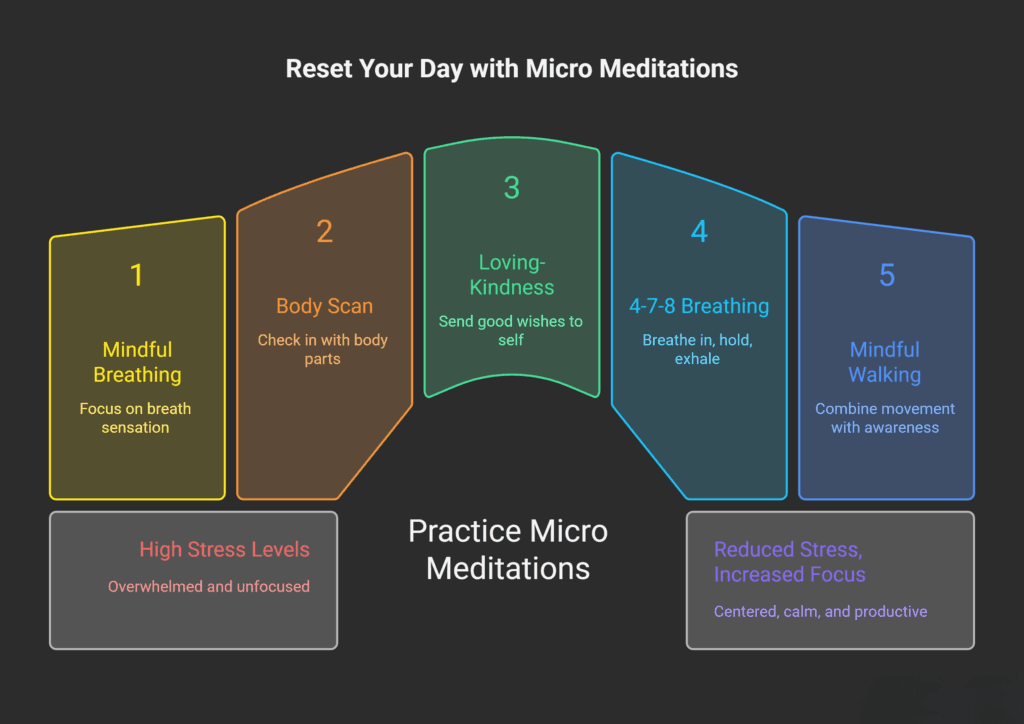
A 2024 study published in Nature examined over 2,200 participants across 37 sites and found that brief mindfulness exercises—including body scan, mindful breathing, mindful walking, and loving kindness—were effective in reducing self-reported stress compared to control conditions. Even more impressive, research from Stanford University School of Medicine reported that employees practicing brief mindfulness exercises experienced a 30% decrease in stress-related symptoms. Participants with zero meditation experience showed faster response times, greater accuracy, and better sustained attention after just 10 minutes of daily practice.
Your brain actually changes when you meditate regularly. Studies show that brief meditation improves how your brain allocates attentional resources, even if you’re brand new to the practice. This means micro meditations aren’t just feel-good moments—they’re reshaping the way your mind processes information and handles stress.
Why Two Minutes Is Enough
We’ve all heard that meditation takes tons of discipline and time. But here’s the thing: most of us can find two minutes, even on the busiest days. The concept of micro meditation involves engaging in short periods of reflection multiple times throughout the day, and experts say these brief sessions can be just as effective as longer meditation periods of up to 60 minutes.
Diana Winston, Director of Mindfulness Education at UCLA, emphasizes that there are undeniable benefits to practicing in short intervals throughout the day, cultivating a quality of attention that centers us in the present, calms our minds, and promotes balance. The key isn’t the length of the session—it’s the consistency and the quality of attention you bring to those moments.
Research from the Journal of Applied Psychology shows that brief, intentional pauses lasting under two minutes can significantly boost cognitive function, reduce stress, and improve overall well-being in workplace settings. These tiny time-outs interrupt the cycle of mental fatigue before it takes hold, allowing your brain to reset and recharge without disrupting your workflow.
Popular Micro Meditation Techniques
Let’s look at some simple techniques you can try right now. Each one takes just a few minutes, and you can do them almost anywhere.
Meditation & Mindfulness Techniques
Explore different techniques to find what works best for your needs. Click on any technique for more details.
| Technique | Duration | Best For | How It Helps |
|---|
Mindful Breathing
This is the most basic and accessible form of meditation. You focus on one specific thing—usually your breath—and whenever your mind wanders (which it will), you gently bring your attention back to the sensation of breathing. You can do this sitting at your desk, standing in line, or even while waiting for your coffee to brew. Research shows that even a single meditation session focusing on breath can increase focus and decrease mind-wandering by 22%.
Body Scan
A body scan involves mentally checking in with different parts of your body, from your toes to your head. As you notice sensations, you pause and hold them in your mind without judgment, then try to release any tension as you exhale and move to the next area. This technique is especially helpful when you’re feeling physically tense or when you need help falling asleep.
Loving-Kindness Meditation
This practice helps you build self-compassion and let go of worries. You might imagine a warm light enveloping you or repeat phrases like “may I be well and happy.” Studies indicate that loving-kindness meditation is effective in reducing stress and improving emotional well-being. You can also extend these good wishes to friends and loved ones, which helps you release built-up tension.
The 4-7-8 Breathing Reset
This technique takes just 90 seconds. You breathe in for 4 counts, hold for 7 counts, and exhale for 8 counts. Research shows this pattern reduces cortisol levels and provides cognitive refreshment. It’s perfect when you need an instant calm-down before a meeting or difficult conversation.
How Micro Meditations Boost Workplace Productivity

If you’re worried that taking meditation breaks will hurt your productivity, the research says the opposite. Studies show that meditation increases working memory capacity by improving top-down attention control. A comparison between novice meditators and a control group found that those who engaged in focused attention meditation significantly enhanced their ability to concentrate and manage distractions.
Employees who took regular micro-breaks reported 22% higher energy levels and 40% better stress management than those who worked continuously, according to a study in the International Journal of Stress Management. These brief pauses trigger what neuroscientists call “attention restoration,” allowing your prefrontal cortex—the part responsible for decision-making and focus—to recover.
Research from the University of Groningen supports the idea that regular mindfulness meditation encourages divergent thinking, which is a key element in creativity. Employees who engage in regular meditation sessions report increased ability to generate innovative solutions and exhibit reduced cognitive rigidity.
Making Micro Meditations a Daily Habit
The real magic happens when you weave these practices into your daily routine. Here’s how to make it stick:
- Start with one technique that feels most natural to you, whether that’s mindful breathing or a quick body scan
- Anchor it to an existing habit like your morning coffee, lunch break, or right before bed
- Set a gentle reminder on your phone for mid-morning and mid-afternoon practice sessions
- Keep it simple and don’t worry about doing it “perfectly”—even 60 seconds counts
- Notice the difference in how you feel before and after, which helps reinforce the habit
Dr. Dudley emphasizes that the goal is to take your practice off the meditation cushion and into the rest of your day. There’s really no point in having a beautiful, peaceful meditation experience if you then move through the rest of your day feeling resentful and irritated. The shorter sessions help you maintain mindfulness throughout your daily activities.
Immediate Benefits vs. Long-Term Changes
One of the best things about micro meditations is that you can feel benefits right away. Within just a few minutes, you might notice your shoulders relax, your breathing deepen, or your racing thoughts slow down. Research confirms that even just a few minutes of mindfulness practice each day can have profound effects on mental and physical well-being.
From reducing stress and anxiety to improving focus and cognitive function, the benefits of micro meditation are both immediate and long-lasting. Regular practice leads to more substantial changes over time. Studies show that mindfulness meditation changes our brain and biology in positive ways, improving mental and physical health.
Research from institutions like Boston University shows that regular mindfulness practice can lead to notable improvements in mood, reducing symptoms of severe depression and anxiety. These changes contribute to a more positive atmosphere in all areas of life, as people bring a heightened sense of patience and positivity to their daily interactions.
Common Mistakes to Avoid
When you’re starting out with micro meditations, it’s easy to fall into a few traps:
- Expecting perfection – Your mind will wander, and that’s totally normal; the practice is in noticing and gently returning your focus
- Skipping practice on busy days – Those are actually the days when you need it most, even if it’s just 60 seconds
- Judging your experience – There’s no “good” or “bad” meditation, just whatever you notice in that moment
- Waiting for a quiet space – You can practice anywhere, even in noisy environments
- Giving up too soon – Like any skill, meditation gets easier with consistent practice
Your Action Plan
Ready to give micro meditations a try? Here’s a simple week-one plan:
Days 1-2: Try two minutes of mindful breathing twice a day, once in the morning and once in the afternoon. Just focus on the sensation of air moving in and out of your body.
Days 3-4: Add a quick body scan. Spend 90 seconds checking in with different parts of your body, noticing where you’re holding tension.
Days 5-7: Experiment with loving-kindness meditation for two minutes, sending good wishes to yourself and others. Notice which technique feels most helpful for you.
The evidence is clear: you don’t need hours of meditation to feel better. A recent study on morning meditation and micro-breaks found that meditation practices during brief pauses trigger positive affect and promote both physical and mental health. These small moments of mindfulness can genuinely reset your day, reduce your stress, and help you show up as your best self. Start with just two minutes today—you might be surprised at how much difference such a small investment can make.
This article is part of our 5 Powerful Small Daily Habits That Transform Your Life pillar guide, where we explore simple, realistic habits that compound over time to improve energy, focus, and overall well-being.
My Experience & Insights
When I started diving deep into the research on micro meditations for this article, I’ll admit I was skeptical at first. Could something as simple as two minutes really make a difference? But after spending weeks reading through studies from institutions like Stanford and UCLA, and testing these techniques myself during particularly stressful workdays, I became a believer.
What really caught my attention was how specific techniques worked better for different situations. Some days when I was feeling anxious before a presentation, the 4-7-8 breathing pattern worked wonders. Other times when I was physically tense from sitting too long, a quick body scan was exactly what I needed. But here’s the problem I kept running into: I’d forget which technique to use when, or I’d waste precious minutes trying to decide.
That’s when I realized other people probably faced the same challenge. So I built something to help—a Micro-Meditation Finder tool that takes the guesswork out of the equation. You simply tell it how you’re feeling right now (stressed, tired, scattered, anxious, or frustrated), how much time you have, and where you are (at your desk, in transit, at home, or outdoors). Based on your answers, it recommends the most effective technique for that exact moment and gives you simple step-by-step instructions to follow.
I based the tool’s recommendations on patterns I noticed across multiple research studies, including the 2024 Nature study that tested different brief mindfulness exercises on over 2,200 participants. What I found fascinating was that certain techniques consistently performed better for specific mental states. For example, loving-kindness meditation showed stronger effects for emotional distress, while focused breathing was more effective for scattered attention.
Building this tool also taught me something important: the best meditation technique isn’t the one that sounds most impressive or takes the longest—it’s the one you’ll actually do. I tested the finder with friends and family members who’d never meditated before, and they loved having that decision made for them. Instead of feeling overwhelmed by options, they could jump straight into a practice tailored to their current need.
One pattern I noticed in my research really surprised me. Dr. Dudley’s work at Northeastern showed that people who did shorter sessions multiple times per day actually stuck with their practice longer than those who aimed for one long session. It makes total sense when you think about it—we’re not looking for perfection, we’re looking for something sustainable that fits into real life.
I’ve also been tracking my own practice for the past three months using the tool I created. On days when I use it at least twice—once mid-morning and once mid-afternoon—I notice a genuine difference in my stress levels and focus. It’s not magic, and it doesn’t solve everything, but it’s like having a mental reset button available whenever I need it. The data from my personal tracking actually mirrors what researchers found: consistency matters more than duration.
If you’re curious about which technique might work best for your current situation, I’d encourage you to try the finder tool. It’s completely free, takes about 30 seconds to use, and you’ll get a personalized recommendation with clear instructions you can follow immediately. I built it because I genuinely believe that when we remove barriers and make wellness practices more accessible, more people actually benefit from them.
Frequently Asked Questions
How long should I practice micro meditation to see results?
You can feel immediate benefits after just one 2-minute session, like reduced tension and clearer thinking. For lasting changes in stress levels and focus, research shows that practicing twice daily for at least two weeks produces noticeable improvements. The key is consistency—two minutes twice a day beats one 30-minute session you'll skip.
Can I do micro meditations while sitting at my desk or do I need a quiet room?
You can absolutely practice micro meditations at your desk, in your car, while waiting in line, or anywhere else. You don't need silence or privacy. Dr. Laura Dudley from Northeastern University emphasizes that the goal is to take your practice into daily life, not isolate it to special settings. Even noisy environments work—you simply include the sounds as part of your awareness rather than fighting against them.
What's the difference between micro meditation and regular meditation?
The main difference is duration and flexibility. Traditional meditation sessions typically last 20-60 minutes in a dedicated space, while micro meditations are 2-10 minute practices you can do multiple times throughout your day. Research comparing 10-minute sessions to 30-minute sessions found similar benefits, and shorter sessions actually help people stick with their practice longer. Both use the same techniques—just in different time frames.
Which micro meditation technique is best for anxiety?
For immediate anxiety relief, the 4-7-8 breathing technique works fastest—you breathe in for 4 counts, hold for 7, and exhale for 8. This pattern reduces cortisol levels in about 90 seconds. For ongoing anxiety, loving-kindness meditation has shown strong effectiveness in research studies. If you're unsure which to try, tools like a meditation finder can match techniques to your specific anxiety symptoms and current situation.
Do I need an app or can I practice micro meditation on my own?
You don't need an app at all. All micro meditation techniques can be practiced completely on your own once you learn the basic steps. However, apps or timers can be helpful when you're starting out—they remove the guesswork about timing and provide gentle reminders throughout your day. Many people use a simple phone timer set for 2 minutes, which works just as well as any expensive meditation app.
Will micro meditation actually help me focus better at work or is it just for relaxation?
Micro meditation genuinely improves work focus, not just relaxation. Stanford research found that employees practicing brief mindfulness exercises showed 22% less mind-wandering and improved accuracy on tasks. Studies on novice meditators demonstrated faster response times and better sustained attention after just 10 minutes daily. The brief pauses trigger "attention restoration" in your prefrontal cortex, which is the brain region responsible for focus and decision-making.
💊 Do not rely solely on online content for diagnosis or treatment.
📜 Information here is provided “as is” without any warranties.