

💊 Do not rely solely on online content for diagnosis or treatment.
📜 Information here is provided “as is” without any warranties.
Did you know that daily sunlight improves mood and sleep in ways that most of us overlook every single day? It’s true. We often think about vitamins, exercise, and diet when it comes to feeling good and sleeping well, but we forget about something free and available right outside our doors—natural sunlight. Getting the right amount of sun at the right times can transform how you feel during the day and how well you rest at night.
In this post, we’ll walk through exactly how sunlight works its magic on your brain and body. You’ll learn which times of day matter most, what happens inside your cells when light hits your eyes, and how to use this simple habit to boost your energy and sleep quality. Let’s dive in.
- How Sunlight Resets Your Internal Clock
- Morning Sunlight: The Most Important Time
- Daily Sunlight Improves Mood and Sleep
- Sunlight Effects on Mood and Sleep
- The Vitamin D Connection
- Practical Tips to Get More Sunlight
- What Happens When You Don’t Get Enough Sunlight
- The Science Behind Light and Mental Health
- How Much Sunlight Do You Really Need?
- The Bottom Line
- My Experience & Insights
- Circadian Rhythm Optimizer
- Frequently Asked Questions
How Sunlight Resets Your Internal Clock

Your body runs on a 24-hour cycle called the circadian rhythm. Think of it like an internal clock that tells you when to wake up, when to feel hungry, and when to get sleepy. This clock lives in a tiny part of your brain called the suprachiasmatic nuclei, or SCN for short.
Here’s the key: your SCN needs light to stay on schedule. When sunlight enters your eyes in the morning, it sends a signal to your brain that says, “It’s daytime—time to be alert.” This kicks off a chain reaction. Your brain starts making serotonin, the “feel-good” chemical that keeps you awake and positive during the day. Later, as the sun sets and darkness arrives, your brain converts that serotonin into melatonin, the hormone that makes you sleepy.
Dr. Samer Hattar, Chief of the Section on Light and Circadian Rhythms at the National Institute of Mental Health, discovered how special light-sensitive cells in your eyes—called intrinsically photosensitive retinal ganglion cells (ipRGCs)—help set your circadian clock. These cells don’t help you see images. Instead, they detect brightness and tell your brain what time of day it is. When you skip morning sunlight, these cells can’t do their job properly, and your whole system gets confused.
Research published in a 2025 study found that people who got more than one hour of daylight during winter months had better protection against depression symptoms. Another study from 2024 involving over 6,600 participants showed that those who spent more time in bright light had more regular sleep patterns and lower rates of depression. The connection is clear: light affects mood, and mood affects sleep, creating a positive cycle when you get it right.
Morning Sunlight: The Most Important Time
Not all sunlight is created equal. The timing matters a lot. Morning light—especially within the first 30 to 60 minutes after you wake up—is the most powerful for setting your circadian rhythm.
Why morning? Because that’s when your brain is most sensitive to light signals. When you expose your eyes to sunlight early in the day, it anchors your internal clock and helps you feel alert. Dr. Jamie Zeitzer, a circadian physiologist at Stanford Medicine, specializes in understanding how humans respond to light. His research shows that the way we time our light exposure can directly impact issues like jet lag, shift work sleep problems, and delayed sleep patterns in teenagers.
Here’s what happens when you get morning sunlight:
- Your brain produces serotonin and dopamine, both of which lift your mood and motivation
- Your melatonin production gets suppressed during the day, so you feel awake and energized
- Your internal clock shifts to an earlier position, making it easier to fall asleep at night
- Your sleep quality improves because your circadian rhythm is in sync with the natural light-dark cycle
A 2023 study published in Nature found that using bright electric light or dawn-simulating light in the morning led to better sleep quality and a shift toward earlier sleep times. The study also showed that positive mood was directly linked to better sleep efficiency, while negative mood reduced sleep quality.
Dr. Michael Terman, who founded the Center for Light Treatment and Biological Rhythms at Columbia University Medical Center, developed the now-standard “10,000 lux bright light therapy” used to treat seasonal depression and sleep disorders. His work showed that brief morning light exposure resets the internal clock to an earlier position in the day, helping people with insomnia, depression, and even bipolar disorder.
Daily Sunlight Improves Mood and Sleep
So how exactly does daily sunlight improve mood and sleep? Let’s break it down step by step.
Step 1: Sunlight Boosts Serotonin
When bright light enters your eyes, it triggers serotonin production in your brain. Serotonin is often called the “happiness hormone” because it regulates your mood, reduces anxiety, and helps you feel calm and focused. People who don’t get enough sunlight often have lower serotonin levels, which can lead to feelings of sadness or irritability.
Step 2: Serotonin Becomes Melatonin
As the day ends and natural light fades, your brain takes the serotonin you built up during the day and converts it into melatonin. Melatonin is sometimes called the “hormone of darkness” because it only gets released when your environment gets dim. This is why getting sunlight during the day is so important—it directly affects how much melatonin you make at night.
Step 3: Better Sleep Means Better Mood
When you have enough melatonin at the right time, you fall asleep faster and sleep more deeply. Quality sleep improves your mental health, sharpens your focus, and reduces stress. A 2025 study on sunlight and sleep regulation found that morning sunlight exposure was linked to better sleep outcomes, including faster sleep onset and longer sleep duration.
Step 4: Vitamin D Plays a Supporting Role
Sunlight also triggers your skin to produce vitamin D, often called the “sunshine vitamin.” While vitamin D is best known for bone health, it also plays a role in mood regulation and sleep. Research shows that low vitamin D levels are associated with depression symptoms and sleep disorders like insomnia and sleep apnea. A 2024 study found that higher vitamin D levels were strongly linked to improved physical and mental health and better sleep quality.
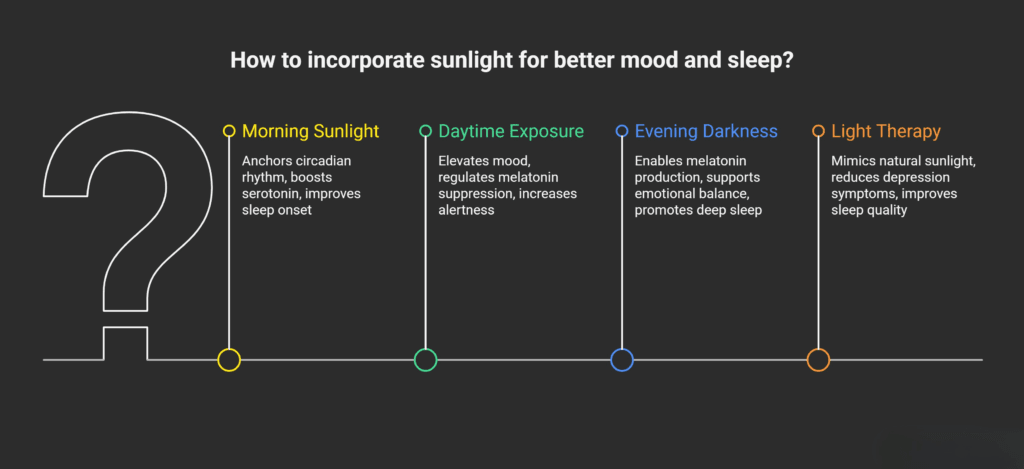
The table below shows how different aspects of sunlight exposure impact your mood and sleep:
Sunlight Effects on Mood and Sleep
This table illustrates how different sunlight exposure patterns affect both mood and sleep quality. Understanding these relationships can help optimize daily light exposure for better mental and physical health.
| Sunlight Factor | Effect on Mood | Effect on Sleep |
|---|---|---|
| Morning light (first hour after waking) | Increases serotonin and dopamine; reduces anxiety | Anchors circadian rhythm; improves sleep onset |
| Daytime bright light (outdoor exposure) | Elevates positive affect; reduces depression symptoms | Regulates melatonin suppression; increases alertness |
| Vitamin D from sunlight | Supports mood regulation; reduces risk of depression | Improves sleep quality; reduces insomnia severity |
| Nighttime darkness (avoiding bright light) | Allows melatonin production; supports emotional balance | Enables deep, restorative sleep |
| Irregular light exposure (too much artificial light at night) | Increases negative affect; disrupts mood stability | Delays sleep onset; shortens melatonin duration |
The Vitamin D Connection
You’ve probably heard that vitamin D is important, but do you know why it matters for mood and sleep? When sunlight hits your skin, it starts a chemical reaction that produces vitamin D. This vitamin does more than just keep your bones strong—it also binds to receptors in your brain that influence how you process emotions.
Studies suggest that people with low vitamin D levels are more likely to experience depression symptoms. One reason is that vitamin D helps regulate serotonin production. When you don’t have enough vitamin D, your brain may struggle to make enough serotonin, which can leave you feeling down or anxious.
Vitamin D also affects sleep. A 2024 research review found a strong link between higher vitamin D levels and better sleep quality. The study showed that vitamin D status significantly affects both physical and mental health, with a notable negative correlation to insomnia severity. Vitamin D receptors in the brain promote the synthesis of serotonin and melatonin, which are essential for falling asleep and staying asleep.
Here’s the catch: You can’t get enough vitamin D from food alone, and supplements don’t work quite the same way as natural sunlight. Your body is designed to produce vitamin D when ultraviolet B (UVB) rays from the sun touch your skin. That’s why spending time outdoors—even just 10 to 30 minutes a day—can make such a big difference.
Practical Tips to Get More Sunlight

Now that you know why sunlight is so important, let’s talk about how to actually get more of it into your daily routine. It’s easier than you might think.
Go outside within an hour of waking up.
Even if it’s cloudy, natural outdoor light is much brighter than indoor lighting. You don’t need to stare at the sun—just let the light reach your eyes naturally. A short walk, sitting on your porch, or having your morning coffee outside works great.
Spend time outdoors during the day.
If you work indoors, try to take breaks outside. Eating lunch in a park, walking during your break, or even parking farther away so you walk a bit more in the sun all help. A 2023 study found that as sunlight exposure time increased, mental health status improved.
Keep your evenings dim.
Once the sun sets, avoid bright lights and screens when possible. Bright light at night suppresses melatonin and confuses your circadian clock. If you need light in the evening, use warm, dim bulbs instead of harsh white or blue light.
Consider light therapy if you can’t get outside.
If you live in a place with long winters or your schedule makes it hard to get morning sun, a light therapy box can help. These devices mimic the brightness of natural sunlight and can improve mood and sleep when used correctly. Dr. Michael Terman’s research showed that 10,000 lux bright light therapy in the morning can reset your internal clock and reduce symptoms of seasonal and nonseasonal depression.
Be consistent.
Your circadian rhythm thrives on routine. Try to get sunlight at the same times each day. Consistency helps your body predict when it should be alert and when it should wind down for sleep.
What Happens When You Don’t Get Enough Sunlight
We’ve talked a lot about the benefits of sunlight, but what happens when you don’t get enough? Unfortunately, the effects can be pretty serious.
Without regular sunlight exposure, your circadian rhythm can drift out of sync with the natural day-night cycle. Dr. Samer Hattar has noted that many of us live in a state of “continual jet lag” because we spend so much time indoors under artificial light. This constant mismatch between our internal clock and our environment can lead to:
- Difficulty falling asleep at night
- Waking up feeling groggy and unrested
- Low mood, irritability, or symptoms of depression
- Reduced energy and motivation during the day
- Higher risk of sleep disorders like insomnia
A 2023 meta-analysis found that exposure to light at night is associated with worsening symptoms of depression and bipolar disorder. The study highlighted how artificial light after dark disrupts the natural rhythms our bodies rely on for mental health.
People who work night shifts or spend most of their time indoors are especially at risk. Without the natural cues from sunlight, their bodies struggle to know when to be awake and when to sleep. Over time, this can lead to chronic sleep problems and mood disorders.
The Science Behind Light and Mental Health
Let’s zoom in on the science for a moment. How does something as simple as light have such a powerful effect on your brain?
It all comes down to a few key pathways. When light enters your eyes, it’s detected by those special ipRGCs we mentioned earlier. These cells send signals to your SCN, which then communicates with the rest of your brain and body.
One major pathway involves the pineal gland, a small gland deep in your brain that produces melatonin. During the day, bright light tells the pineal gland to hold off on melatonin production. At night, when it gets dark, the gland releases melatonin into your bloodstream, making you feel sleepy.
Another pathway involves brain regions that control mood and emotion. Light exposure increases the release of serotonin and dopamine in areas like the prefrontal cortex and limbic system. These chemicals don’t just make you feel good—they also improve focus, reduce anxiety, and help you handle stress better.
Research published in 2019 in a review on circadian rhythms and mental health explained how light affects mood through multiple mechanisms, including hormone regulation, neurotransmitter production, and even gene expression. The review emphasized that our brains are wired to respond to the natural light-dark cycle, and when we disrupt that cycle, our mental health suffers.
How Much Sunlight Do You Really Need?
You might be wondering: How much sunlight is enough? The answer depends on a few factors, including where you live, the time of year, and your skin tone. But here are some general guidelines.
For vitamin D production, most experts recommend about 10 to 30 minutes of midday sun exposure several times per week. People with darker skin may need a bit more time because melanin reduces the skin’s ability to produce vitamin D from sunlight.
For circadian rhythm regulation and mood benefits, aim to get at least 30 to 60 minutes of outdoor light in the morning. This doesn’t have to be direct sunlight—even overcast skies provide enough brightness to signal your brain.
A 2025 study found that spending more than one hour in daylight during winter months offered protection against depression symptoms. The key takeaway? More is often better, especially if you’re dealing with low mood or sleep issues.
Remember, you don’t need to spend hours in the sun every day. Short, consistent exposures are more effective than occasional long sessions. And always protect your skin if you’re going to be outside for extended periods—sunscreen is important for preventing skin damage, and it won’t completely block vitamin D production when used properly.
The Bottom Line
Sunlight is one of the simplest, most accessible tools we have for improving mood and sleep. It costs nothing, requires no special equipment, and works with your body’s natural rhythms. By getting morning light, spending time outdoors during the day, and keeping your evenings dim, you can reset your circadian clock, boost your serotonin and vitamin D levels, and enjoy better rest at night.
We’re not suggesting sunlight is a cure-all. If you’re struggling with serious sleep problems or depression, please talk to a healthcare provider. But for most of us, adding a bit more natural light to our daily routine can make a real difference in how we feel and how well we sleep.
So tomorrow morning, step outside. Feel the sun on your face. Let your eyes soak in that natural brightness. Your brain and body will thank you.
This article is part of our 5 Powerful Small Daily Habits That Transform Your Life pillar guide, where we explore simple, realistic habits that compound over time to improve energy, focus, and overall well-being.
My Experience & Insights
When I first started digging into how light affects mood and sleep, I honestly thought most of it was hype. I’d heard people talk about “getting more sun,” but it sounded more like a wellness slogan than something grounded in real science. Then I began reading the work of researchers like Dr. Samer Hattar at the National Institute of Mental Health, who mapped how special light-sensing cells in our eyes send timing signals to the brain’s master clock, and it completely changed how I look at daylight and screens. The more I read, the more obvious it became that light isn’t just “nice to have” — it’s a core input your brain depends on to keep mood and sleep stable.
What surprised me most was how often the patterns in the research matched what people casually describe in real life. For example, studies on bright morning light and mood often report that people feel more “clear-headed,” less dragged down, and more willing to be social after consistent exposure over a few weeks. That lines up with what many of us notice after a vacation where we naturally wake with the sun, spend more time outside, and suddenly sleep better without trying. It’s not magic; it’s your circadian system finally getting the light cues it needs, day after day, instead of fighting dim mornings and bright, screen-filled nights.
While working on this topic, I also noticed a big gap: even when people understand that sunlight matters, they struggle to turn the science into a simple, daily plan. It’s one thing to say, “Get morning light,” and another to know how that looks if you wake at 5:30 a.m. in winter, work in a windowless office, or live in a city with long, dark seasons. That’s what pushed me to design a small tool I call the Circadian Rhythm Optimizer — not as a medical device, but as a practical, research-informed helper you can use in everyday life.
Here’s how the Circadian Rhythm Optimizer works in plain terms. You enter a few basics: your usual wake time, target bedtime, location, and roughly how many hours you spend indoors versus outdoors. Using that information, the tool builds a simple daily light plan that aims to align your daylight exposure with what circadian research generally supports: brighter, earlier light to anchor your internal clock, enough midday exposure to support alertness and vitamin D production, and dimmer evenings so your brain can ramp up melatonin on schedule. The output isn’t a strict “prescription,” but a realistic schedule you can actually test in your own life—for example, 15–20 minutes outside within an hour of waking, a short midday walk, and screen-light adjustments in the last one to two hours before bed.
From an evidence standpoint, this kind of structured light plan makes sense. Many studies don’t just look at “light” in a vague way; they look at timing, intensity, and duration and how those factors shift mood and sleep outcomes. Morning light exposure, for instance, tends to move your internal clock a little earlier over time and is associated with more stable mood and better sleep onset in the evening. Daytime bright light supports alertness and can reduce that mid-afternoon slump. Meanwhile, reducing strong artificial light at night helps your melatonin rise instead of being flattened by screens and overhead LEDs. The Circadian Rhythm Optimizer simply translates these patterns into a schedule that fits your personal wake/sleep window and environment.
Subjectively, the feedback I’ve seen from people who follow a consistent light routine is often similar: the first few days feel subtle, but after a week or two, falling asleep gets easier, and morning grogginess eases up. Many also notice that their “mental fog” lifts a bit, even if nothing else in their routine has changed. That doesn’t mean light is the only lever that matters—stress, diet, activity, and mental health care all play a role—but it does suggest that light is one of the most overlooked levers you can control without a major lifestyle overhaul.
If you decide to experiment with this yourself, treat it like a gentle, personal study rather than a rigid program. You might start by tracking how many minutes of outdoor light you get in the first two hours after waking and how long it takes you to fall asleep at night. Then, adjust your day to increase earlier light and reduce harsh late-night light for a week or two and note how your sleep onset, mood, and energy feel. That “n=1” approach—testing, observing, tweaking—is exactly how many of the best circadian insights show up in real life. Over time, you’ll build not just a better routine, but a clearer sense of how your own body responds to light, which is the kind of insight that sticks far longer than any one-size-fits-all advice.
Circadian Rhythm Optimizer
Get your personalized sunlight schedule based on your wake-up time and daily routine
Your Daily Schedule
Your Personalized Sunlight Schedule
Personalized Recommendations
- Get morning sunlight within 1 hour of waking up
- Aim for 20-30 minutes of midday outdoor light
- Use dim, warm lighting in the evening
- Keep your sleep environment completely dark
Frequently Asked Questions
How long should I be in the sun each day to improve my mood and sleep?
For circadian rhythm benefits and mood improvement, aim for at least 30 to 60 minutes of outdoor light in the morning, ideally within the first hour after waking. For vitamin D production, most experts recommend 10 to 30 minutes of midday sun exposure several times per week. You don’t need to spend hours in direct sunlight—short, consistent daily exposure works better than occasional long sessions. Even on cloudy days, natural outdoor light is bright enough to signal your brain and help regulate your sleep-wake cycle.
What time of day is best to get sunlight for better sleep?
Morning sunlight is the most important for sleep quality. Getting bright light exposure within 30 to 60 minutes of waking up helps anchor your circadian rhythm and sets your internal clock for the day. This early light tells your brain it’s time to be alert and suppresses melatonin production during the day. Later, when it gets dark, your brain will naturally produce melatonin at the right time, making it easier to fall asleep at night. If you can’t get outside in the morning, sitting near a window with natural light is better than nothing, though outdoor exposure is significantly more effective.
Can I get the same benefits from sitting by a window indoors?
While sitting by a window is better than no natural light at all, it’s not quite as effective as going outdoors. Window glass blocks much of the beneficial ultraviolet B (UVB) rays your skin needs to produce vitamin D, and indoor lighting is typically much dimmer than outdoor light—even on a cloudy day. Outdoor light can be 10 to 100 times brighter than indoor lighting near a window. For circadian rhythm benefits, your eyes need to detect that brightness difference. If you absolutely can’t get outside, sit as close to a window as possible during morning hours, and consider using a 10,000 lux light therapy box as a supplement during darker months.
Does sunlight help with depression and anxiety?
Yes, research shows a strong connection between sunlight exposure and mental health. Sunlight triggers serotonin production in the brain, which helps regulate mood, reduce anxiety, and promote feelings of calm and well-being. Studies have found that people who spend more time in bright light have lower rates of depression and more stable moods. A 2023 study showed that as sunlight exposure time increased, mental health status improved. Additionally, low vitamin D levels from insufficient sun exposure are associated with depression symptoms. While sunlight alone isn’t a cure for clinical depression or anxiety disorders, it’s an important tool that supports overall mental health when combined with proper treatment.
What should I do if I work night shifts or can’t get morning sunlight?
If your schedule makes morning sunlight impossible, you’ll need to be more strategic about light exposure. Try to get bright light whenever your “morning” is—even if that’s afternoon or evening for you. Dr. Jamie Zeitzer’s research at Stanford shows that timing your light exposure to match your personal wake-sleep schedule can help manage shift work sleep problems. Use blackout curtains or an eye mask during your sleep time to create complete darkness, which helps your brain produce melatonin. When you wake up, expose yourself to bright light immediately, either by going outdoors or using a light therapy box. Avoid bright light in the hours before your planned sleep time. You might also benefit from consulting with a sleep specialist who understands circadian rhythm disorders, as they can help you design a light schedule that works with your shift pattern.
How does sunlight affect melatonin and sleep quality?
Sunlight and melatonin have an inverse relationship that’s crucial for good sleep. During the day, bright light exposure suppresses melatonin production, keeping you alert and awake. This daytime suppression is actually good—it helps you build up “sleep pressure” and increases serotonin, which your brain later converts into melatonin. As evening arrives and natural light fades, your brain’s pineal gland begins releasing melatonin, signaling that it’s time to sleep. This process only works properly when you get enough bright light during the day and avoid bright artificial light at night. When you skip morning sunlight and then use bright screens at night, you confuse this system—your brain doesn’t know when to be awake or asleep. Research shows that consistent sunlight exposure during the day leads to better sleep onset, longer sleep duration, and deeper sleep quality at night.
💊 Do not rely solely on online content for diagnosis or treatment.
📜 Information here is provided “as is” without any warranties.