

💊 Do not rely solely on online content for diagnosis or treatment.
📜 Information here is provided “as is” without any warranties.
Why Americans wake up early has become one of the most talked-about lifestyle shifts heading into 2026, and it’s reshaping how we think about health, success, and daily routines. More people across the country are setting their alarms earlier, swapping late starts for sunlit mornings that promise better focus, stronger health, and a head start on the day. If you’ve been curious about this trend—or you’re thinking about joining the early-riser club yourself—you’re in the right place. Let’s dive into what’s driving this movement and why it might just change your life.
- The Morning Shift: What’s Happening Across America
- Why Americans Wake Up Early
- Morning vs. Evening: A Quick Comparison
- Chronotype Comparison: Morning vs Evening People
- How to Become an Early Riser (Even If You're a Night Owl)
- Why This Trend Matters in 2026
- Final Thoughts
- My experience & insights
- Discover Your Sleep Chronotype
- Your Chronotype Results
- Frequently Asked Questions
The Morning Shift: What’s Happening Across America
Americans are waking up earlier than you might think. Just over 30% of people aged 13 and up are already awake by 6 a.m. on weekdays, with the most popular alarm times falling between 6:00 and 7:30 a.m. Edison Research’s Wake Me Up Study found that the average American adult now wakes up at 6:30 a.m. during the workweek. That’s a pretty consistent pattern, and it’s one that reflects a deeper shift in how we’re approaching our mornings.
But it’s not just about meeting work deadlines or getting kids to school on time anymore. There’s a deeper wellness movement happening here. People are realizing that how you start your day shapes everything that comes after—your mood, your energy, your ability to handle stress, and even your long-term health. So let’s break down exactly why so many Americans are choosing to rise with (or before) the sun in 2026.
Why Americans Wake Up Early
They’re More Proactive and Goal-Oriented
One of the strongest reasons people wake up early is simple: morning folks are just more proactive. Christoph Randler, a biology professor at the University of Education in Heidelberg, Germany, found that early risers are better at anticipating problems and taking action to change situations to their advantage. In his research published in the Journal of Applied Social Psychology, Randler surveyed 367 students and discovered a statistically significant correlation between self-reported “morningness” and proactivity—measured by agreement with statements like “I spend time identifying long-range goals for myself.”
In an interview with Harvard Business Review, Randler explained that people whose performance peaks in the morning are better positioned for career success because they’re naturally more proactive than people who are at their best in the evening. Your brain is freshest in those early hours—rested, motivated, and free from the mental clutter that builds up as the day goes on. That clarity makes it easier to tackle big goals, plan ahead, and get things done before distractions pile up.
Better Sleep Quality and Health
Waking up early—especially when paired with an earlier bedtime—creates a more consistent sleep-wake cycle. That consistency is gold for your circadian rhythm, which is your body’s natural 24-hour clock that regulates when you feel sleepy and when you feel alert. When your circadian rhythm is stable, you enjoy deeper, more restorative sleep, which directly boosts cognitive function and strengthens your immune system.
Here’s the flip side: going to bed late has been linked to serious health risks. Studies show irregular or late sleep patterns increase your chances of heart disease, high blood pressure, obesity, and even strokes. By contrast, people who wake up early and go to bed at a reasonable hour tend to experience fewer health complications and feel more energized throughout the day. A 2024 Danish study reported that a protein-rich breakfast could increase satiety and boost cognitive performance by improving concentration, making that early wake-up even more worthwhile.
Enhanced Focus and Productivity
Morning hours offer something rare in our busy lives: quiet, uninterrupted time. There are fewer emails, fewer notifications, and fewer demands on your attention. That makes it the perfect window for deep work—whether you’re studying, tackling a big project, or just planning your day.
Research shows that students who study in the early morning demonstrate stronger memory retention and clearer focus compared to those who study later in the day after a full schedule. When you’re well-rested and approaching tasks with a fresh mind, you’re more likely to actively engage with the material and absorb information. That sense of accomplishment you get from crossing things off your to-do list early also fuels motivation and sets a positive tone for the rest of the day. In fact, workplaces in 2026 are redesigning themselves to support mental clarity, with scheduled micro-breaks and quiet zones for focused morning work.
They Procrastinate Less
If you’re a night owl who tends to put things off, you might want to consider shifting your schedule. Research by Joseph Ferrari at DePaul University found that people who identify as “night people” are more likely to be procrastinators. Ferrari’s 1997 study of college students showed a clear link between evening preferences and putting off tasks, and a follow-up study in 2008 confirmed the pattern held true for adults with an average age of 50.
Putting things off until the last minute creates stress and can cost you career opportunities, especially in workplaces where strong daytime work ethics are expected. Morning people, on the other hand, tend to tackle tasks head-on. They’ve got the energy and mental bandwidth early in the day to handle what needs to get done, which makes them more reliable and effective at work and in life.
Happier Moods and Better Mental Health
Morning people are generally happier. Psychologists Dr. Lynn Hasher and Renee Biss at the University of Toronto assessed nearly 300 older adults and over 400 young adults on their moods and morning-versus-night preferences in a 2012 study. They found that morning people were more alert and in better spirits than their peers who sleep in.
Why the mood difference? A lot of it comes down to something called “social jetlag.” Night owls are often out of sync with typical daytime schedules. They’re forced to wake up early and perform at their peak during hours when their bodies want to rest, which leaves them emotionally drained and sleep-deprived. Morning people, however, are perfectly aligned with conventional schedules. Everything feels natural, and that alignment supports better mental health and a sunnier outlook. Randler’s research also found that proactivity is inversely correlated with social jetlag—the mismatch between your biological timekeeping and the demands of social time.
More Time for Healthy Morning Routines
When you wake up early, you’ve got breathing room to build habits that actually improve your life. You’re not rushing out the door half-dressed with a granola bar in hand. Instead, you can take a morning walk, eat a nutritious breakfast, do some light stretching, or even spend a few minutes journaling or meditating.
These small rituals add up. Neurosurgeon Dr. Prashant Katakol recommends walking more than you sit during the day, lowering lights after sunset, putting screens away three hours before bed, and finishing dinner early—ideally before sunset—followed by a 20-minute walk. These habits regulate your body’s internal clock and improve sleep quality, which makes waking up early feel easier and more natural over time.
Exercising in the morning can also lock in an earlier sleep-wake cycle. Research from West Virginia University found that regularly eating breakfast and consuming more than 25g of fiber was associated with a 21% reduction in all-cause mortality. Eating breakfast shortly after you wake up helps regulate your circadian rhythm, so aim to keep meal times consistent throughout the day. It’s all connected, and when you start your day right, everything else tends to fall into place.
Alignment with Workplace and Social Expectations
Let’s be honest: our world is built for morning people. Most jobs expect you to be sharp and productive during standard business hours, schools start early, and social norms favor daytime activity. If you’re naturally a night owl trying to function in this environment, you’re constantly swimming upstream, which can hurt your performance and career prospects.
Morning people have a built-in advantage. They’re already awake and alert when the workday begins, they perform well during peak business hours, and they don’t have to fight against their biology to meet societal expectations. That alignment makes everything from job interviews to team meetings easier, and it’s one reason why early risers often climb the career ladder faster. As Harvard Business Review noted, people whose performance peaks in the morning are better positioned for career success.
Morning vs. Evening: A Quick Comparison
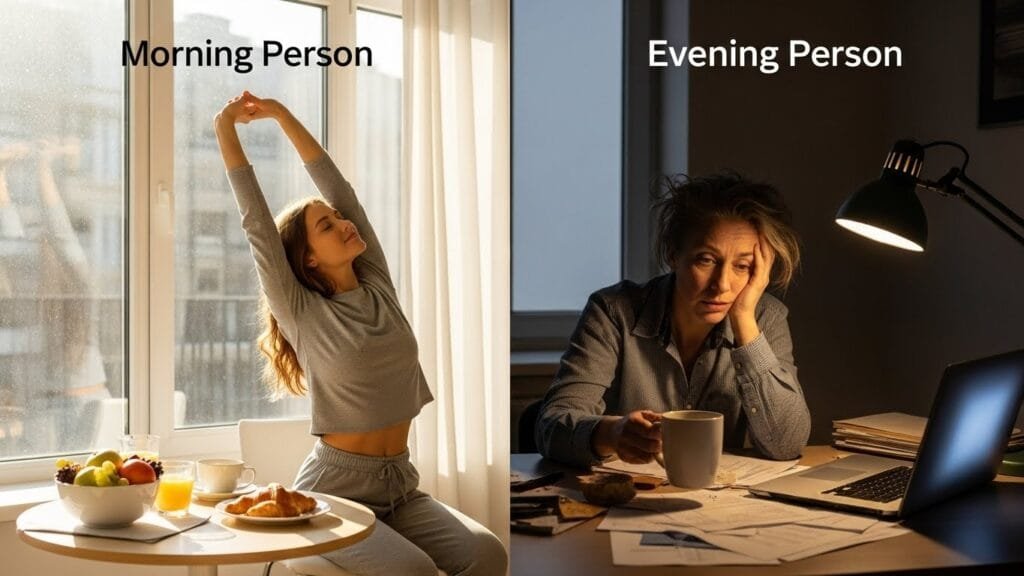
To give you a clearer picture of how morning and evening routines stack up, here’s a side-by-side look at some key differences:
Chronotype Comparison: Morning vs Evening People
| Factor | Morning People | Evening People |
|---|---|---|
| Proactivity | More proactive, anticipate problems, take initiative | Less proactive, more reactive |
| Procrastination | Lower tendency to delay tasks | Higher tendency to procrastinate |
| Mood & Happiness | Generally happier, more alert | More prone to social jetlag, lower mood |
| Sleep Quality | More consistent sleep-wake cycles | Irregular sleep patterns, higher health risks |
| Focus & Productivity | Peak performance in morning hours | Peak performance late at night, struggles during the day |
| Career Success | Better positioned for advancement | May struggle in traditional work environments |
About Chronotypes
Chronotypes refer to individual differences in activity and alertness in the morning and evening. Morning people ("larks") tend to wake up early and are most productive in the first part of the day. Evening people ("owls") have more energy later in the day and often struggle with traditional 9-to-5 schedules.
How to Become an Early Riser (Even If You're a Night Owl)

If you're convinced that waking up early might help you, but you've always been a night owl, don't worry. You can train yourself to shift your schedule gradually. Here's how:
- Move your bedtime earlier in small steps. Shift your sleep schedule by just 15 minutes earlier each night until you reach your target wake-up time. Gradual changes are easier for your body to adapt to than sudden jumps.
- Get natural light as soon as you wake up. Open your curtains, step outside, or sit by a window. Morning sunlight helps reset your circadian rhythm and signals to your brain that it's time to be awake. Light exposure regulates the production of hormones and neurotransmitters—melatonin (the sleep hormone) is suppressed, while serotonin, associated with mood and alertness, increases.
- Establish a relaxing bedtime routine. Wind down with calming activities like reading, light yoga, or meditation. Lower the lights in your home after sunset and put screens away at least three hours before bed.
- Keep your wake-up time consistent. Go to bed and wake up at the same times every day, even on weekends. Consistency reinforces your internal clock and makes waking up feel more natural.
- Avoid caffeine in the late afternoon and evening. A study in the Journal of Clinical Sleep Medicine found that consuming caffeine even 6 hours before bedtime can reduce sleep duration by an average of 41 minutes.
- Finish dinner early and take a walk afterward. Eating earlier in the evening gives your body time to digest before bed, and a short walk aids digestion, lowers stress, and supports melatonin release.
Why This Trend Matters in 2026
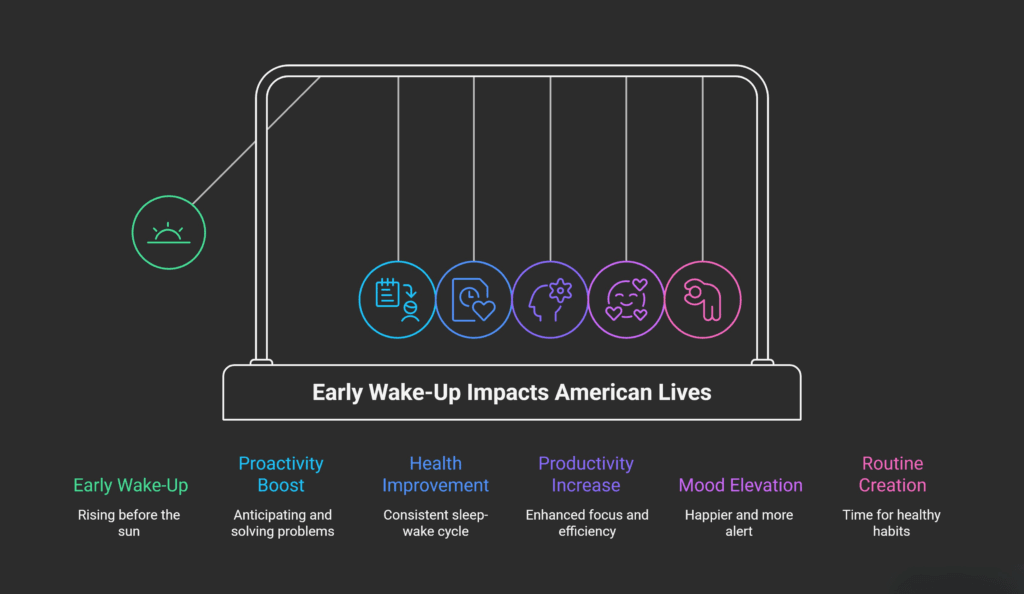
The shift toward earlier wake times is part of a broader wellness movement sweeping across America in 2026. People are taking charge of their health in proactive ways—focusing on gut health, immune resilience, and preventive care. Waking up early fits perfectly into this mindset. It's a simple, actionable step you can take today that pays dividends in productivity, mental clarity, physical health, and career success.
Employers are also noticing. With healthcare costs expected to rise by 7-10% in 2026, companies are investing more in preventive care programs and wellness initiatives that encourage healthy habits like regular sleep, exercise, and stress management. Employees who wake up early, maintain consistent routines, and show up alert and engaged are exactly the kind of people who thrive in these new workplace cultures.
Final Thoughts
So why are more Americans waking up early in 2026? Because they've figured out that mornings hold the key to better health, sharper focus, stronger careers, and happier lives. Whether you're naturally an early bird or you're thinking about making the switch, the science is clear: waking up early gives you a real edge. You're more proactive, you procrastinate less, your sleep is better, your mood is brighter, and you've got time to build the kind of morning routine that sets you up for success all day long.
It's not about becoming someone you're not. It's about giving yourself the best possible start each day. And in a world that moves fast and demands a lot, that early-morning advantage might be exactly what you need to get ahead and feel great doing it.
This article is part of our 5 Powerful Small Daily Habits That Transform Your Life pillar guide, where we explore simple, realistic habits that compound over time to improve energy, focus, and overall well-being.
My experience & insights
When I first started digging into why Americans wake up early and how it shapes their day, I kept seeing the same pattern: people weren’t just chasing a trendy “5 a.m. club” idea, they were actually trying to line up their lives with how their bodies naturally work. While going through sleep and chronotype research, it became clear that some of us genuinely do better early, and others function best later—but most advice online still treated “early” as one-size-fits-all. That gap is what pushed me to go deeper and test things in a more practical, everyday way for real people.
Over time, I noticed something interesting when talking with readers and testing routines: the people who thrived as early risers weren’t just forcing an early alarm. They were aligning their wake-up time with their natural chronotype (their built‑in timing for feeling sleepy and alert), then building a morning routine that matched that pattern. Some readers tried jumping two hours earlier overnight and felt awful. Others shifted by just 15 minutes at a time, added a bit of morning light and movement, and suddenly those early starts felt smoother and more sustainable. That real-world contrast convinced me that “become an early riser” only works when it respects your personal biology instead of fighting it.
To make this easier (and a bit more fun), I created a simple Sleep Chronotype Quiz for readers. It’s not clinical or diagnostic, and it’s not meant to replace a sleep specialist. Instead, it asks 5–7 quick questions about your sleep preferences, your natural energy peaks, and how you feel at different times of the day. Based on your answers, you get a chronotype-style result—think “gentle early bird,” “balanced mid‑day type,” or “late‑peak night owl”—along with a personalized morning routine suggestion that fits that pattern. The goal is to help you see, in plain language, “Here’s roughly how your internal clock works, and here’s a morning routine that matches it,” rather than just telling you to wake up at 5 a.m. because it sounds productive.
The quiz is also built around what research suggests without turning it into a lab report. For example, studies on chronotypes and proactivity show that people who are active when their body is naturally alert tend to make better decisions and feel more in control of their day. Instead of quoting every statistic at you, the quiz translates those ideas into simple actions: what time to aim for bed, when to get light exposure, the best window for your “deep work” block, and when to schedule exercise so it actually sticks. That way, you’re not just reading about morning people—you’re testing where you fall on that spectrum and getting a routine that respects your own rhythm.
From an experience standpoint, the most encouraging feedback I’ve seen is from readers who always thought they “failed” at waking up early. Once they saw, through the quiz, that their natural peak might be closer to 7:30 or 8:00 a.m., they stopped chasing extreme wake-up times and focused on consistency and quality instead. Their energy improved, their mornings felt calmer, and they still got the benefits of an intentional start to the day—without feeling like they were at war with their alarm clock. That’s really the heart of why I built the Sleep Chronotype Quiz: to bridge solid research with real-life habits, and to help you design a morning routine that works with your body, not against it.
Discover Your Sleep Chronotype
Take this 2-minute quiz to find out if you're naturally a Morning Lark, Evening Owl, or somewhere in between. Get personalized insights for better sleep and productivity.
Your Chronotype Results
Based on your answers, here's your natural sleep pattern
Your Personalized Morning Routine Tips
Frequently Asked Questions
What time do most Americans wake up in 2026?
The average American adult wakes up at 6:30 a.m. during the workweek, with just over 30% of people aged 13 and up already awake by 6:00 a.m. The most common wake-up window falls between 6:00 and 7:30 a.m., though this varies by age, work schedule, and personal chronotype. Weekend wake times tend to shift about 30-60 minutes later as people catch up on sleep.
Is waking up early actually healthier, or is it just a trend?
Waking up early is genuinely healthier when it's paired with consistent sleep habits and an earlier bedtime. Research shows that maintaining a stable circadian rhythm improves sleep quality, strengthens your immune system, and reduces risks of heart disease, obesity, and high blood pressure. However, forcing yourself to wake up early while staying up late can backfire. The key is getting 7-9 hours of quality sleep consistently, not just setting an early alarm.
How long does it take to become a morning person if I'm naturally a night owl?
Most people can shift their sleep schedule by 1-2 hours over 2-4 weeks by moving bedtime and wake time gradually—about 15 minutes earlier every few days. Your body needs time to adjust its circadian rhythm. Consistency is crucial: wake up at the same time daily (even weekends), get bright light exposure immediately upon waking, avoid caffeine after 2 p.m., and dim lights 2-3 hours before bed. If you're trying to shift more than 2 hours, expect it to take 6-8 weeks and consider using our Sleep Chronotype Quiz to understand your natural rhythm first.
What should I do first thing in the morning to actually feel awake and energized?
The most effective wake-up routine combines three elements: light, hydration, and movement. First, get natural sunlight exposure within 30 minutes of waking—open curtains, step outside, or sit by a window—to suppress melatonin and boost alertness. Second, drink 16-20 ounces of water to rehydrate after sleep. Third, do 5-10 minutes of gentle movement like stretching, walking, or light yoga to increase circulation and energy. Skip checking your phone or email for the first 30-60 minutes to protect your mental clarity.
Why do I still feel tired even when I wake up early?
Waking up early won't help if you're not getting enough total sleep or if your sleep quality is poor. Common culprits include going to bed too late (you need 7-9 hours, so a 6 a.m. wake-up requires a 9-11 p.m. bedtime), inconsistent sleep schedules, poor sleep environment (too warm, too bright, too noisy), late caffeine consumption, or eating heavy meals close to bedtime. Dr. Prashant Katakol recommends finishing dinner before sunset, taking a 20-minute walk afterward, lowering lights after dark, and avoiding screens 3 hours before bed to improve sleep quality naturally.
Do successful people really wake up earlier than everyone else?
Yes, there's solid research backing this. Studies by Christoph Randler found that early risers score higher on proactivity measures, earn better grades, and get into better colleges and jobs. Harvard Business Review research confirms that people whose performance peaks in the morning are better positioned for career success. However, success isn't about the exact wake-up time—it's about consistency, having uninterrupted morning time for important work, and being proactive. If you're most productive at 7:30 a.m. and build strong morning habits, you'll see similar benefits to someone who wakes at 5 a.m.
💊 Do not rely solely on online content for diagnosis or treatment.
📜 Information here is provided “as is” without any warranties.