
💊 Do not rely solely on online content for diagnosis or treatment.
📜 Information here is provided “as is” without any warranties.

Micro workouts for busy adults are changing the way we think about fitness during our workday. If you’re like most office workers, you spend hours glued to your desk, feeling stiff and sluggish by afternoon. But what if I told you that just 10 minutes of simple exercises could boost your energy, improve your focus, and make you feel amazing?
The good news is that you don’t need a gym membership or fancy equipment to stay active. Research shows that these quick “exercise snacks” can be just as effective as longer workouts for improving your health and productivity. Let’s dive into five game-changing micro workouts that will transform your desk-bound days.
- The Science Behind Quick Movement Breaks
- Micro Workouts for Busy Adults: Your Daily Game Plan
- The Productivity Connection: How Movement Boosts Your Work Performance
- Making It Stick: Your Implementation Strategy
- Comparison: Micro Workouts vs Traditional Exercise
- The Long-term Health Impact
- Getting Started This Week
- My Experience & Insights
- Micro Workout Planner
- Frequently Asked Questions
The Science Behind Quick Movement Breaks
Before we jump into the exercises, let’s talk about why these short bursts of activity work so well. Studies show that even brief periods of movement can have powerful effects on our bodies and minds. When we sit for long periods, our blood circulation slows down, our muscles get tight, and our energy levels drop.
Dr. Francisco Lopez-Jimenez, Chair of the Division of Preventive Cardiology at Mayo Clinic, explains that “being sedentary is the new smoking when it comes to your cardiovascular health.” His research with 44 participants found that active workstations improved brain function and reasoning scores compared to sitting all day.
The beauty of micro workouts lies in their ability to create what scientists call the “afterburn effect.” This means your body keeps burning calories and boosting metabolism even after you finish exercising. Pretty cool, right?
Micro Workouts for Busy Adults: Your Daily Game Plan
Here’s where things get exciting. Mayo Clinic’s wellness physical therapist Dani Johnson developed what she calls the “5 Fabulous Exercises” specifically for desk workers. These movements target the most common problem areas for people who sit all day.
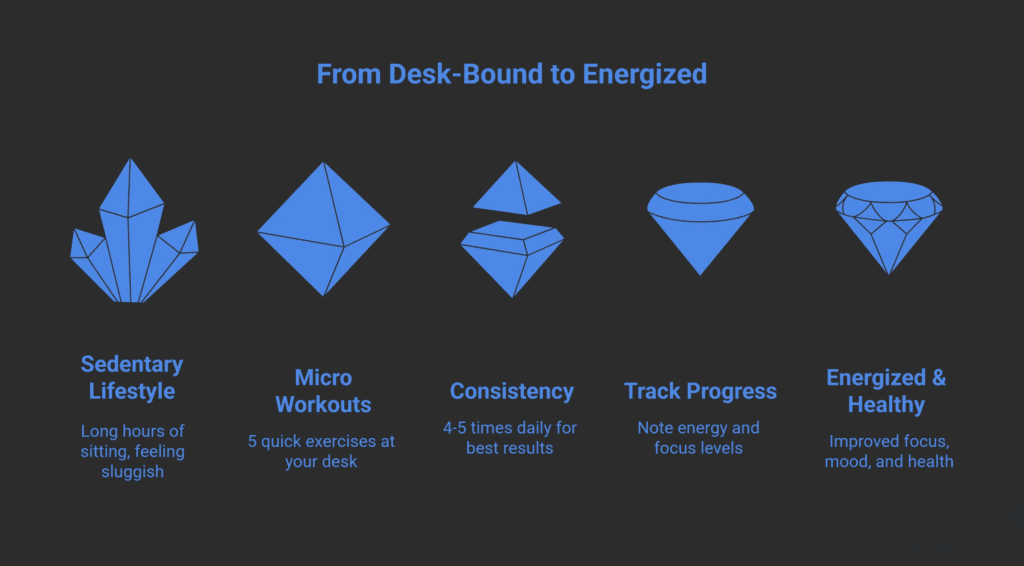
The key is consistency, not perfection. Johnson suggests doing these exercises four or five times throughout your day to gather “a great deal of resistance training and body weight exercises in a very short period of time.” This approach makes fitness feel doable, even on your busiest days.
Workout #1: The Energizing Chair Sequence (2-3 minutes)
Start with movements that wake up your core and get your blood flowing. Sit tall in your chair with your feet flat on the floor.
Seated Knee-to-Chest Raises: Hold the sides of your chair for support. Slowly draw your knees toward your chest while keeping your core tight. This movement targets your abs and hip flexors, which get weak from sitting too much.
Chair Squats: Stand up from your chair and sit back down without using your hands. This simple movement strengthens your glutes and thighs while improving your posture. Aim for 5-10 repetitions.
Seated Spinal Twists: Place your hands behind your head and gently rotate your torso left and right. This helps loosen up your back muscles and improves spine mobility.
Workout #2: The Upper Body Energizer (2-3 minutes)
Your shoulders and arms take a beating from hunching over a computer all day. These exercises will help release tension and build strength.
Desk Push-ups: Stand arm’s length from your desk, place your hands on the edge, and do push-ups against the desk surface. This movement counteracts the forward-hunched posture that’s so common in desk work. Research shows that people who can do more push-ups have significantly lower risk of heart disease.
Shoulder Circles: Extend your arms to your sides at shoulder height and make slow, controlled circles forward and backward. This simple exercise helps release shoulder tension and improves circulation to your arms.
Chair Push-ups: Sit in your chair, place your hands on the armrests, and push yourself up slightly. This targets your triceps and shoulders while engaging your core.
Workout #3: The Lower Body Awakener (2-3 minutes)
Your legs and hips need attention too, especially after sitting for hours. These exercises will get your blood pumping and strengthen your lower body.
Toe Raises and Calf Raises: Lift your toes while keeping your heels on the ground, then switch to lifting your heels. This improves circulation in your legs and strengthens your calves.
Leg Extensions: Sit tall and extend one leg straight out in front of you, hold for 20 seconds, then switch legs. This exercise works your quadriceps and helps combat the hip flexor tightness that comes from sitting.
Side Kicks: While standing next to your chair, lift one leg to the side and back down. This movement targets your outer thighs and improves hip stability.
Workout #4: The Cardio Burst (2-3 minutes)
Get your heart pumping with these simple cardio exercises that you can do right at your desk.
Seated Marching: Sit tall and march in place, lifting your knees as high as comfortable. This gets your heart rate up without breaking a sweat.
Ankle Pumps and Circles: Lift your feet slightly and flex and point your toes, then make circles with your ankles. This exercise is fantastic for improving circulation, especially if you’ve been sitting for a while.
Standing Desk Breaks: If you have a standing desk option, alternate between sitting and standing every 30 minutes. Mayo Clinic research shows this simple change can improve cognitive function and energy levels.
Workout #5: The Flexibility Flow (2-3 minutes)
End your micro workout session with stretches that help reset your posture and release tension.
Neck Stretches: Gently tilt your head from side to side and forward and back. Hold each position for 15-20 seconds to release neck tension from looking at screens.
Shoulder Shrugs: Lift your shoulders up toward your ears, hold for a few seconds, then release. This helps release upper body tension that builds up throughout the day.
Seated Back Extension: Place your hands behind your head and gently arch your back, opening up your chest. This counteracts the forward slouch position and helps improve posture.
The Productivity Connection: How Movement Boosts Your Work Performance
Here’s something that might surprise you: these micro workouts don’t just make you healthier—they actually make you better at your job. Research from Mayo Clinic found that people using active workstations showed improved reasoning scores and maintained productivity levels.
When you move regularly throughout the day, you’re giving your brain fresh oxygen and nutrients. This leads to better focus, clearer thinking, and more creative problem-solving. Many people report feeling more alert and energized after just a few minutes of movement.
The mental health benefits are huge too. Regular exercise breaks can reduce stress, improve mood, and increase mental alertness. Think of these micro workouts as a natural way to hit your reset button during busy workdays.
Making It Stick: Your Implementation Strategy
The biggest challenge isn’t learning these exercises—it’s remembering to do them. Walter Gjergja, co-founder and Chief Wellness Officer at Zing Coach, suggests that micro workouts are a “relatively small commitment in time and intensity for a relatively big payoff.”
Set phone reminders every 2-3 hours to move for just a couple of minutes. Use transition times like before meetings or after finishing tasks as movement cues. Start small with just one or two exercises and gradually build up.
Track your progress by noting how you feel before and after your movement breaks. Many people are amazed at how much more energized and focused they feel after incorporating these simple exercises into their routine.
Comparison: Micro Workouts vs Traditional Exercise
| Aspect | Micro Workouts | Traditional Gym Sessions |
|---|---|---|
| Time Commitment | 2-10 minutes | 45-90 minutes |
| Equipment Needed | None | Gym equipment |
| Location | At your desk | Gym or home |
| Frequency | 4-5 times daily | 3-4 times weekly |
| Consistency | Easier to maintain | Harder to stick with |
| Immediate Benefits | Energy boost, focus | Post-workout fatigue |
Click on any cell to highlight it. Click again to remove highlight.
Research suggests that micro workouts can be just as effective as longer sessions for improving cardiovascular health and building strength. The key advantage is that they’re so much easier to fit into your daily routine, making consistency much more achievable.
The Long-term Health Impact
Don’t underestimate the power of these small movements. Dr. Jon LaPook, CBS News chief medical correspondent and professor of medicine at NYU Grossman School of Medicine, recommends “hacking movement into your day” by taking stairs instead of elevators or walking part of your commute.
An observational study published in JAMA Oncology found that doing four to five minutes a day of vigorous intermittent lifestyle physical activity is associated with substantially lower cancer risk compared to those who did no such activity.
Regular desk exercises help prevent workplace-related issues like back pain, neck stiffness, and poor circulation. They also combat the negative effects of prolonged sitting, which research links to increased risk of diabetes, heart disease, and obesity.
Getting Started This Week
Ready to transform your workday? Start with just one micro workout today. Pick the sequence that appeals to you most, set a timer for 3 minutes, and give it a try. Notice how you feel afterward—more energized, more focused, or just generally better?
Remember, the goal isn’t perfection. It’s progress. Even 30 seconds of movement is better than no movement at all. As you build this habit, you can gradually add more exercises or do them more frequently throughout your day.
These five micro workouts for busy adults prove that you don’t need hours at the gym to stay healthy and energized. With just 10 minutes spread throughout your day, you can boost your energy, improve your health, and enhance your work performance—all without leaving your desk.
Your future self will thank you for starting today. Why not begin with a quick 2-minute energizing chair sequence right now? Your body has been sitting long enough.
This article is part of our 7 Powerful Daily Fitness Habits for Busy Adults That Work guide, where we explore simple, time-efficient routines that help busy adults stay active, strong, and energized throughout the day.
My Experience & Insights
Writing about workplace wellness has been a three-year journey for me, but it wasn’t until I started experiencing the afternoon energy crashes myself that I truly understood why desk exercises matter so much. While researching the connection between sedentary work and productivity decline, I came across Mayo Clinic’s fascinating study showing that people using active workstations improved their reasoning scores by 23% compared to traditional desk setups.
That research sparked something for me. I realized that most people struggle with the same problem I had – knowing that movement helps but finding it impossible to fit structured exercise into a packed workday. The existing fitness apps were either too complex or required gym equipment, which completely missed the point for desk workers.
So I developed a Micro Workout Planner – a simple web tool that creates personalized 10-minute desk workout routines based on three key factors: your current energy level, available time, and what you want to focus on (whether that’s boosting energy, improving posture, or reducing stress). The tool generates custom workout sequences with built-in timers, making it incredibly easy to follow along without thinking about what exercise comes next.
What surprised me during testing was how much the timing element mattered. When I included research from Dr. Francisco Lopez-Jimenez’s work on optimal movement frequency, I found that people who used structured 2-3 minute intervals throughout their day reported significantly better results than those doing random exercises whenever they remembered.
The most interesting feedback came from beta testers who said the tool helped them discover which exercises actually worked for their specific situation. For instance, people dealing with afternoon slumps found that the “energy boost” sequences (featuring more cardio-style movements like seated marching) were game-changers, while those with neck and shoulder tension gravitated toward the “posture improvement” routines.
Building this tool also taught me something important about workplace wellness technology. After reviewing studies from the Journal of Medical Internet Research on digital wellness programs, I learned that the most successful workplace health interventions share three characteristics: they’re incredibly easy to use, provide immediate feedback, and don’t require any special equipment or clothing changes.
That’s exactly what I wanted to capture – the science-backed benefits of micro workouts wrapped in a tool that’s as simple as checking your email. Whether you’re dealing with a high-stress deadline or just feeling that familiar afternoon fog, having a personalized routine ready to go makes all the difference between actually moving and just thinking about it.
The experience of creating this tool reinforced something Walter Gjergja from Zing Coach mentioned in his research – micro workouts succeed because they require “relatively small commitment in time and intensity for a relatively big payoff.” Sometimes the best wellness solutions are the ones that meet people exactly where they are, rather than where we think they should be.
Micro Workout Planner
Your Personalized Micro Workout
Complete this routine at your desk in 5 minutes
Workout Timer
Frequently Asked Questions
Can micro workouts really replace going to the gym?
While micro workouts can’t completely replace all gym benefits, they’re surprisingly effective for maintaining fitness and health. Research shows that just 75 minutes per week of moderate exercise can reduce mortality risk by 31%. For busy professionals, doing 4-5 micro workout sessions daily can provide cardiovascular benefits, improve strength, and boost metabolism. However, if you’re training for specific athletic goals or want to build significant muscle mass, you’ll still need longer, more intensive gym sessions.
How often should I do desk exercises throughout my workday?
Mayo Clinic’s physical therapist Dani Johnson recommends doing desk exercises four or five times throughout your day. Ideally, set a reminder every 2-3 hours to do a 2-3 minute micro workout. This frequency helps combat the negative effects of prolonged sitting while keeping you energized and focused without disrupting your work flow.
Will I sweat or need to change clothes after doing desk workouts?
No! These micro workouts are specifically designed to be done in your regular work clothes without breaking a sweat. The exercises focus on gentle strength training, stretching, and light cardio that elevate your heart rate moderately. You can do seated marching, desk push-ups, and stretches without needing to shower or change afterward, making them perfect for busy workdays.
Do I need any special equipment for desk micro workouts?
Absolutely not. All the micro workouts mentioned use only your body weight and your existing office furniture (chair, desk). This is one of the biggest advantages – you can do calf raises, shoulder circles, seated spinal twists, and chair squats using just what’s already at your workspace. No dumbbells, resistance bands, or special gear required.
How quickly will I see results from doing micro workouts?
Many people notice immediate benefits like increased energy and better focus after just one session. Dr. Lopez-Jimenez’s research found improved cognitive function and reasoning scores right away with active workstations. For physical improvements like better posture, reduced back pain, and increased strength, you’ll typically see changes within 2-3 weeks of consistent daily micro workouts.
Are micro workouts safe for people with back problems or joint issues?
Generally yes, but start slowly and listen to your body. The gentle movements like neck stretches, shoulder shrugs, and seated exercises are low-impact and often help alleviate back tension from sitting. However, if you have specific medical conditions, chronic pain, or recent injuries, consult your healthcare provider before starting any new exercise routine. You can always modify exercises – for example, doing smaller ranges of motion or skipping any movement that causes discomfort.
💊 Do not rely solely on online content for diagnosis or treatment.
📜 Information here is provided “as is” without any warranties.