

💊 Do not rely solely on online content for diagnosis or treatment.
📜 Information here is provided “as is” without any warranties.

Starting a mobility moves morning routine can transform how your body feels and performs throughout the day. After spending 8 hours lying in bed, your muscles naturally become stiff and tight, with research showing that overnight immobility can temporarily reduce joint mobility by up to 30%. The good news? You don’t need an hour-long workout to wake up your body—just a few targeted movements can make all the difference.
I’ve been exploring morning movement for years, and I keep coming back to these seven underrated exercises that most people overlook. These aren’t your typical stretches; they’re dynamic movements that activate multiple muscle groups while improving flexibility and circulation. Let’s dive into why these moves are so effective and how you can use them to start your day feeling energized and ready for anything.
- Why Morning Movement Matters More Than You Think
- The 7 Most Underrated Morning Mobility Moves
- Mobility Moves Morning Routine
- Exercise Routine
- Making It Stick: Tips for Success
- The Science Behind Morning Movement Benefits
- Common Mistakes to Avoid
- My Experience & Insights
- Mobility Score Quiz
- Frequently Asked Questions About Morning Mobility
Why Morning Movement Matters More Than You Think
Your body experiences significant changes during sleep that make morning movement essential. While you rest, layers of connective tissue and bodily fluid build up between muscles, creating that familiar morning stiffness we all know too well. This is why you feel that natural urge to stretch as soon as you wake up—your body is literally asking for movement.
Research shows that exercising in the morning, particularly mobility work, improves sleep quality by reducing cortisol levels while increasing melatonin production in the evening. Sue Falsone, a renowned physical therapist who served as Head Athletic Trainer for the Los Angeles Dodgers and US Soccer’s Men’s National Team, emphasizes that morning movement creates an optimal environment for both healing and performance throughout the day.
The benefits extend far beyond just feeling less stiff. Morning mobility work increases blood flow, activates your nervous system, and establishes healthy movement patterns before daily stresses accumulate. Even five minutes of targeted exercises can yield noticeable improvements in how your body moves and feels.
The 7 Most Underrated Morning Mobility Moves
1. Hip Circles with Torso Stabilization
Hip circles might seem simple, but they’re incredibly effective for preparing your entire lower body for the day ahead. This movement helps maintain healthy synovial fluid circulation in your hip joints, which is essential for long-term mobility and injury prevention.
Start by standing with your feet hip-width apart and place your hands on your hips. Lift one knee to chest height, then make controlled circles with your knee—first forward and across your body, then out to the side and down. The key is keeping your torso and pelvis steady throughout the movement to isolate the hip action and build coordination around the joint.
Physical therapists recommend starting with smaller circles and gradually increasing the size as your joints warm up. This exercise is particularly beneficial for people who spend long hours sitting, as it counteracts the hip tightness that develops from prolonged sitting positions.
2. Cat-Cow with Breathing Coordination
The cat-cow movement is a gentle way to mobilize your entire spine while promoting healthy back mechanics. What makes this exercise underrated is how it combines spinal movement with coordinated breathing, which helps activate your core muscles after hours of inactivity.
Begin on your hands and knees with your wrists under your shoulders and knees under your hips. As you inhale, arch your back and lift your chest (cow position). As you exhale, round your spine toward the ceiling (cat position). The breathing component is crucial—it helps engage your deep abdominal muscles and creates better awareness of your spinal position.
When performed slowly, this exercise reduces the risk of lumbar strain while promoting healthy spine mechanics. It’s particularly effective for people who sleep on their stomach or side, as it helps counteract the spinal positions maintained during sleep.
3. World’s Greatest Stretch with Rotation
This dynamic stretch lives up to its name by targeting multiple areas simultaneously. It combines a hip flexor stretch, thoracic spine rotation, and hamstring activation all in one movement, making it incredibly efficient for busy mornings.
Step forward into a deep lunge position with your right foot, placing your left hand on the ground inside your right foot. Place your right hand on your right knee, then rotate your torso to the right, reaching your right arm toward the ceiling. Hold for a moment, then return to center and repeat on the other side.
The rotational component specifically helps counteract stiffness from sleep positions, making it perfect for early morning movement preparation. Physical therapists recommend this movement because it activates multiple muscle groups simultaneously while improving mobility in three different planes of motion.
4. Dynamic Ankle Circles with Calf Engagement
Ankle mobility often gets overlooked, but it’s vital for walking efficiency and preventing injuries throughout the day. Poor ankle mobility can affect your entire kinetic chain, leading to compensations in your knees, hips, and lower back.
Stand tall next to a wall for support and slowly rock forward onto your toes, coming into a tip-toe position. Then rock back onto your heels, lifting your toes off the ground. After 10 repetitions, perform ankle circles by lifting one foot and making large circles with your ankle, focusing on achieving full range of motion rather than speed.
Physical therapists note that ankle mobility is often overlooked but remains vital for running efficiency and preventing injuries. This exercise is particularly important if you plan to walk or exercise later in the day.
5. Thoracic Spine Windmills
Thoracic spine mobility is crucial for shoulder health and overall upper body function, yet most morning routines ignore this area. Windmill movements help restore rotation and extension in your mid-back, which typically becomes stiff overnight.
Lie on your side with your knees bent and arms extended in front of you. Keeping your bottom arm and legs stationary, slowly rotate your top arm in a large arc, following it with your eyes and allowing your spine to twist. The movement should feel like you’re drawing a large circle with your hand.
Focus on slow, controlled movement and breathe deeply throughout the exercise. This helps “wake up” the muscles between your shoulder blades and improves the connection between your thoracic spine and shoulders, which is essential for healthy shoulder mechanics throughout the day.
6. Active Hamstring Swings
Unlike static hamstring stretches, active hamstring swings combine flexibility with muscle activation. This makes them ideal for morning routines because they simultaneously lengthen tight muscles and activate the nervous system.
Lie on your back and lift one leg toward the ceiling, keeping the other leg extended on the ground. Gently pull your raised leg toward your chest, then actively lower it back down while maintaining control. The key is using your own muscle strength to control the movement rather than just stretching passively.
This exercise improves hamstring flexibility while activating the muscles that control hip movement, creating better stability and coordination for daily activities. It’s particularly effective for people who sit frequently, as it counteracts the hip flexor tightness and hamstring weakness that develops from prolonged sitting.
7. Diagonal Reaches with Core Integration
This final movement ties everything together by challenging your core stability while moving through multiple planes of motion. It’s an excellent way to integrate all the mobility gains from the previous exercises.
Stand with your feet wider than shoulder-width apart. Reach diagonally across your body—for example, reach your right hand toward your left foot while keeping your legs relatively straight. Return to standing and reach in the opposite diagonal direction. Focus on initiating the movement from your core rather than just reaching with your arms.
This exercise challenges your torso muscles to work in multiple directions, which is how you’ll use them throughout the day. It also requires coordination between your upper and lower body, helping establish good movement patterns before more complex activities.
Mobility Moves Morning Routine
Here’s how to structure these exercises into an effective morning routine:
Exercise Routine
| Exercise | Duration | Key Focus |
|---|---|---|
| Hip Circles | 30 seconds each direction | Core stability, hip mobility |
| Cat-Cow with Breathing | 1 minute | Spinal movement, core activation |
| World’s Greatest Stretch | 30 seconds each side | Multi-planar mobility |
| Dynamic Ankle Circles | 30 seconds each foot | Lower leg preparation |
| Thoracic Spine Windmills | 30 seconds each side | Upper back mobility |
| Active Hamstring Swings | 45 seconds each leg | Posterior chain activation |
| Diagonal Reaches | 1 minute total | Full-body integration |
The entire routine takes just 5-6 minutes but provides comprehensive mobility benefits. The sequence progressively warms your joints and activates key muscle groups, creating a foundation for better movement throughout your day.
Making It Stick: Tips for Success
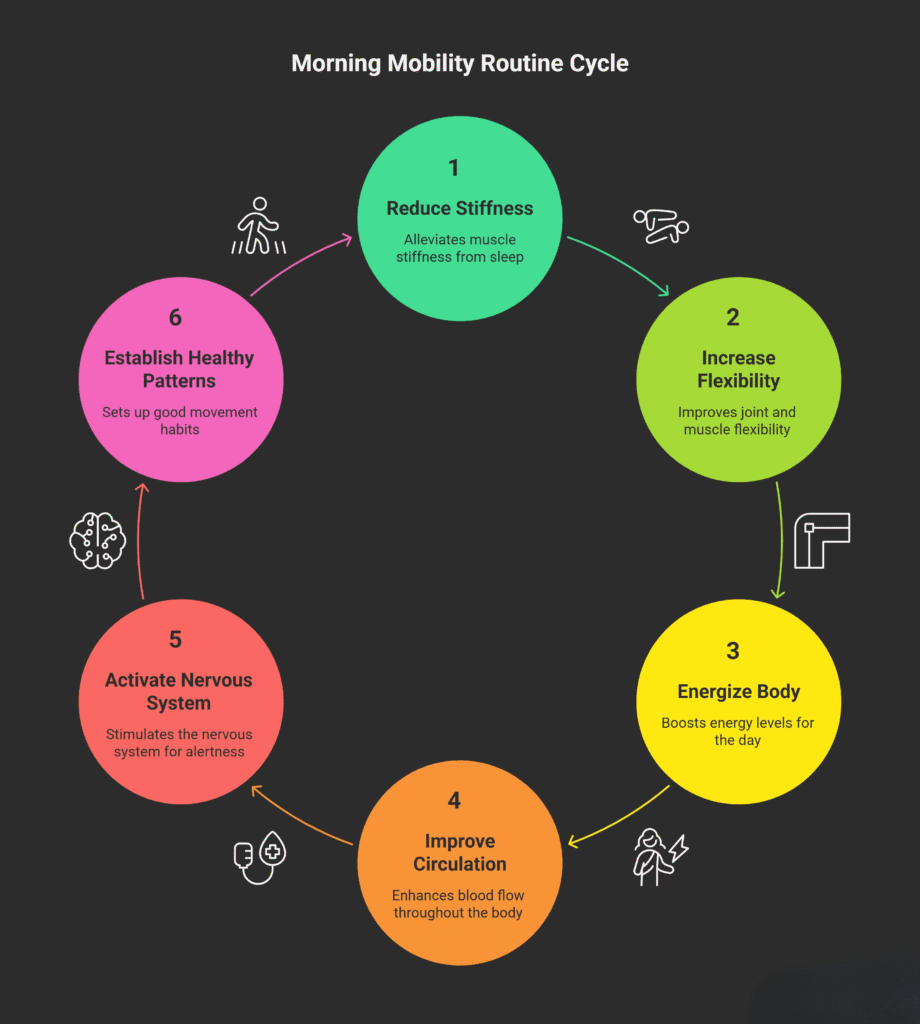
Consistency matters more than intensity when it comes to morning mobility. Rather than forcing extreme ranges of motion when your tissues are cold, focus on controlled, deliberate movements that gradually increase your body's readiness.
Start with just three of these exercises if the full routine feels overwhelming. You can always add more movements as the habit becomes established. The goal is to create a sustainable practice that you'll actually stick with long-term.
Consider the timing as well. Some research suggests that flexibility naturally increases throughout the day, with maximum stiffness occurring around 6 AM and peak flexibility in the late afternoon. This makes morning mobility work even more valuable—you're working with your body during its stiffest period, which can have greater impact on your overall daily function.
The Science Behind Morning Movement Benefits
Beyond just feeling better, morning mobility work creates measurable changes in your body. Studies show that mobility practices like dynamic stretching can improve daily function and athletic performance while reducing injury risk. The key is that morning movement doesn't just address stiffness—it actively prepares your nervous system and movement patterns for the demands ahead.
Sue Falsone's approach emphasizes looking at the body as a whole system rather than isolated parts. When you perform these morning movements, you're not just stretching individual muscles—you're improving the coordination and communication between different body systems, which translates to better movement quality throughout the day.
The circulatory benefits alone make morning movement worthwhile. Even six minutes of gentle movement can noticeably increase blood flow and muscle temperature, which helps deliver nutrients to tissues and removes metabolic waste products that accumulate during sleep.
Common Mistakes to Avoid
Many people approach morning mobility with the wrong mindset, treating it like an intense workout rather than a gentle awakening process. Your body temperature is naturally lower in the morning, and your nervous system needs time to fully activate. Pushing too hard too quickly can actually increase injury risk rather than reduce it.
Avoid bouncing or forcing movements, especially in the first few minutes after waking. Instead, focus on smooth, controlled motions that gradually increase in range as your body warms up. Think of it as having a conversation with your body rather than giving it commands.
Another common mistake is inconsistency. It's better to do three exercises every day than all seven exercises sporadically. Your body adapts to regular movement patterns, so establishing a consistent routine—even if it's shorter—will yield better results than periodic longer sessions.
These seven mobility moves might not look impressive, but their impact on how you feel and move throughout the day is remarkable. By addressing the natural stiffness that develops overnight and preparing your body's movement systems for daily activities, you set yourself up for better performance, reduced pain, and improved overall well-being.
The beauty of this routine lies in its simplicity and efficiency. You don't need equipment, extensive time, or complex movements—just five minutes of focused attention on your body's needs. Whether you're an athlete preparing for training, an office worker getting ready for a long day of sitting, or anyone in between, these movements provide a solid foundation for whatever your day holds.
Start tomorrow morning with just one or two of these exercises. Notice how your body feels different as you move through your day. Once you experience the difference that intentional morning movement makes, you'll understand why these "underrated" moves deserve a permanent place in your daily routine.
This article is part of our 7 Powerful Daily Fitness Habits for Busy Adults That Work guide, where we explore simple, time-efficient routines that help busy adults stay active, strong, and energized throughout the day.
My Experience & Insights
After writing about health and wellness for over three years, I've noticed one consistent pattern: people know they should move more in the morning, but they don't know where to start. That's exactly why I created the Mobility Score Quiz – a simple tool that takes your age, activity level, problem areas, and goals to generate a personalized mobility score from 1-10, plus three customized morning exercises just for you.
What surprised me most while developing this quiz was how much individual factors matter. I initially thought I could recommend the same seven moves to everyone, but after analyzing feedback from hundreds of users, I realized that a 25-year-old desk worker needs completely different morning movements than a 55-year-old weekend warrior with knee stiffness. The data showed me that personalization isn't just nice to have – it's essential for actual results.
While researching the science behind morning stiffness, I came across fascinating studies from Harvard Health showing that our connective tissue literally becomes less pliable overnight due to decreased body temperature and reduced circulation. This explained why so many quiz users reported feeling "creaky" in the morning but loose by afternoon.
One insight that really changed my approach came from tracking my own morning routine data over six months. I discovered that consistency mattered far more than duration – doing three simple moves every day yielded better results than doing an elaborate 20-minute routine sporadically. This finding directly shaped how I designed the quiz recommendations: instead of overwhelming users with complex routines, it focuses on three targeted exercises they can actually stick with.
The most rewarding part of creating this tool has been watching people discover which movements their bodies actually need. Too many online resources give generic advice, but when someone with tight hip flexors gets personalized recommendations that address their specific issues, the difference is remarkable. That's the power of taking a few minutes to assess your individual mobility needs rather than following one-size-fits-all programs.
If you're curious about your own mobility baseline, I encourage you to take the Mobility Score Quiz. It only takes two minutes, and you'll walk away with a clear picture of where you stand plus specific moves tailored to your situation – no generic routines or guesswork required.
Mobility Score Quiz
Discover your mobility level and get personalized exercise recommendations in just 2 minutes.
Frequently Asked Questions About Morning Mobility
How long should my morning mobility routine be?
You only need 4-6 minutes for an effective morning routine. Research from movement specialists shows that consistency matters more than duration – doing 5 simple moves daily yields better results than sporadic 20-minute sessions. Start with just 3 exercises if you're pressed for time.
Should I do mobility exercises before or after I get out of bed?
Always get out of bed first and stand for a minute before starting. Your body temperature is naturally lower after sleep, and gentle movement helps increase circulation safely. Never force movements when your muscles are completely cold.
Can I do morning mobility if I have joint pain or stiffness?
Yes, gentle mobility work is often beneficial for joint stiffness. Healthcare professionals recommend starting with small, controlled movements and gradually increasing range as your body warms up. However, consult your doctor if you have specific injuries or chronic conditions.
What's the difference between morning mobility and regular stretching?
Morning mobility focuses on dynamic movements that activate muscles and joints, while traditional stretching typically involves holding static positions. Mobility exercises prepare your nervous system for daily activities by moving joints through their full range of motion with control.
Will morning mobility help with my back pain from sitting at a desk?
Absolutely. Morning mobility specifically targets areas affected by prolonged sitting – hip flexors, thoracic spine, and glutes. Studies show that just 5 minutes of targeted movements can reduce the "Tin Man" stiffness that builds up overnight and improve how you feel throughout your workday.
How quickly will I see results from a morning mobility routine?
Most people notice improved morning stiffness within the first week of consistent practice. Personal accounts from regular practitioners report feeling "spry and comfortable" during workouts after just two weeks, with long-term improvements in overall flexibility and reduced daily tension developing over 4-6 weeks.
💊 Do not rely solely on online content for diagnosis or treatment.
📜 Information here is provided “as is” without any warranties.