


💊 Do not rely solely on online content for diagnosis or treatment.
📜 Information here is provided “as is” without any warranties.
When poor sleep affects productivity, remote workers feel it harder than anyone else. You’re already dealing with blurred boundaries between work and life, and now your brain is foggy, your motivation is tanking, and simple tasks feel overwhelming. Sound familiar? You’re not alone—nearly 74% of remote workers report poor sleep quality, and it’s quietly destroying their work performance.
Here’s the thing: working from home was supposed to make life easier. But without a commute to separate work from rest, many of us end up working longer hours and sleeping worse. The good news? You don’t need a complete life overhaul to fix it. Small changes can make a big difference.
Poor Sleep Affects Productivity
Let’s talk numbers. Sleep-deprived remote workers don’t just feel tired—they lose over 5% of their work productivity, which translates to thousands of dollars per employee annually. Dr. Sophie Bostock, founder of TheSleepScientist.com and a sleep expert who has worked with the University of Oxford, explains that poor sleep makes it harder to manage stress throughout the day, which directly affects how well you wind down at night.
But it gets worse. When you’re running on four or five hours of sleep, your brain doesn’t just slow down—it starts making mistakes. More than half of sleep-deprived workers struggle to stay focused in meetings, take longer to finish tasks, and find it hard to come up with new ideas. You might think you’re pushing through, but your output tells a different story.
The Work-From-Home Sleep Trap
Remote work comes with a hidden cost. Without the natural transition of a commute, your brain never gets a clear signal that work is over. Dr. Melissa Milanak, a clinical psychologist and Assistant Professor at the Medical University of South Carolina, points out that remote workers often struggle because their brains haven’t had a chance to decompress by bedtime.
Nearly 40% of remote workers report getting only six hours of sleep each night—well below the recommended seven to eight hours. That’s not just about quantity either. Working in your bedroom creates unhealthy associations between your bed and work, making it even harder to fall asleep at night.
Sleep Issues Impact on Remote Workers
| Sleep Issue | Impact on Remote Workers | Productivity Loss |
|---|---|---|
| Insomnia (moderate-severe) | Difficulty focusing, slower task completion | 107% more than well-rested workers |
| Insufficient sleep (under 6 hours) | Poor decision-making, reduced motivation | 5.5% productivity loss |
| Poor sleep quality | Memory problems, attention issues | 58% more productivity loss |
Three Quick Fixes That Actually Work

You don’t need to overhaul your entire life to sleep better. These three evidence-based strategies take minutes to implement but deliver real results for remote workers.
Fix #1: Create a Hard Stop Between Work and Rest
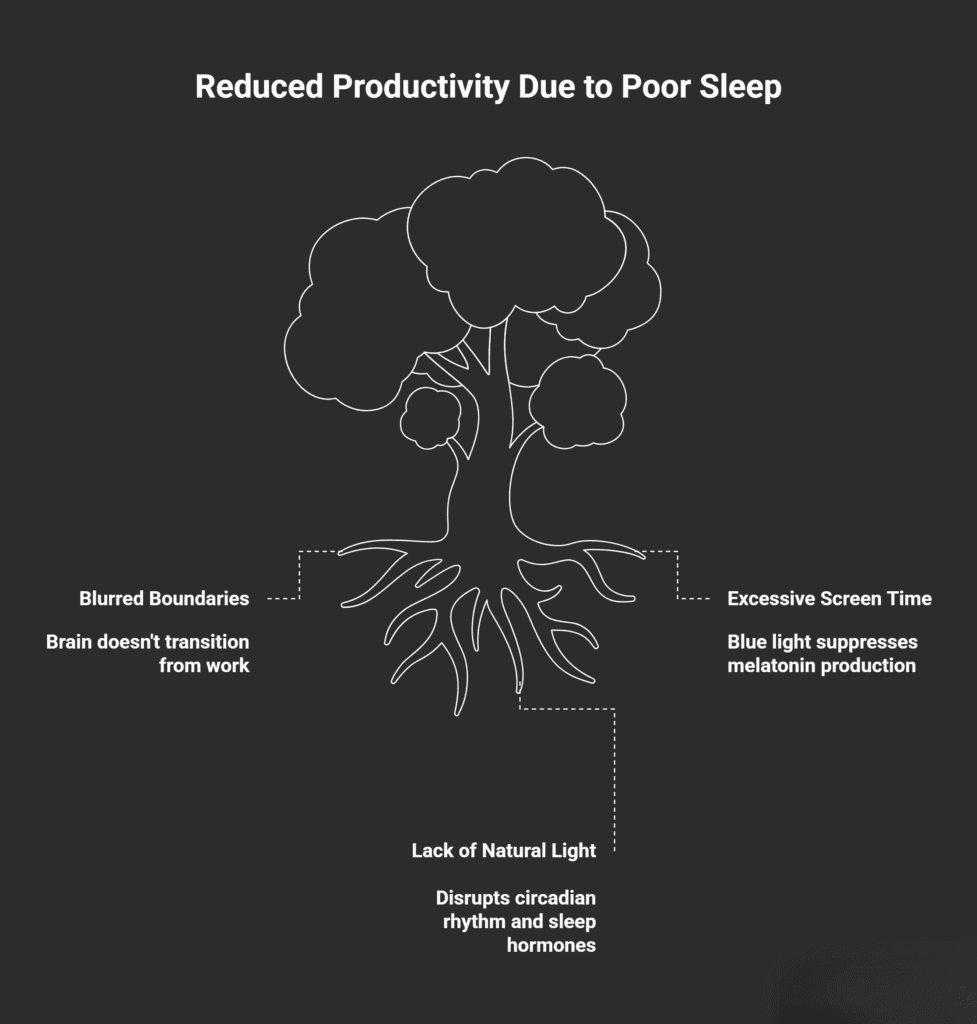
One of the biggest reasons remote workers can’t sleep is that they never truly “leave” work. Your brain needs clear signals. Pick a specific time to sign off—shut down your laptop, turn off work notifications, and physically move to another space.
Even better, replace your commute with a simple 10-minute routine. Go for a short walk around your block, change out of work clothes, or do light stretches. This tells your brain, “Work is done. It’s time to relax.”
Workers who set clear boundaries between work and personal time reported better well-being and productivity. It’s not just about working less—it’s about creating mental space to recover.
Fix #2: Limit Screen Time One Hour Before Bed
Screens are productivity killers when it comes to sleep. The blue light from your laptop and phone suppresses melatonin, the hormone that makes you feel sleepy. If your work runs late into the evening, you’re sabotaging your own rest.
Here’s what works: set a “digital sundown” about an hour before bed. Put away all screens—laptops, tablets, and phones—and switch to a non-screen activity like reading a book, listening to music, or gentle stretches. If you absolutely must use screens late, turn on blue light filters or night mode on your devices.
Dr. Sophie Bostock recommends setting boundaries with technology rather than banning it outright. The goal is control, not perfection. Even small reductions in screen time before bed can improve sleep quality.
Fix #3: Get Natural Light Early in Your Day
Your body runs on an internal clock called your circadian rhythm, and natural light is the reset button. Remote workers often miss out on morning sunlight because they roll straight from bed to desk. That’s a mistake.
Spending just 20 minutes in natural light early in the day—whether it’s opening your blinds, sitting by a window, or taking a short walk—helps regulate your sleep hormones and boosts your mood. Research shows that lack of natural light in workspaces is associated with sleep and depressive symptoms.
Even if you can’t get outside, position your workspace near a window and let in as much daylight as possible. Natural light during the day doesn’t just help you feel awake—it makes falling asleep easier at night.
Why This Matters More Than You Think
Sleep isn’t a luxury for remote workers—it’s a performance tool. When you sleep well, you make better decisions, stay focused longer, and handle stress without spiraling. On the flip side, chronic poor sleep increases workplace mistakes, slows down your work, and even raises your risk of burnout.
A comprehensive review of remote work found that isolation, stress, and poor work-life balance all contribute to sleep problems, which then create a vicious cycle of declining productivity and well-being. Breaking that cycle starts with small, intentional changes.
We often think productivity is about working harder or longer, but the truth is simpler: you can’t perform your best when your brain is running on fumes. Sleep gives you back your edge. It sharpens your focus, improves your memory, and helps you think clearly under pressure.
One More Thing to Try
Consistency beats perfection every time. Experts recommend sticking to a regular sleep schedule—even on weekends—to reinforce your body’s natural rhythm. Remote workers have more flexibility with their schedules, but using that flexibility to stay up late and sleep in on weekends actually makes it harder to fall asleep when Monday rolls around.
If your bedroom doubles as your office (and you can’t change that), at least avoid working in bed. Your brain needs to associate your bed with sleep, not emails and deadlines. Consider rearranging furniture to create separate work and sleep zones, even in a small space.
Finally, practice a simple bedtime routine. It doesn’t need to be elaborate—just a consistent sequence of calming activities like brushing your teeth, changing into pajamas, and reading for 10 minutes. Dr. Milanak’s research emphasizes that wind-down routines help your brain transition into sleep mode, especially when work and home life overlap.
Remote work isn’t going anywhere. More than 50% of workers who can work from home want to keep doing it. But to make it sustainable, we need to protect our sleep. Start with one fix tonight—whether that’s setting a hard stop time, dimming screens an hour before bed, or stepping outside for morning light. Your brain (and your productivity) will thank you.
This article is part of our 7 Healthy Daily Lifestyle Choices That Transform Your Well-Being pillar guide, where we explore practical, science-backed habits that improve energy, sleep, focus, and overall well-being in everyday life.
My Experience & Insights
While researching the connection between sleep and remote work performance, I kept stumbling across the same troubling pattern: people knew they weren’t sleeping well, but they had no idea how much it was actually costing them. The numbers I found were eye-opening.
Harvard’s research with Brigham Health showed that a company with just 1,000 workers loses about $1.4 million annually due to tired employees. That’s not just from people calling in sick—it includes slower work, more mistakes, and higher healthcare costs. When I dug deeper, I found that fatigue-related productivity losses cost about $1,967 per employee each year, according to a study published in the Journal of Occupational and Environmental Medicine.
But here’s what really struck me: Gallup estimated that poor sleep costs U.S. businesses $44.6 billion annually in lost productivity. Workers who consistently get poor sleep miss more than double the workdays compared to well-rested colleagues. That’s a staggering hidden cost that most remote workers never calculate for themselves.
So I built something to make this personal. I created a Productivity Loss Calculator that lets you see how much poor sleep might be costing you individually—not just in vague terms, but in actual dollars. You enter your salary, typical sleep hours, and any focus issues you’re experiencing, and it estimates your annual productivity loss and recovery potential.
The idea came from reading research by RAND Corporation, which found that people sleeping less than six hours lose about six full workdays of productivity each year. I wanted readers to connect those abstract statistics to their own lives. When you see that poor sleep might be costing you $3,000 or $5,000 in lost earning potential annually, it becomes real. It’s no longer just “I’m tired”—it’s “I’m leaving money on the table.”
What surprised me most during this research was learning how work intensity affects sleep quality even more than long hours. A study of over 13,000 Australian workers found that each unit increase in work intensity led to an 8% decrease in sleep quality. For remote workers juggling back-to-back video calls without commute breaks, that intensity never lets up.
The calculator helps visualize what you’re gaining back when you fix your sleep. It’s not about guilt or shame—it’s about seeing the return on investment when you prioritize those three fixes we talked about earlier. Better boundaries, less screen time, and morning light aren’t just “nice to have” habits. They’re financially smart decisions that protect your income and career growth.
I’ve heard from readers who used the tool and told me it was the wake-up call (no pun intended) they needed to take their sleep seriously. One person said seeing the dollar amount made them finally set a hard stop time for work. Another said it helped them justify buying blackout curtains to their partner because the investment would literally pay for itself in recovered productivity.
The research is clear: every additional hour of sleep per week can increase your wage income by 1.1% in the short term. That might not sound like much, but it compounds over months and years. Better sleep doesn’t just make you feel better—it makes you perform better, earn more, and build a sustainable remote work lifestyle.
If you’re curious about your own numbers, give the Productivity Loss Calculator a try. Sometimes seeing the real cost is what it takes to make sleep a non-negotiable priority instead of something you sacrifice for one more email.
Productivity Loss Calculator
Estimate how poor sleep affects your work performance and earnings
Your Productivity Impact
Frequently Asked Questions
How does poor sleep affect remote workers more than office workers?
Remote workers face unique challenges that office workers don’t. Without a commute to separate work from rest, your brain never gets a clear signal that the workday has ended. Many remote workers also deal with longer hours, increased screen time from virtual meetings, and the stress of always feeling “on.” Studies show that 74% of remote workers report poor sleep quality, and they often work in their bedrooms, which creates unhealthy associations between sleep spaces and work stress. The lack of natural light exposure during commute times also disrupts your circadian rhythm, making it harder to fall asleep at night.
How many hours of sleep do remote workers actually need to stay productive?
Remote workers need seven to nine hours of sleep per night to maintain peak productivity. Research from Deloitte shows that this duration allows your brain to complete both NREM sleep (for learning and memory) and REM sleep (for creativity and emotional processing). Getting less than six hours consistently can reduce your productivity by 5.5% and increase mistakes by over 100%. Even one night of reduced sleep—just one or two hours less—can raise your heart rate and blood pressure, affecting your ability to focus the next day.
What’s the fastest way to improve sleep quality when working from home?
The fastest fix is creating a hard stop between work and rest. Pick a specific time to shut down your laptop completely, turn off work notifications, and physically leave your workspace. Replace your lost commute with a 10-minute transition routine—take a short walk, change clothes, or do light stretches. This signals your brain that work is done. The second quick win is limiting screen time one hour before bed. Blue light from devices suppresses melatonin, the hormone that makes you sleepy. Even small reductions in evening screen exposure can improve sleep quality within days.
Can working from your bedroom really ruin your sleep?
Yes, absolutely. When you work from your bedroom or bed, your brain creates unhealthy associations between your sleep space and work stress. Your bed should signal rest and relaxation, not deadlines and emails. Sleep experts consistently recommend having a designated workspace separate from your bedroom whenever possible. If you can’t avoid working in your bedroom, at least avoid working in or on your bed, and try to create physical separation—even using a room divider or facing your desk away from the bed helps. When you enter your bedroom, it should only be for sleep and relaxation, which helps you fall asleep effortlessly.
Does flexible work schedule help or hurt sleep quality?
Flexible schedules can help or hurt depending on how you use them. The benefit is that you can align work hours with your natural energy levels and avoid early morning commutes. However, too much flexibility often backfires. Varying your work schedule disrupts your circadian rhythm—if you start work at 7 a.m. one day and 2 p.m. the next, your body can’t determine when to feel sleepy or alert. Research shows that maintaining a consistent sleep schedule—going to bed and waking up at the same time even on weekends—dramatically improves sleep quality and daytime alertness. Use flexibility wisely by creating structure, not chaos.
How much money am I actually losing from poor sleep as a remote worker?
The financial impact is significant. Research shows that fatigue-related productivity losses cost about $1,967 per employee annually, and poor sleep is linked to $44.6 billion in lost productivity across U.S. businesses. For individuals, if you’re sleeping less than six hours per night, you’re likely losing over 5% of your work productivity, which translates to thousands of dollars per year depending on your salary. Even more concerning, each additional hour of sleep per week can increase your wage income by 1.1% in the short term. Better sleep isn’t just about feeling rested—it’s about protecting your earning potential and career growth.
💊 Do not rely solely on online content for diagnosis or treatment.
📜 Information here is provided “as is” without any warranties.