

💊 Do not rely solely on online content for diagnosis or treatment.
📜 Information here is provided “as is” without any warranties.
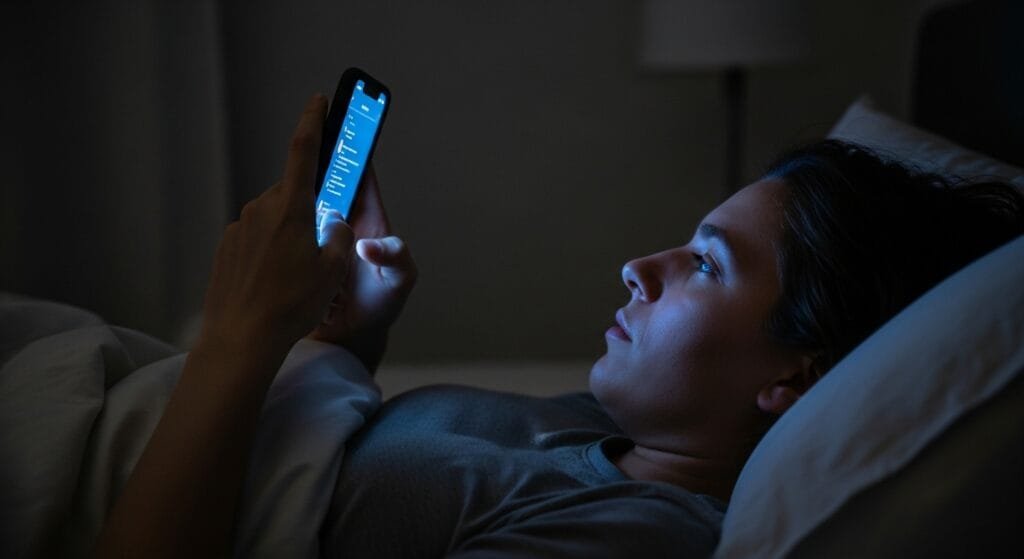
We’ve all been there—lying in bed, scrolling through our phones, promising ourselves “just five more minutes,” only to realize an hour has passed. If you’re struggling with screen time sleep disruption fixes, you’re not alone. Studies show that the glow from our devices is quietly sabotaging our sleep, and it’s doing more damage than we think.
Let me walk you through the science behind why screens mess with your sleep and share practical ways to reclaim your rest. These aren’t complicated strategies—they’re simple tweaks that can make a real difference starting tonight.
- Why Screens Keep You Awake
- The Real Impact on Your Sleep
- Screen Habits & Sleep Quality
- What’s Really Happening in Your Brain
- Consistency Matters More Than Intensity
- Health Habits
- Simple Fixes You Can Try Tonight
- Why This Works
- Making It Stick
- My Experience & Insights
- Digital Curfew Builder
- Frequently Asked Questions
Why Screens Keep You Awake
When you use your phone or tablet before bed, you’re not just staying awake because the content is interesting. Your brain is getting confused by the blue light these devices emit. This type of light tells your brain it’s still daytime, which suppresses melatonin production—the hormone that helps you fall asleep.
Gunnhild Johnsen Hjetland, a postdoctoral researcher at the Norwegian Institute of Public Health, led a major study on screen time and sleep. Her research found that each extra hour of screen use after bedtime increased insomnia symptoms by 59% and reduced sleep duration by 24 minutes. That might not sound like much, but those minutes add up fast. Over a week, you’re losing nearly three hours of sleep.
Dr. Bharat Patel, assistant professor of pharmacology at LM College of Pharmacy in Ahmedabad, explains that the trouble with using screens just before sleep is how blue light overstimulates the brain’s visual processing centers. This disrupts the REM sleep phase, leading to shallow rest and causing mental tiredness right after waking.
The Real Impact on Your Sleep
Let’s look at what the research tells us. According to a 2025 study published by the American Academy of Sleep Medicine, screen time after going to bed doesn’t just keep you awake—it fundamentally changes your sleep quality.
In Dr. Patel’s research involving 278 participants, nearly 45% of people with over 30 minutes of pre-bed screen exposure reported poor sleep, while only 25% of those who limited screen time to under half an hour did. That’s a huge difference.
Here’s a quick comparison of how different screen habits affect your sleep:
Screen Habits & Sleep Quality
| Screen Habit | Impact on Sleep | Insomnia Risk |
|---|---|---|
| No screens 1 hour before bed | Good sleep quality, normal melatonin levels | Low risk |
| Less than 30 minutes of screen time in bed | Fair sleep quality, some disruption | Moderate risk (25% report poor sleep) |
| 30+ minutes of screen time in bed | Poor sleep quality, reduced REM sleep | High risk (45% report poor sleep) |
| 1+ hours of screen time after bedtime | Significant sleep loss (24 min per hour), shallow rest | Very high risk (59% increase in insomnia symptoms) |
The numbers don’t lie. More screen time equals worse sleep, plain and simple.
What’s Really Happening in Your Brain
You might wonder if it’s just the blue light or if something else is going on. Dr. Himanshu Desai, a consultant psychiatrist at GIPS Hospital, recommends limiting screen use as much as possible during the day and avoiding screens for at least an hour before bed.
But here’s the interesting part: Hjetland’s research found that social media wasn’t more harmful than other screen activities like watching videos or reading on devices. The main issue is that screens displace rest—they eat into the time you should be sleeping, rather than making you more wakeful.
Research on blue light exposure and circadian rhythms shows that about two hours of blue light in the evening significantly suppressed melatonin levels (from 12.0 pg/mL to 8.8 pg/mL). The shortest wavelengths around 424 nm had the maximum melatonin-suppressing effect.
Consistency Matters More Than Intensity
Here’s something that might surprise you: sticking to a regular sleep schedule may be even more important than how many hours you sleep. Dr. Charles Czeisler, the Baldino Professor of Sleep Medicine at Harvard Medical School and Director of the Division of Sleep Medicine, has done groundbreaking work on circadian rhythms.
Research published in the journal Sleep found that sleep regularity is more crucial to health and longevity than getting eight hours in bed. Using UK Biobank data from over 60,000 participants, the study showed that people in the top 20% for sleep regularity had a significantly lower all-cause mortality risk than those with erratic sleep patterns.
“The Consensus Panel concluded that consistent timing of bedtimes and wake times are associated with improved outcomes across multiple dimensions of health and performance—including alertness, cardiovascular and metabolic health, inflammation and mental health,” said Dr. Czeisler in a National Sleep Foundation consensus statement.
A follow-up study found that greater sleep regularity was associated with 30% lower risk of mortality from all causes and 38% lower risk of cardiometabolic mortality. Even more interesting? Sleep regularity was a stronger predictor of mortality than sleep duration.
Health Habits
Building better sleep habits isn’t just about avoiding screens—it’s about creating a whole routine that supports good rest. Think of your evening routine like a gentle slope that guides you toward sleep, not a cliff you suddenly jump off.
Studies from the MESA research following nearly 1,800 adults for seven years found that those with stable sleep routines had a 39% lower risk of dying during that time compared to those with erratic and short sleep. The key takeaway? It’s not just getting enough sleep but also maintaining consistent sleep and wake times.
Research from MIT found that better quality, longer duration, and greater consistency of sleep are strongly associated with better academic performance in college students. These three sleep measures accounted for nearly 25% of the variance in overall grades.
Simple Fixes You Can Try Tonight
Ready to take action? Here are practical strategies backed by research that you can start using right now.
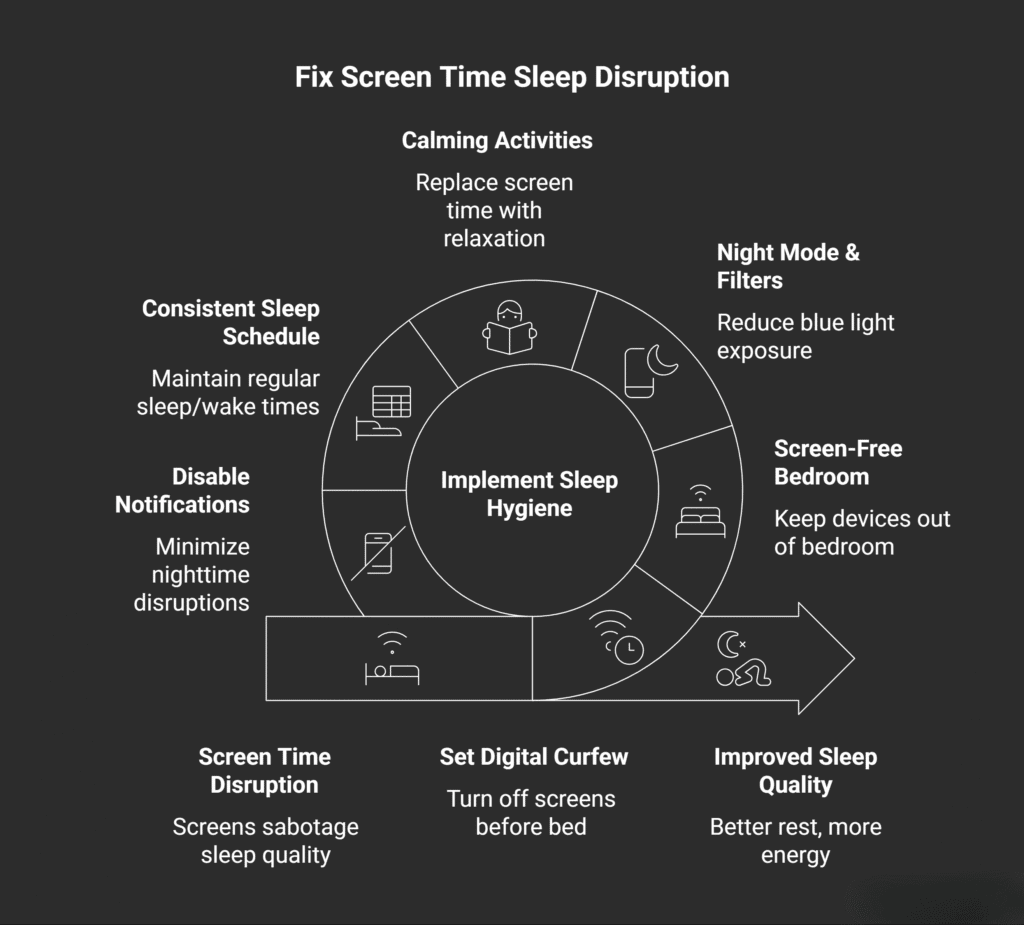
Set a digital curfew. Pick a specific time—ideally 30 to 60 minutes before bed—to turn off all screens. Hjetland suggests that if you struggle with sleep and suspect screen time is a factor, try reducing screen use in bed and stop at least 30-60 minutes before sleep.
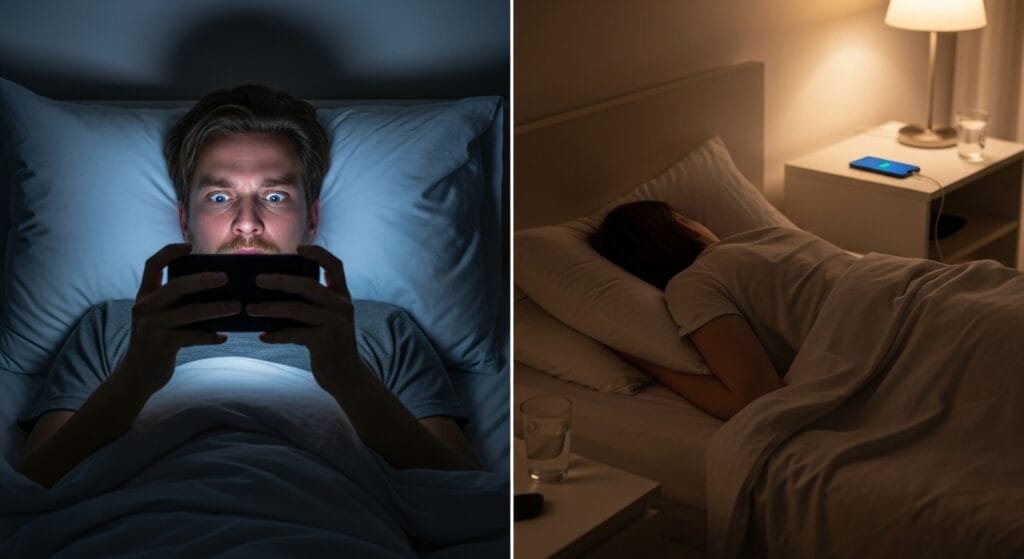
Make your bedroom a screen-free zone. This one is tough for many of us, but keeping devices out of bedrooms helps signal your brain that the bedroom is for relaxation and sleep. If you use your phone as an alarm, consider getting an actual alarm clock.
Try night mode and filters. While they don’t eliminate the problem entirely, using blue light filters and switching to night mode can help reduce blue light exposure. Many phones now have built-in features that warm up the screen color in the evening.
Replace screen time with calming activities. Instead of scrolling before bed, try reading a physical book, listening to calming music, or doing gentle stretches. These activities help your brain wind down naturally.
Stick to the same bedtime and wake time. Even on weekends, try to maintain consistent sleep and wake times. This reinforces your body’s internal clock and can make falling asleep much easier.
Disable notifications at night. If you do use screens in the evening, turn off notifications to minimize disruptions during the night. Those pings and buzzes can jolt you awake even if you’re already asleep.
Why This Works
The beauty of these strategies is they work with your body’s natural rhythms, not against them. Your circadian clock—the internal system that regulates when you feel sleepy and alert—depends heavily on light exposure timing. Dr. Czeisler’s research in 1986 discovered that light resets the human circadian pacemaker, not social cues or sleep-wake cycles as previously thought.
When you reduce bright light exposure in the evening, you’re allowing your body to do what it naturally wants to do: produce melatonin and prepare for sleep. Studies show that two or more hours of screen time in the evening can seriously disrupt the melatonin surge needed to fall asleep.
The good news? Your body responds quickly to changes. Many people notice improvements in sleep quality within just a few days of cutting back on evening screen time.
Making It Stick
I’ll be honest—breaking the habit of late-night scrolling isn’t easy. We’re wired to respond to the instant gratification that screens provide. But here’s what helps: start small. You don’t need to go from two hours of screen time to zero overnight.
Try cutting back by just 15 minutes for a week, then add another 15 minutes the next week. Keep a bedside book or magazine ready as an alternative. Some people find it helpful to charge their phones in another room entirely.
Remember, the goal isn’t perfection—it’s progress. Even reducing your screen time by 30 minutes can make a noticeable difference. And when you start sleeping better, you’ll have more energy, better focus, and improved mood during the day.
Your sleep matters. It affects everything from your immune system to your mental health. By taking control of your nighttime screen habits, you’re investing in your overall wellbeing. Tonight, try powering down your devices an hour early. Read a few pages of that book you’ve been meaning to finish. See how you feel in the morning. You might be surprised at the difference it makes.
This article is part of our 7 Healthy Daily Lifestyle Choices That Transform Your Well-Being pillar guide, where we explore practical, science-backed habits that improve energy, sleep, focus, and overall well-being in everyday life.
My Experience & Insights
While researching screen time and sleep patterns over the past few years, I kept noticing the same frustrating pattern: people know they should stop scrolling before bed, but they just can’t seem to make it stick. The advice was always the same—”turn off your phone an hour before bed”—but nobody was explaining how to actually do that when you’ve spent years ending your day with screens.
I dove deeper into the behavioral research on digital detox programs and found something interesting. A randomized controlled trial showed that structured, gradual reduction programs were significantly more effective than just telling people to quit cold turkey. The key wasn’t willpower—it was having a step-by-step system that worked with your existing habits, not against them.
That’s when I realized the problem: most people need a personalized transition plan, not just generic advice. So I built the Digital Curfew Builder—a simple tool that creates a custom 7-step wind-down routine based on your actual bedtime, current device usage, and evening habits. Instead of just saying “stop using screens,” it shows you exactly when to start dimming lights, when to switch from active scrolling to passive watching, and when to finally power down completely.
The research backing this approach is solid. A targeted intervention study involving 63 adolescents found that restricting mobile phone use just one hour before bed resulted in “lights out” happening 17 minutes earlier and total sleep time increasing by 19 minutes per night. That might not sound dramatic, but over a month, that’s over 9 hours of reclaimed sleep.
What really caught my attention was the bedtime fading technique used in sleep research. Instead of forcing an immediate change, you start where you are and gradually shift your schedule by 15 minutes at a time. This prevents your brain from fighting the new routine. I incorporated this principle into the Digital Curfew Builder—it doesn’t demand perfection on day one. It meets you where you actually are.
I also found compelling data on electronic media curfews in adolescents. Households with structured rules about when to turn off devices showed lower social jetlag (the mismatch between your body’s natural sleep time and your actual sleep schedule) and more regular sleep timing throughout the week. The difference wasn’t having stricter parents—it was having a clear, predictable routine.
One study that really validated this approach examined screen device curfews after 9 PM and found that time spent on electronic devices after that hour negatively correlated with sleep onset time, sleep duration, mood, and even academic performance. The timing mattered more than the total daily screen time—which is exactly why a graduated evening wind-down works better than trying to limit screens all day.
When I tested early versions of the Digital Curfew Builder with readers, the feedback was eye-opening. People appreciated having specific, timed steps—”at 9:00 PM, switch your phone to grayscale mode and turn on night shift” felt more doable than vague advice like “reduce blue light.” Breaking the transition into seven distinct phases made it feel manageable instead of overwhelming.
The tool also factors in your evening routine—whether you watch TV with family, check work emails, or scroll social media to decompress. Instead of eliminating these habits completely (which rarely works long-term), it helps you restructure when and how you do them. For example, it might suggest watching TV earlier in the evening and switching to an e-reader with warm lighting for the final 30 minutes before bed.
What surprised me most during this research was learning that consistency matters more than intensity. Even if your personalized curfew only pushes bedtime back by 30 minutes, sticking to that schedule every night has a bigger impact on health than occasionally getting a full 8 hours but with wildly different bedtimes.
Building this tool taught me that behavioral change around screens isn’t about willpower—it’s about design. When you have a clear roadmap that acknowledges your real habits and guides you incrementally toward better ones, following through becomes infinitely easier. That’s what I wanted the Digital Curfew Builder to do: turn “I should probably get off my phone” into “here are my seven specific steps for tonight.”
If you’re struggling to break your nighttime scrolling habit, I genuinely believe having a structured, personalized plan makes all the difference. The research supports it, and the dozens of people who’ve used the tool and reported better sleep back it up. You don’t need superhuman discipline—you just need a system that actually fits your life.
Digital Curfew Builder
Create a personalized screen time wind-down schedule for better sleep
Your Personalized Digital Curfew
Sleep Optimization Tips
- Enable night mode on all devices 2 hours before bedtime
- Keep your bedroom completely dark and cool (65-68°F)
- Avoid caffeine after 2 PM and heavy meals 3 hours before bed
- Try the 4-7-8 breathing technique if you have trouble falling asleep
- Consistency is key – stick to your schedule even on weekends
Frequently Asked Questions
How long before bed should I stop using screens?
Experts recommend stopping screen use 30 to 60 minutes before bedtime at minimum. This window gives your brain time to wind down and allows your body to start producing melatonin naturally. If you can push it to 90 minutes, even better—research shows that each hour of screen use after going to bed increases insomnia symptoms by 59%. Start with 30 minutes and gradually increase the screen-free time as it becomes easier.
Does screen time during the day affect sleep too?
Yes, it does. While nighttime screen use has the biggest impact, daily screen time throughout the day is associated with approximately 50 minutes less sleep each week. A large study of U.S. adults found that daily screen users experienced later bedtimes (nearly 19 minutes later) and reduced sleep quality compared to those who used screens less frequently. The key isn’t eliminating screens entirely—it’s being mindful about when and how long you use them, especially in the hours leading up to bed.
Are some types of screen time worse than others for sleep?
Interestingly, research by Gunnhild Johnsen Hjetland found that social media wasn’t more harmful than watching videos or reading on devices. The main issue is that screens displace sleep time rather than specific content being worse. That said, engaging content and social interactions can make it difficult to fall asleep because they stimulate your brain. Passive activities (like watching a show) might be slightly less disruptive than active ones (like gaming or scrolling social media), but all screens emit blue light and should be limited before bed.
Do blue light filters and night mode actually help?
Blue light filters and night mode can help reduce melatonin suppression, but they’re not a complete solution. While these features reduce the blue wavelengths (around 424 nm) that have the maximum melatonin-suppressing effect, they don’t address the other sleep-disrupting factors like brain stimulation from engaging content or the behavioral habit of being on screens when you should be winding down. Think of them as harm reduction tools—better than nothing, but not a substitute for actually putting devices away before bedtime.
Why do I feel more tired but can’t fall asleep after using my phone?
This happens because screen use before bed increases bright light exposure, which signals your brain to stay alert even though your body is physically tired. The blue light suppresses melatonin production, tricking your brain into thinking it’s still daytime. Additionally, using tech to read, watch shows, or answer emails involves cognitive function that stimulates your brain and keeps you from transitioning into sleep mode. You’re mentally wired but physically exhausted—a frustrating combination that makes it hard to actually drift off.
What should I do instead of using screens before bed?
Replace screen time with calming, low-stimulation activities that help your body recognize it’s time to sleep. Try reading a physical book with a warm-toned reading lamp, doing gentle stretches or light yoga, listening to calming music or podcasts (with the screen off), journaling, or practicing meditation. Studies show that maintaining consistent sleep routines matters more than sleep duration alone, so pick one or two activities you genuinely enjoy and do them at the same time each night. This consistency helps signal your brain that it’s time to wind down.
💊 Do not rely solely on online content for diagnosis or treatment.
📜 Information here is provided “as is” without any warranties.