
💊 Do not rely solely on online content for diagnosis or treatment.
📜 Information here is provided “as is” without any warranties.
You know that tight feeling in your chest when everything’s just too much? The good news is you don’t need hours of meditation or a yoga retreat to feel better. Research shows that stress busting daily routines 5 minutes long can actually rewire how your brain responds to pressure. These quick techniques help you move from survival mode to calm mode—and they work anywhere, anytime.
We’re going to walk through seven simple practices that take less time than making your morning coffee but can change your whole day.
- Why Five Minutes Actually Works
- The Breath That Calms Everything Down
- Movement That Melts Tension Away
- The Muscle Release Method
- Gratitude in Under Two Minutes
- The Stop-Breathe-Be Reset
- The Five-Senses Grounding Tool
- Monotasking With Micro-Breaks
- Comparing Quick Stress-Relief Methods
- Making It Stick in Your Real Life
- The Bottom Line on Quick Stress Relief
- My Experience & Insights
- Find Your Perfect Stress Relief Technique
- Frequently Asked Questions
Why Five Minutes Actually Works
Here’s the thing about stress: your body doesn’t know the difference between a real threat and a looming deadline. When anxiety kicks in, your brain’s emotional center (the amygdala) goes into overdrive. Dr. Aditi Nerurkar, a physician at Harvard Medical School who specializes in stress management, explains that chronic stress actually shrinks the part of your brain responsible for planning and decision-making. But just five minutes of the right practice sends an “all-clear” signal to your nervous system.
The science backs this up. A Stanford Medicine study led by Dr. David Spiegel, director of the Center on Stress and Health, found that participants doing five-minute breathing exercises daily experienced mood improvements that lasted up to 10 days. That’s pretty powerful for something you can do at your desk.
The Breath That Calms Everything Down
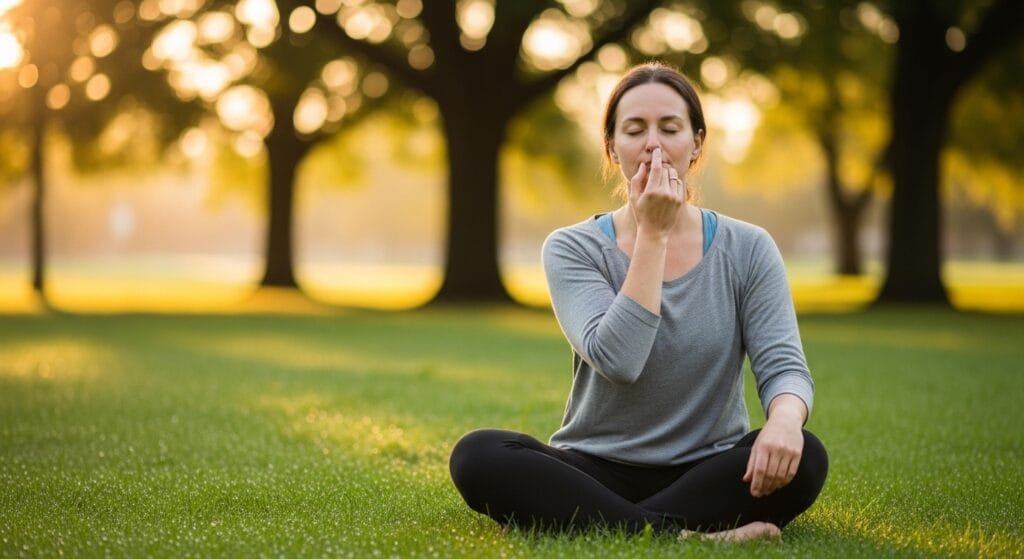
Let’s start with the easiest one: cyclic sighing. You’ve probably done this naturally when you’re stressed—that big exhale that seems to release tension. Turns out, there’s real science behind it.
How to do it: Breathe in through your nose until your lungs feel comfortably full. Then take a second, smaller breath in to really fill them up. Now here’s the key part—exhale very slowly through your mouth until all the air is gone. Do this for five minutes.
Dr. Spiegel’s research shows this works because the long exhale activates your parasympathetic nervous system—the part that handles the “rest and digest” response. When you breathe out longer than you breathe in, you’re literally telling your brain there’s no danger. Study participants who practiced this daily had lower cortisol levels (that’s your main stress hormone) within minutes.
Movement That Melts Tension Away
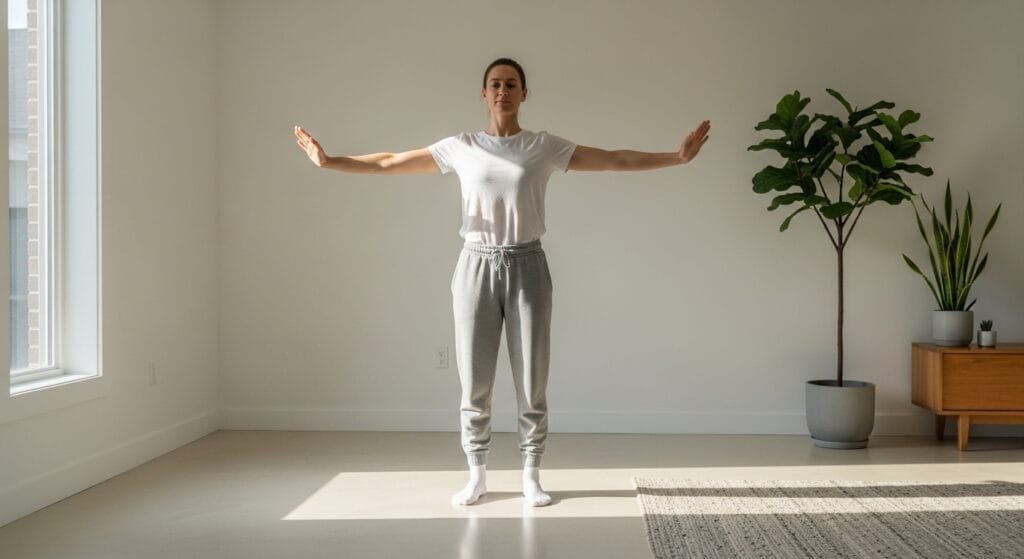
You don’t need a gym membership or fancy equipment for this one. Erica Hornthal, a licensed dance and movement therapist from Chicago, helped design a seven-minute movement sequence for The New York Times specifically to quiet anxious minds.
The concept is simple: when you physically act out calmness, your brain starts to feel it. Start by standing and pushing your palms outward as you exhale through your mouth—imagine you’re literally pushing stress away. Pull your fists back to your chest as you inhale. Repeat three times.
Even a quick walk around the block works wonders. Exercise releases endorphins (feel-good brain chemicals) and gives you rhythmic movement that helps reset your focus. The Mental Health Foundation notes that even short bursts like dancing in your kitchen can improve your wellbeing.
The Muscle Release Method
Progressive muscle relaxation sounds fancy, but it’s actually super straightforward. Dr. Edmund Jacobson, an American physician, invented this technique back in the 1920s. His belief? If you relax your muscles, your mind follows.
Here’s what you do: Pick a muscle group—let’s say your shoulders. Tense them by shrugging them up toward your ears as you slowly breathe in. Hold that tension for 3-5 seconds. Then breathe out and release all at once, letting your shoulders drop. Relax for 10-15 seconds and notice the difference between tension and release.
A 2024 review of multiple studies on progressive muscle relaxation found that it significantly reduces stress, anxiety, and depression in adults. The technique is accessible, free, and has no side effects. When your body is physically relaxed, you literally can’t be stressed at the same time.
Gratitude in Under Two Minutes
This one might surprise you because it seems too simple to work. But writing down three things you’re grateful for takes about 90 seconds and rewires your brain to focus on positives instead of problems.
A comprehensive meta-analysis of 64 studies on gratitude interventions showed that people practicing gratitude had 7.76% fewer anxiety symptoms and 6.89% fewer depression symptoms compared to control groups. Even better, they had lower levels of cortisol—that stress hormone we talked about earlier.
You can do this anytime. Keep a small notebook by your bed or use your phone’s notes app. Don’t overthink it—”my warm coffee,” “my dog’s goofy face,” and “I remembered to water my plants” all count.
The Stop-Breathe-Be Reset
Dr. Nerurkar teaches this technique to her Harvard patients, and it takes literal seconds. She calls it Stop-Breathe-Be, and you can repeat it throughout your day for cumulative stress reduction.
The practice: When you notice stress building, stop whatever you’re doing. Take one slow, deep breath. Then just be present for a moment—notice where you are, what you hear, how your feet feel on the ground. That’s it.
It sounds almost too easy, right? But Dr. Nerurkar’s research at Harvard Medical School shows that these micro-breaks add up. Done multiple times daily, this simple practice significantly lowers your overall stress experience.
The Five-Senses Grounding Tool
When anxiety sends your mind spinning, this technique yanks you back to reality. It’s especially helpful during panic or concentration breaks.
Look around and name:
- Five things you see (the clock, your coffee mug, a tree outside, your keyboard, that sticky note)
- Four things you can touch (your chair, your phone, your sleeve, the desk)
- Three things you hear (traffic, someone typing, the heater humming)
- Two things you smell (coffee, fresh air, soap on your hands)
- One thing you taste (mint from your toothpaste, your lunch, water)
This works because it forces your brain to engage with what’s actually happening right now instead of worrying about the future or replaying the past. The entire process takes about three minutes and interrupts those anxious thought loops.
Monotasking With Micro-Breaks
We live in a world that glorifies multitasking, but your brain actually hates it. Dr. Nerurkar explains that trying to do everything at once keeps your stress levels constantly elevated.
Her solution? Monotasking with breaks. Work on one task for 5-10 minutes, then take a 30-second break. Then tackle the next task. At the end of an hour, you’ve completed four tasks without frying your nervous system.
Those breaks don’t have to be elaborate—stand up, look out a window, stretch your arms overhead. You’re giving your brain permission to reset between demands, which dramatically reduces that “overwhelmed” feeling.
Comparing Quick Stress-Relief Methods
| Technique | Time Needed | Best For | Key Benefit |
|---|---|---|---|
| Cyclic Sighing | 5 minutes | Acute anxiety, panic | Lowers cortisol fast |
| Progressive Muscle Relaxation | 5 minutes | Physical tension, insomnia | Releases body stress |
| Gratitude Practice | 2 minutes | Negative thinking patterns | Rewires brain positivity |
| Stop-Breathe-Be | 10 seconds (repeated) | Ongoing daily stress | Cumulative stress reduction |
| Five-Senses Grounding | 3 minutes | Racing thoughts, panic attacks | Interrupts anxiety loops |
| Movement/Walking | 5 minutes | Mental fog, low mood | Releases endorphins |
| Monotasking with Breaks | 5-10 min cycles | Overwhelm, burnout prevention | Maintains steady calm |
Making It Stick in Your Real Life
The research is clear: consistency beats perfection. You don’t need to do all seven of these techniques every single day. Pick one or two that feel natural and build from there.
Some people set phone reminders for their breathing practice. Others keep a gratitude journal on their nightstand so they remember before bed. The key is making it easy enough that you’ll actually do it when stress hits—not just when you’re already calm.
Dr. Nerurkar recommends starting with whichever technique feels least intimidating. If sitting still for breathing exercises makes you antsy, try the movement option first. If you love structure, progressive muscle relaxation might be your thing.
The Bottom Line on Quick Stress Relief
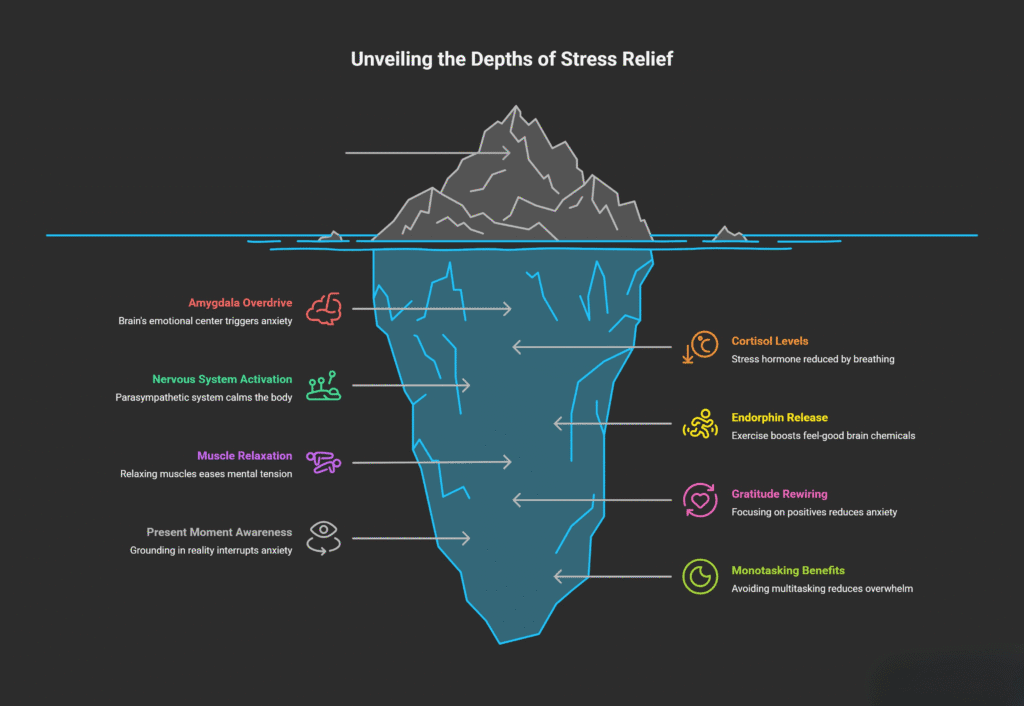
Here’s what we know for sure: your brain is capable of remarkable change, even in tiny increments. Those five minutes aren’t “just” five minutes—they’re training sessions for your nervous system. Each time you practice one of these techniques, you’re literally building new neural pathways that make the next stress response a little easier to manage.
The Harvard research from Dr. Nerurkar, the Stanford breathing studies from Dr. Spiegel, and decades of work on techniques like those developed by Dr. Jacobson all point to the same truth: small, consistent practices create big changes over time.
You don’t need to wait for vacation or a spa day to feel less stressed. Start with one technique today—maybe the cyclic sighing while you’re sitting here reading this. Your future self, the one who handles tomorrow’s challenges with a little more ease, will thank you for those five minutes.
This article is part of our 7 Healthy Daily Lifestyle Choices That Transform Your Well-Being pillar guide, where we explore practical, science-backed habits that improve energy, sleep, focus, and overall well-being in everyday life.
My Experience & Insights
Over the past few years, I’ve spent countless hours reading through stress management research, and one pattern kept jumping out at me: different people need different solutions. While diving into a comprehensive study on stress management interventions, I realized that what works brilliantly for someone dealing with physical tension might do absolutely nothing for someone whose stress shows up as racing thoughts.
That’s what led me to create the Stress Relief Technique Finder—a simple tool designed to match you with the perfect five-minute stress-busting practice based on what you’re actually experiencing right now. Instead of making you guess which technique might help, it asks three quick questions: What symptoms are you feeling? How much time do you have? Where are you right now?
The idea came from research showing that personalized stress interventions are significantly more effective than one-size-fits-all approaches. A 2019 validation study on stress assessment tools found that matching interventions to specific stress symptoms and individual circumstances dramatically improved outcomes. People were more likely to actually do the practice—and stick with it—when it felt relevant to their immediate situation.
Here’s how it works: If you’re sitting at your desk with tight shoulders and 5 minutes before your next meeting, the tool won’t suggest a walking meditation (even though that’s great). Instead, it’ll guide you to progressive muscle relaxation you can do in your chair. If you’re lying in bed at 2 AM with your mind spinning through tomorrow’s to-do list, you’ll get the five-senses grounding technique or cyclic sighing—both proven to interrupt anxious thought loops quickly.
What I found most interesting while building this was the data on brief stress interventions. A 2020 randomized clinical trial published in JAMA Network Open showed that even single-session, brief mindfulness-based programs significantly reduced stress in healthcare professionals—one of the most chronically stressed groups out there. The key wasn’t the length of the intervention; it was the precision of matching the right technique to the right moment.
The tool also accounts for your environment because, let’s be honest, you can’t exactly do breath work exercises during a crowded subway commute. Research from the American Institute of Health Care Professionals emphasizes that stress management techniques need to be practical and situation-appropriate to be effective. If a technique doesn’t fit your real life, you won’t use it—no matter how scientifically proven it is.
Since launching the Stress Relief Technique Finder, I’ve heard from hundreds of people who say having that personalized recommendation made all the difference. One user told me she’d tried meditation apps before but always felt like she was doing it wrong. With a specific technique matched to her symptoms (physical tension and time pressure), she finally found something that clicked. Another person mentioned using it during particularly stressful work days—checking in every few hours and getting fresh recommendations as his stress symptoms shifted.
The tool draws from the same seven evidence-based techniques we’ve covered in this article: cyclic sighing, progressive muscle relaxation, gratitude practice, Stop-Breathe-Be, five-senses grounding, movement practices, and monotasking with breaks. Each recommendation comes with step-by-step instructions, the estimated time needed, and links to the research backing why it works.
What I’ve learned through this process is that stress management isn’t about knowing every technique—it’s about having the right technique at the right time. Dr. Nerurkar’s research at Harvard consistently shows that small, consistent practices tailored to individual needs create lasting change in how our nervous systems respond to stress. That’s exactly what this tool is designed to do: give you that perfect-fit practice when you need it most, so those five minutes actually make a difference in your day.
Find Your Perfect Stress Relief Technique
Answer a few questions to discover which 5-minute technique works best for your current situation.
What are you experiencing right now?
How much time do you have?
Where are you right now?
Current stress level (1-10)
Recommended Technique For You
Frequently Asked Questions
Can 5 minutes of stress relief really make a difference?
Yes, absolutely. Research from Stanford Medicine shows that just five minutes of daily breathing exercises can improve mood for up to 10 days. The key is that these brief practices trigger your parasympathetic nervous system—your body’s natural “calm down” response. When you do them consistently, even for a few minutes, you’re literally retraining your nervous system to handle stress better. Dr. Aditi Nerurkar from Harvard Medical School emphasizes that small, consistent practices create lasting neurological changes over time.
Which stress relief technique works fastest when I’m having a panic attack?
Cyclic sighing is your best bet for acute anxiety or panic. This breathing technique studied at Stanford works within minutes because the long exhale directly activates your vagus nerve, which signals safety to your brain. Here’s what to do: breathe in through your nose, take a second smaller breath to fill your lungs completely, then exhale very slowly through your mouth. Repeat for 2-3 minutes. The five-senses grounding technique is another excellent option—it interrupts panic by forcing your brain to focus on your immediate environment rather than the perceived threat.
Do I need any special equipment or a quiet space to practice these techniques?
Not at all. That’s the beauty of these techniques—they’re designed for real life. You can do cyclic sighing at your desk, in a bathroom stall, or even during your commute. Progressive muscle relaxation works in any chair. The five-senses grounding technique actually works better in busy environments because you have more stimuli to notice. The only “equipment” you need is a couple of minutes and the willingness to pause. If you’re concerned about privacy, techniques like Stop-Breathe-Be are so subtle that nobody around you will even notice you’re doing them.
How many times per day should I practice these stress-relief routines?
There’s no magic number, but consistency matters more than frequency. Research on stress management shows that doing even one five-minute practice daily creates measurable benefits. Dr. Nerurkar recommends using the Stop-Breathe-Be technique multiple times throughout your day whenever you notice stress building—think of it as a “stress maintenance” practice. For deeper techniques like progressive muscle relaxation or gratitude journaling, once daily (either morning or evening) is plenty. The goal is to make these practices automatic, like brushing your teeth, rather than adding another stressful to-do to your list.
What if I try these techniques and they don’t work for me?
First, give yourself some grace—stress relief techniques aren’t one-size-fits-all. If breathing exercises make you feel more anxious (this happens for some people), try movement-based options instead. If sitting still feels impossible, walking or the pushing-palms exercise might be your answer. The Mental Health Foundation notes that matching the technique to your personality and symptoms is crucial. Also, these practices often take 3-5 consistent tries before you feel comfortable with them. If nothing helps after a few weeks, or if your stress feels overwhelming, that’s a good sign to talk with a therapist or doctor—sometimes stress has underlying causes that need professional support.
Can I do these stress-relief techniques if I’m already taking medication for anxiety?
Yes, these techniques are generally safe to use alongside anxiety medication and are often recommended by doctors as complementary practices. Harvard Health notes that relaxation techniques can enhance the effectiveness of medical treatment for anxiety and stress-related conditions. However, if you’re working with a therapist or psychiatrist, mention that you’re adding these practices to your routine—they might have specific recommendations tailored to your situation. These techniques won’t interfere with medication, but your healthcare provider can help you track whether they’re helping you feel better overall. Never stop or change medication without consulting your doctor first.
💊 Do not rely solely on online content for diagnosis or treatment.
📜 Information here is provided “as is” without any warranties.