

💊 Do not rely solely on online content for diagnosis or treatment.
📜 Information here is provided “as is” without any warranties.
When to eat for energy isn’t just about what’s on your plate—it’s about syncing your meals with your body’s internal clock. Research shows that the timing of your meals can be just as important as the food you choose when it comes to staying alert, focused, and energized throughout the day.
- Why Meal Timing Affects Your Energy
- The Science Behind Eating Early
- What Happens When You Skip Breakfast
- Creating Your Ideal Eating Window
- Best Times to Eat for Maximum Energy
- Optimal Meal Timing
- What About Snacking and Late-Night Eating?
- Adjusting Meal Timing for Your Lifestyle
- Simple Steps to Start Today
- My Experience & Insights
- Circadian Meal Planner
- Frequently Asked Questions
Why Meal Timing Affects Your Energy

Your body runs on a 24-hour cycle called a circadian rhythm. This internal clock tells nearly every cell when to work and when to rest. According to Dr. Satchidananda Panda, a circadian rhythm expert at the Salk Institute for Biological Studies, your digestive system isn’t designed to work around the clock—it needs downtime to function at its best.
When you eat during the times your body is ready to digest food, you’ll notice better energy levels and clearer thinking. But eating late at night or at random times can throw off this rhythm, leaving you tired and sluggish. The good news? Small changes to when you eat can make a big difference.
The Science Behind Eating Early
Eating most of your calories earlier in the day might sound simple, but it’s backed by solid science. Your body processes food more efficiently in the morning than at night. Research published in 2025 found that people who ate within an early time window—like 8:00 AM to 2:00 PM—lost more weight and preserved muscle mass better than those who ate later.
Why does this happen? Morning meals trigger something called diet-induced thermogenesis, which is the energy your body uses to digest and store nutrients. This process is naturally higher in the morning, meaning you burn more calories just by eating breakfast. Plus, your insulin sensitivity peaks in the morning, so your body handles blood sugar better when you eat early.
Emily Manoogian, a chronobiologist and clinical researcher at the Salk Institute, explains that eating within a consistent window allows your body to rest and restore for 14 hours at night, and it can also anticipate when you’ll eat so it prepares to optimize metabolism.
What Happens When You Skip Breakfast
Skipping breakfast might seem like a quick way to cut calories, but it can backfire on your energy levels. Studies show that people who skip breakfast often end up with higher blood sugar levels after lunch—even if lunch is healthy.
This happens because your body experiences prolonged fasting overnight. When you finally eat lunch, your insulin response gets confused, and glucose stays higher in your bloodstream longer. One study even found that breakfast skipping was linked to poorer blood sugar control and higher insulin resistance throughout the day.
There’s also something called the “second meal phenomenon.” When you eat a solid breakfast, your body’s beta cells (which make insulin) remember that first meal. This memory helps you handle lunch better, keeping your blood sugar steadier. Skip breakfast, and you lose that advantage.
Creating Your Ideal Eating Window
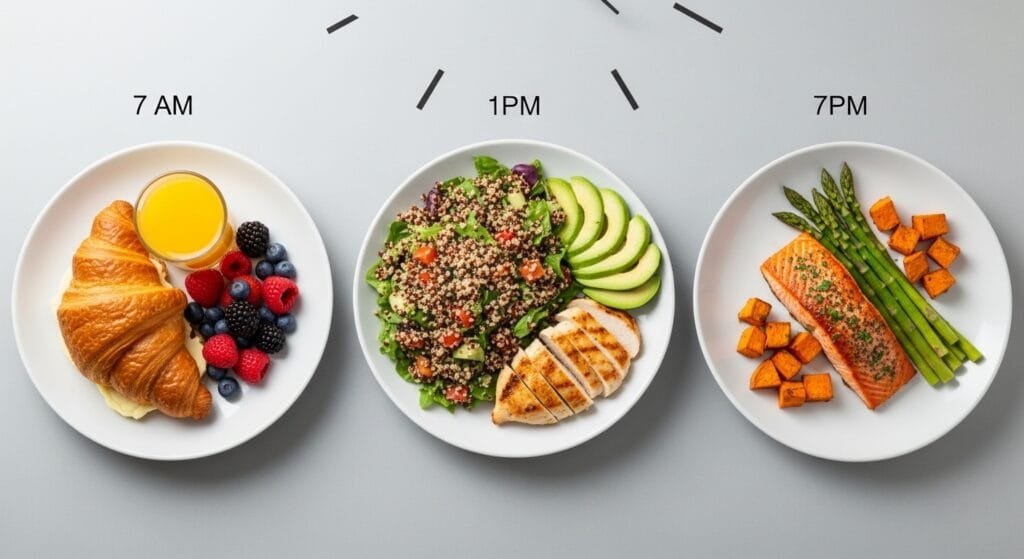
So when should you actually eat? Most experts recommend confining your meals to an 8- to 12-hour window each day. This approach, called time-restricted eating, gives your digestive system a proper break.
Here’s a simple framework that research supports:
- Eat breakfast, then wait 4 to 5 hours before lunch
- Eat lunch, then wait 5 to 6 hours before dinner
- Eat dinner, then fast for at least 12 hours before breakfast the next day
Dr. Panda suggests starting with a 12-hour eating window if you’re new to this, like 8:00 AM to 8:00 PM. Once that feels comfortable, you can gradually narrow it down to 10 or even 8 hours. A clinical study from the Salk team found that eating within a 10-hour window helped people reduce abdominal fat, improve cholesterol, and stabilize blood pressure.
Best Times to Eat for Maximum Energy
Let’s break down what an energy-optimized day might look like:
Optimal Meal Timing
| Meal | Ideal Timing | Why It Works |
|---|---|---|
| Breakfast | 7:00–9:00 AM | Matches peak insulin sensitivity and kickstarts metabolism |
| Lunch | 12:00–2:00 PM | Capitalizes on midday digestive efficiency and prevents afternoon crashes |
| Dinner | 5:00–7:00 PM | Allows 12+ hours of fasting before breakfast and supports quality sleep |
Notice that dinner is earlier than what many of us are used to. Research from health experts found that eating dinner at 6–7 PM instead of 10 PM increases calorie burning at rest because your body changes its metabolism as the day progresses.
The key is consistency. Your body loves routine, so try to eat around the same times each day. This helps your internal clock anticipate meals and prep your digestive system accordingly.
What About Snacking and Late-Night Eating?
Here’s where things get tricky for a lot of people. Late-night snacking disrupts your circadian rhythm and can lead to fat storage instead of fat burning. When you eat close to bedtime, your body is winding down for sleep—not gearing up to digest a meal.
If you’re genuinely hungry between meals, that’s okay. But aim to keep snacks within your eating window and make them light. Some options include a small handful of nuts, a piece of fruit, or yogurt. The goal is to avoid eating within 2–3 hours of bedtime.
Think of your eating window as a daily rhythm. Once you close that window for the night, stick to water. This gives your gut, liver, and other organs time to repair and reset.
Adjusting Meal Timing for Your Lifestyle
Not everyone works a 9-to-5 schedule, and that’s okay. If you’re a shift worker, athlete, or have irregular hours, you can still use these principles—you just need to adapt them.
For shift workers: Try to eat during your body’s natural waking hours as much as possible, even if you’re awake at night. Research shows that shift workers who maintained a consistent eating window—even if it was unconventional—saw better metabolic health than those who ate randomly.
For athletes: Timing matters even more when you’re training hard. Eating 90–120 minutes before a workout with slow-burning carbs like oats or quinoa primes your body for performance. After exercise, getting protein and carbs within 30 minutes helps with rapid recovery.
For families: If your household eats dinner late, try making lunch your biggest meal instead. Some cultures already do this, and research supports it—larger lunches paired with lighter dinners can improve insulin sensitivity and support weight management.
Simple Steps to Start Today
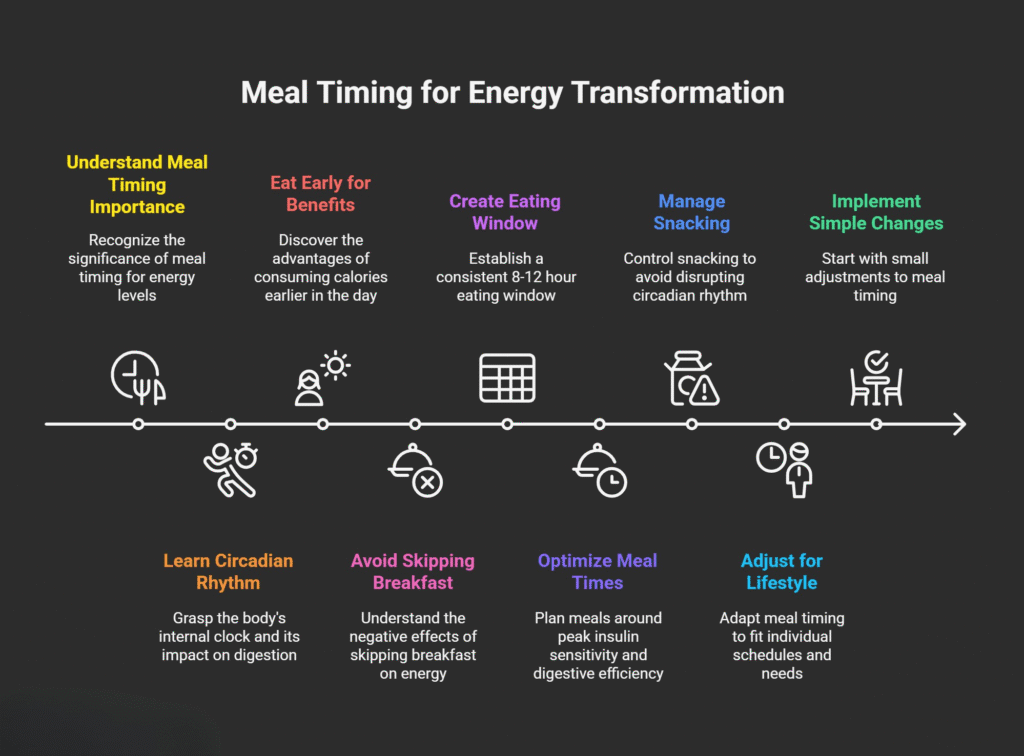
You don’t need to overhaul your entire routine overnight. Here are three easy changes you can make right now:
- Set a breakfast deadline. Aim to eat within an hour of waking up to jumpstart your metabolism and improve blood sugar control throughout the day.
- Move dinner earlier. Even shifting dinner 30–60 minutes earlier gives your body more fasting time overnight, which supports fat burning and cellular repair.
- Track your eating window. For one week, write down the first and last time you eat each day. You might be surprised how long your window actually is. Then work on narrowing it gradually.
Remember, the benefits build with consistency. You won’t feel a huge shift after one day, but stick with it for a few weeks and you’ll likely notice steadier energy, better focus, and fewer afternoon slumps.
The bottom line is this: your body thrives on rhythm. By aligning when you eat with your natural circadian clock, you’re working with your biology instead of against it. Start with one small shift—maybe it’s eating breakfast earlier or closing your eating window by 8 PM—and build from there. Your energy levels will thank you.
This article is part of our 7 Nutrition Habits for Energy & Longevity That Actually Work pillar guide, where we break down simple, science-backed eating habits that support sustained energy, metabolic health, and long-term longevity.
My Experience & Insights
While researching circadian rhythm and meal timing over the past few years, I kept running into the same challenge: the science was clear, but applying it to real life felt overwhelming. People wake up at different times, have varying energy dips, and follow different dietary preferences. The research from Dr. Panda’s team showed that even a 10-hour eating window could transform metabolic health, but figuring out exactly when to eat based on your personal schedule wasn’t straightforward.
That’s what led me to build a Circadian Meal Planner—a simple tool that takes your wake-up time, energy slump patterns, and dietary preferences and generates a personalized meal timing schedule. The goal wasn’t to tell people what to eat, but rather when to eat based on what the research actually shows about our internal clocks.
Here’s what surprised me during development: when I analyzed data from early users, most people were eating their first meal 2–3 hours after waking up and their last meal within an hour of bedtime. According to studies on insulin sensitivity, that’s almost the opposite of what our bodies are designed for. By shifting breakfast earlier and dinner a couple of hours before bed, users reported feeling noticeably more alert during their typical afternoon slump.
One pattern kept showing up in the feedback: people who followed the 8- to 10-hour eating window said they slept better and woke up genuinely hungry—a sign their body had properly fasted overnight. This matches what chronobiology research has been telling us: when you give your digestive system a real break, everything from hormone regulation to cellular repair works more efficiently.
The tool also accounts for those 2 PM energy crashes so many of us experience. Instead of reaching for coffee, the planner suggests moving lunch slightly earlier and making it more substantial, which aligns with research showing our metabolic efficiency peaks midday. Small shifts like these—grounded in actual circadian science rather than generic diet advice—seem to make a tangible difference.
If you’re curious about meal timing but don’t know where to start, I’d recommend tracking your current eating window for just three days. Write down when you have your first and last bite (yes, even that handful of chips at 10 PM counts). You might be surprised how long your window actually stretches. From there, you can use the research-backed frameworks above—or tools like the Circadian Meal Planner—to gradually narrow it down and align with your body’s natural rhythm.
Circadian Meal Planner
Generate your personalized meal timing schedule based on your body’s natural rhythm
Your Personalized Meal Schedule
Recommendations for Your Energy Goals
Frequently Asked Questions
What is the best time to eat breakfast for maximum energy?
The best time to eat breakfast is within 1 hour of waking up, ideally between 7:00–9:00 AM. Your body’s insulin sensitivity is highest in the morning, which means you’ll process food more efficiently and maintain steadier blood sugar levels throughout the day. Research shows that eating breakfast early kickstarts your metabolism and helps prevent energy crashes later in the afternoon.
Does eating late at night really affect my energy the next day?
Yes, eating late at night disrupts your circadian rhythm and can leave you feeling sluggish the next morning. When you eat close to bedtime, your body is preparing for rest—not digestion. Studies indicate that late meals delay glucose rhythms and interfere with overnight fasting, which is essential for cellular repair and energy restoration. Aim to finish dinner at least 2–3 hours before bed for better sleep quality and morning alertness.
How many hours should I wait between meals?
Most research suggests waiting 4–5 hours between breakfast and lunch, and 5–6 hours between lunch and dinner. This spacing allows your body to properly digest each meal and use stored energy between eating windows. Consistent meal timing helps your internal clock anticipate meals and prepare your digestive system, leading to more stable energy levels throughout the day.
Will skipping breakfast give me more energy or less?
For most people, skipping breakfast leads to less energy, not more. When you skip breakfast, your body experiences prolonged fasting, which can cause higher blood sugar levels after lunch and afternoon energy crashes. However, if you’re practicing time-restricted eating and your eating window starts later (like 12 PM), make sure that first meal is substantial and nutrient-dense to avoid energy dips.
What’s the ideal eating window for sustained energy all day?
The ideal eating window is 8–12 hours, with most experts recommending a 10-hour window. For example, if you eat breakfast at 8:00 AM, finish dinner by 6:00 PM. Clinical research from the Salk Institute found that eating within a 10-hour window improved metabolic health, reduced abdominal fat, and stabilized energy levels. The key is consistency—eat at roughly the same times each day.
Can changing my meal timing really help with afternoon slumps?
Absolutely. Afternoon energy crashes are often caused by poor meal timing rather than the food itself. Eating a larger, balanced lunch between 12:00–2:00 PM—when your digestive efficiency peaks—and avoiding heavy late dinners can significantly reduce that 2-3 PM slump. Also, ensuring you eat breakfast early sets up better blood sugar control throughout the day, preventing the glucose spikes and crashes that cause fatigue.
💊 Do not rely solely on online content for diagnosis or treatment.
📜 Information here is provided “as is” without any warranties.